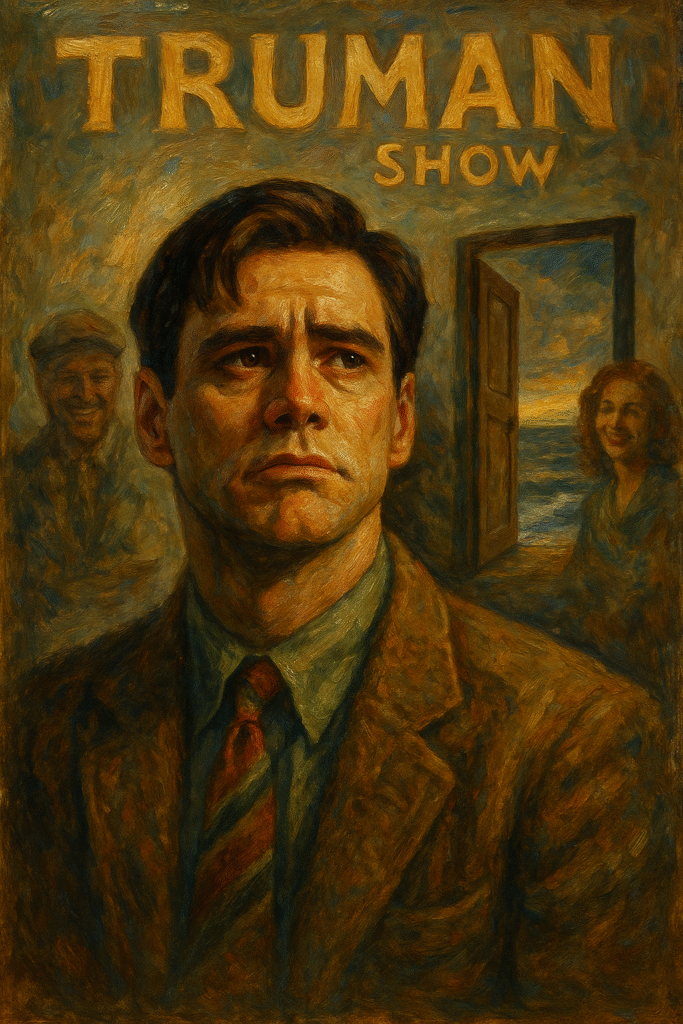

‘The Truman Show,’ directed by Peter Weir and released in 1998, is a film that has carved its own niche in cinematic history as a profound exploration of identity, reality, and the nature of existence itself. The film stars Jim Carrey as Truman Burbank, a man unknowingly living in a meticulously crafted reality. His life is a continuous broadcast watched by millions, with every element curated for entertainment. This premise has invited deep-analysis frameworks, particularly from performance theory, to understand how identity is constructed and perceived in a world defined by artificiality.
The film highlights key themes such as the illusion of reality, the performance of identity, and the quest for authenticity in a world dominated by societal expectations. Truman’s journey toward self-discovery and autonomy resonates powerfully across various dimensions of human experience, making it not only a film about an individual but also a commentary on collective human existence. As viewers, we are compelled to question the nature of our realities and identities, particularly in an increasingly mediated society.
Analysis of Identity and Reality within the Film
The Duality of Identity
In ‘The Truman Show,’ Truman Burbank embodies a duality of identity: the persona he projects to the world and the genuine self yearning for freedom. The film immediately thrusts viewers into his artificial world — a quintessentially manufactured environment where every conceivable aspect has been fine-tuned to maintain the illusion of normal life. The various characters, such as his wife Meryl (Laura Linney) and best friend Marlon (Blair Underwood), are inconsequential in shaping his reality, serving only to uphold the show and further delineate the distinction between Truman’s perceived identity and his actual self.
This duality highlights the theatricality and performance in everyday life, wherein individuals often craft their behaviors and identities to fit societal norms. The characters in Truman’s life perform their roles to keep him confined within the script of his existence, effectively illustrating Erving Goffman’s theory of self-presentation, where people curate their identities based on social expectations. Each performance is laden with meaning, yet devoid of genuine connection, raising the question: can we truly know someone if their identity is a construct?
The Awakening of Authenticity
As the narrative progresses, Truman begins exhibiting signs of discontent, suggesting an innate drive towards personal authenticity. His experiences become increasingly surreal, marking a transition from passive acceptance to active questioning of his reality. This transformation can significantly be analyzed through a psychological lens as it underscores the potential and power of innate human intuition and desire for the authentic self. Truman’s small acts of rebellion — from attempting to leave Seahaven to his emotional outbursts — symbolize humanity’s deep-seated hunger for genuine identity and reality, encapsulating the essence of authenticity in a world designed to suppress it.
Moreover, Truman’s confrontation with the controlled environment leads to a breaking point, culminating in the stunning realization that his life has been an elaborate performance that was never truly his. This quest for authenticity speaks to a common struggle present in contemporary society, wherein individuals often feel trapped by societal constructs and expectations.
The Illusion of Reality
‘The Truman Show‘ does not merely question individual identity but also challenges the notion of reality itself. The film encapsulates a hyper-real environment, echoing the postmodern concept of simulacra articulated by Jean Baudrillard. In Truman’s reality, everything is illusionary — there is a sense of unreality palpable throughout the film, making us question what is authentic and what is merely performance. The show’s producers, particularly Christof (Ed Harris), embody the role of a puppeteer, manipulating Truman’s life for mass consumption while exploiting these constructs, subverting the essence of genuine human experiences.
The illusion of reality is further emphasized through the performances of supporting characters who, while appearing to care for Truman, are ultimately placeholders in a scripted narrative. As Truman unfurls the layers of his existence, he embarks on a conflict between perceived reality versus true self. His breaking of societal constraints leads him to confront the creators of his world, showcasing an important philosophical inquiry: what is a life wholly constructed, devoid of free will?
The Role of Performance and Societal Expectations
Societal Expectations in a Controlled Environment
Within the narrative framework of ‘The Truman Show,’ societal expectations are starkly laid bare, revealing a world that orchestrates human life into convenient performances. The societal script of Seahaven is predicated upon conformity and predictability, whereby each citizen plays an assigned role. The concept of performance theory becomes essential in contextualizing how individuals mold their identities according to prevailing norms and expectations, much like Truman’s constructed reality.
Each character in the film serves as an actor on the global stage, yet it transcends beyond performance for entertainment. The roles reflect a broader critique of modern consumerist culture, where individuals are often relegated to mere roles, stripped of complexity and individuality. The pressures of societal performance and the normalization of surveillance underscore larger existential questions pertinent to our audience today, illustrating how identities are often shaped by external validation rather than intrinsic authenticity.
Examining Psychological Implications
The psychological implications of living in a controlled environment, as experienced by Truman, are profound. Human psychology suggests that the need for autonomy and genuine connection is intrinsic, yet Truman is conditioned to accept a false sense of belonging and safety. The psychological discomfort and eventual rebellion against this performance reflect the inner conflict many individuals experience in contexts that limit personal freedom or authenticity.
The phenomenon of cognitive dissonance becomes pronounced in Truman’s behavior as he grapples with doubts about his perceived reality. With each moment of clarity, Truman transforms from a compliant performer into an agent of change seeking his authentic self. This character journey resonates strongly with modern viewers, portraying their own struggles against the constraints and expectations of society.
Concluding Thoughts on the Implications for Viewers and Society
‘The Truman Show‘ offers a rich terrain for analyzing the intersections of identity, reality, and performance theory. As Truman awakens not only to the manipulation of his reality but also to the possibility of self-discovery and authenticity, viewers are urged to confront their habitual performances within society. The film serves as a mirror reflecting reality in the human experience, raising essential inquiries into the nature of one’s existence, identity, and the influence of external forces.
In the modern world, dominated by social media and the constant curation of self-image, the themes explored in ‘The Truman Show’ resonate deeply. People might find themselves maneuvering through identities eclipsed by societal expectations and perceptions, subconsciously performing for an audience rather than existing authentically. As such, ‘The Truman Show’ invites us to reflect on our own lives, urging a conscious effort towards unmasking our authentic selves. The film champions the pursuit of genuine identity amid artificial constructs, pivotal in encouraging viewers to dismantle the barriers that define their realities.
Ultimately, the implications of ‘The Truman Show’ extend beyond the screen, pressing individuals to seek authenticity in a world fraught with artificiality. It challenges society to create spaces where performance can coexist with truth, where identity can flourish beyond societal expectations, and where the quest for reality becomes the cornerstone of human existence.
FAQ Section
1. What is the primary theme of ‘The Truman Show’?
The primary theme of ‘The Truman Show’ revolves around identity and reality. It critically examines how an individual’s identity can be shaped and manipulated by external forces, reflecting broader societal issues related to performance and authenticity.
2. How does performance theory apply to ‘The Truman Show’?
Performance theory applies to ‘The Truman Show’ by emphasizing how individuals perform specific identities based on societal expectations. Truman’s life is an extreme case, as he performs a role dictated by the creators of his reality, highlighting the tension between constructed identity and genuine self.
3. What psychological implications are shown in the film?
The film portrays significant psychological implications, particularly regarding cognitive dissonance. Truman experiences discomfort as his understanding of reality clashes with the artificiality surrounding him, showcasing the human struggle for autonomy and authentic connection.
4. How does ‘The Truman Show’ resonate with contemporary viewers?
The film resonates with contemporary viewers by mirroring the influence of social media and digital personas. It prompts audiences to question the authenticity of their identities and highlights the ongoing conflict between societal pressures and the pursuit of genuine self-expression.
5. What lessons can viewers take from ‘The Truman Show’?
Viewers can learn from ‘The Truman Show’ about the importance of self-discovery and authenticity. The film encourages individuals to examine their realities, question societal constructs, and embrace their true identities, pushing against conformity and performance pressures.



Pingback: Wearing The Mask: Study Of The False Self - screenpsyche.com