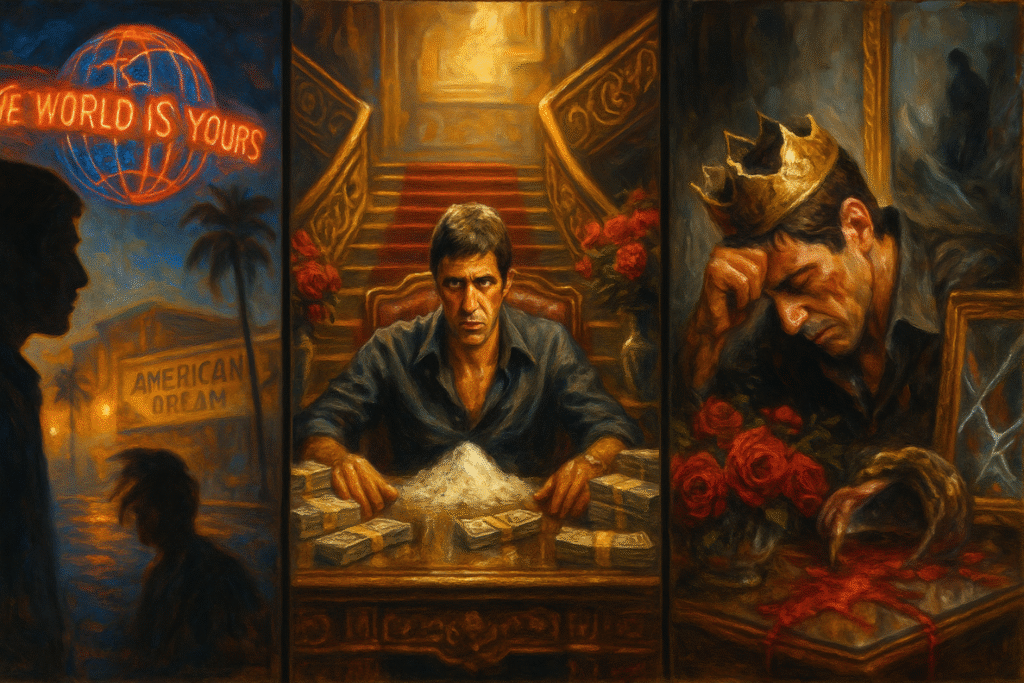

Thesis: In this Scarface Tony Montana analysis we argue that Tony’s hunger is not only for money or power but a corrosive appetite that steadily erodes his moral compass. By tracing scene-by-scene signposts, applying psychological frameworks (Maslow, attachment/trauma theory, Freudian dynamics, Nietzsche) and examining cinematic craft, this Tony Montana character study explains the film’s rise-and-fall narrative and its cultural critique of 1980s excess.
Spoiler warning: This analysis discusses key plot points, scenes, and themes from Brian De Palma and Oliver Stone’s Scarface (1983) including violence and drug use, addressed analytically and critically.
Scarface Tony Montana analysis: Key takeaways
- Moral erosion is gradual: Tony’s transformation from dispossessed immigrant to isolated kingpin is built from incremental choices.
- Psychology explains motive: Trauma, unmet needs, and a will-to-power logic make Tony’s behavior comprehensible though not excusable.
- Cinematic form reinforces theme: De Palma’s mise-en-scène, Pacino’s physical performance, editing and sound make the moral decline visceral.
- Cultural reading: Scarface critiques a distorted American Dream where greed, spectacle, and market logic hollow out ethics.
Scarface Tony Montana analysis — Psychological frameworks for Tony Montana
This section uses the psychology of Tony Montana to show why desire displaces morality.
- Maslow’s Hierarchy: Tony’s early deprivation—safety and belonging—makes esteem and dominance urgent goals. However, he pursues them through violent, extra-legal means, preventing authentic self-actualization.
- Attachment & trauma theory: Refugee status and social rupture seed mistrust and hypervigilance. Therefore, relationships become transactional and defensive rather than secure.
- Freudian reading: Tony often privileges id impulses (aggression, immediate gratification) while the ego rationalizes and the superego is weakened.
- Nietzsche’s will to power: Tony’s drive to dominate is existential—power becomes identity, not merely a tool.
- Moral disengagement: He dehumanizes rivals, displaces responsibility, and uses euphemisms to justify escalating harm.
Together, these lenses reveal how trauma plus structural exclusion and acute desire produce a predictable pattern of moral decline.
Tony Montana’s Moral Decline: Scarface Tony Montana analysis scene-by-scene
Below are pivotal signposts that map Tony’s moral decline and help any Scarface movie analysis or Scarface film essay focused on his arc.
Arrival and humiliation (Act I)
- Signpost: The refugee camp interrogation and Tony’s defiant refusal to be invisible.
- Reading: Shame and exclusion ignite an aggressive survival code.
Expanded reading: the arrival scenes are dense with social meaning. The cramped, fluorescent-lit processing center is staged as an institutional claustrophobia that frames Tony’s later obsession with space and display. In classroom or seminar use, this sequence functions as a case study in how bureaucratic dehumanization can catalyze hyper-competitiveness: students can annotate mise-en-scène elements (props, costume, dialogue) to trace how early indignities are dramatized into motive.
First moral crossing — the early kills (Early Act II)
- Signpost: Tony uses violence as social currency; ‘All I have in this world is my balls and my word…’ reframes morality around brute honor.
- Reading: Violence becomes legitimized as identity-building rather than exceptional behavior.
Detailed example: The beach execution of Omar is commonly studied in film classes as the moment where Tony’s personal code redefines justice. Compare this to later courtroom-evading moments to show how an initial ‘necessary’ violence metastasizes into habitual extermination.
Rise to power and the normalization of corruption (Mid Act II)
- Signpost: Nightclub sequences, Elvira’s seduction, and alliance with Frank Lopez show ambition superseding ethics.
- Reading: Social assimilation is bought with moral compromises; loyalty becomes transactional.
Case study: The negotiation scenes with drug suppliers illustrate how business protocols mimic legitimate commerce yet lack institutional checks. In organizational-behavior discussions, Tony’s deals can be framed as an example of ‘‘informal institutions’’ that produce corruption through opaque incentives.
Excess, numbness and relational decay (Late Act II)
- Signpost: Wealth montage, parties, and cocaine normalize sensation and flatten moral shock.
- Reading: Sensory overload replaces moral reflection; relationships (Elvira, Manny) become expendable.
Step-by-step of escalation: 1) Minor transgression (skirting law); 2) Reward (money, status); 3) Rationalization (ends justify means); 4) Repeat with larger stakes; 5) Emotional numbing; 6) Social isolation. This sequence maps the typical progression from opportunism to full moral collapse.
Point of no return — murder of Frank (Act III transition)
- Signpost: Eliminating Frank fuses violent method to identity.
- Reading: Choice becomes ritual; violence is no longer instrumental but constitutive.
Expert insight: A trauma psychologist might describe this as ‘‘identity foreclosure through violence’’—where the individual fuses self-worth to an inflexible role (kingpin) such that reversing course is psychologically impossible.
Paranoia, betrayal and final isolation (Final Act)
- Signpost: Manny’s murder, the mansion siege, and theatrical last stand (‘Say hello to my little friend!’).
- Reading: Paranoia and spectacle close the arc: appetite culminates in self-destruction.
Comparative note: When teaching moral philosophy through film, the final act is a practical prompt for debating just punishment versus tragic inevitability — was Tony fated, or did he choose this end?
Cinematic craft and Al Pacino’s performance (Al Pacino Scarface performance analysis)
Brian De Palma’s direction and Pacino’s performance externalize Tony’s inner life.
- Mise-en-scène: Visual shift from cramped refugee spaces to cavernous ostentation mirrors ethical expansion and emptiness.
- Camera & lensing: Aggressive close-ups and distortion present Tony as grandiose and isolated—narcissism made visible.
- Editing & montage: Rapid sequences of excess dull moral shock and implicate viewers in normalization.
- Sound & score: Giorgio Moroder’s synth textures create an aural loop of adrenaline and emptiness, underscoring addiction-like desire.
- Pacino’s craft: His cadence, facial tic, and bodily energy convert charisma into menace; charisma becomes a vehicle for appetite.
Specific technique example: De Palma’s use of long takes in the initial confrontations lets performances breathe, building tension organically. In contrast, the rapid-cut montages of late Act II rely on associative editing to produce a sense of time collapsed into consumption — a formal mimicry of addiction.
Expert comment (film critic paraphrase): Critics have argued that Pacino’s growl and physicality turn Tony’s swagger into a visible wound; it’s a performance that invites empathy while making the viewer complicit in his rise.
Themes in Scarface: American Dream, greed, and ambition (themes in Scarface)
Scarface functions as a cultural parable:
- Perverted American Dream: Tony’s creed (‘The World is Yours’) inverts meritocratic myth into an entitlement to dominate when legitimate paths are blocked.
- Capitalism and spectacle: Wealth is performative; consumption signals dominance rather than security.
- Immigration and structural barriers: Tony’s immigrant ambition meets blocked legal mobility; illicit markets offer rapid mobility at moral cost.
Historical context: Set against 1980s Miami—a real-world hub of the cocaine trade and laxer regulatory oversight—Scarface reflects social anxieties about neoliberalism, widening inequality, and the commodification of violence. Referencing contemporaneous reporting on the Miami drug wars helps ground the film’s exaggerations in empirical context: the rapid influx of illicit capital transformed neighborhoods, politics, and policing.
Actionable tip: When using this film in a class, pair it with primary sources from 1980s Miami newspapers to let students juxtapose cinematic exaggeration and historical fact.
Modern relevance and lessons from Tony Montana (Scarface lessons on greed and ambition)
Why Tony endures in pop culture and criticism:
- Social-media spectacle: The film anticipates curated success—appearance often outruns ethics.
- Cautionary tale: Tony illustrates the cost of moral outsourcing—substituting institutions or community for raw power.
- Trauma-informed empathy: We can explain Tony’s path without excusing his violence; early wounds distort judgment but are not moral absolution.
Practical applications:
- Education: Use the film to teach narrative structure, mise-en-scène analysis, and ethical case studies. Assign students to trace one psychological lens (e.g., attachment theory) across scenes.
- Leadership training: Scarface can power a discussion about unethical leadership—how charisma without accountability becomes toxic.
- Clinical illustration: Therapists can use anonymized clips to discuss trauma responses (with sensitivity and consent), emphasizing that cinematic portrayals simplify complex clinical realities.
Recommendations for instructors: 1) Provide trigger warnings; 2) Frame scenes with historical readings; 3) Assign reflective essays that separate empathy from endorsement.
Future trends & predictions: As streaming platforms reintroduce Scarface to new audiences, its iconography (the mansion, the line “The World is Yours”) will keep circulating in memes and music. That repetition flattens nuance, so future critical work will likely focus on how pop-cultural recycling alters the film’s moral lessons. Expect scholarship that pairs digital culture studies with traditional film criticism to track this evolution.
Comparative perspective: Tony as antihero (Tony Montana antihero analysis)
Tony sits in a line of American antiheroes (Michael Corleone, Walter White). Key contrasts:
- Michael Corleone: bleak, procedural descent rooted in family and duty.
- Walter White: calculated pride and methodical moral calculus.
- Tony Montana: impulsive, sensory, and performative—his fall is immediate and combustible.
Comparative case study: Compare Scarface to The Sopranos arc — Tony Soprano’s moral calculus is bureaucratic and relational; Tony Montana’s is theatrical and identity-driven. A seminar assignment could ask students to map decisions across protagonists and identify where institutional pressures (family, state, market) influence ethical choices differently.
Conclusion: Scarface Tony Montana analysis verdict
This Scarface Tony Montana analysis shows Tony’s moral erosion is a cumulative, intelligible arc created by trauma, distorted desire, and a cultural economy that rewards spectacle. Cinematic craft amplifies the trajectory so that audiences feel the collapse, not just observe it. The film warns: when desire becomes identity, ethics become expendable—and the cost is human.
Practical takeaway: Use the film as a diagnostic tool in classrooms and discussions to remind audiences how incentives shape behavior and why structural responses (policy, community supports) are necessary to prevent similar real-world escalations.
Sources & further reading
- Felitti VJ et al., “The Adverse Childhood Experiences (ACE) Study” (see the CDC summary in external links below) — for trauma-behavior correlations.
- British Film Institute and film-criticism archives — for historical context and director interviews (external links below).
- Recommended pairing: contemporary reporting on 1980s Miami crime (newspapers, documentaries) for context.
FAQ — Scarface Tony Montana analysis (short answers)
Q: Is Tony Montana a tragic hero or a villain?
A: Read as a tragic antihero: his origins invite sympathy, but his escalating violence and hubris place him in villainous territory. The fall is driven by fatal flaws—unchecked appetite and moral disengagement.
Q: Which psychological model best explains Tony’s actions?
A: A synthesis: attachment/trauma explains distrust; Maslow shows distorted needs; Freud highlights id-driven impulses; Nietzsche frames his will to power. Together they map motive without excusing behavior.
Q: Does Scarface glamorize violence and drug culture?
A: The film contains glamorized images, but its arc and denouement function as a critique: addiction, isolation, and violent consequences are staged as punishment rather than celebration.
Q: Which scenes are best for film-studies analysis?
A: Arrival/refugee scenes; nightclub rise; Frank Lopez confrontation; wealth-and-addiction montage; and the final mansion sequence—each rich for mise-en-scène, editing, performance, and sound study.
Q: Where to learn more about trauma research referenced here?
A: See the CDC summary of the Adverse Childhood Experiences (ACE) Study (external links).
Q: How can teachers responsibly assign Scarface?
A: Provide context (historical and ethical), give trigger warnings, pair with scholarly texts, and require reflective assignments that separate admiration for craft from endorsement of violence.
Q: Can Scarface be used in leadership or ethics training?
A: Yes. Use it as a negative case study to illustrate how charisma and unchecked incentives lead to unethical decisions. Facilitate discussion with structured reflection and real-world policy alternatives.
Q: Why does Tony remain culturally resonant?
A: Because he embodies a vivid contradiction: charismatic ambition that self-destructs. In an era of performative success (social media, influencer culture), his arc continues to be a cautionary mirror.