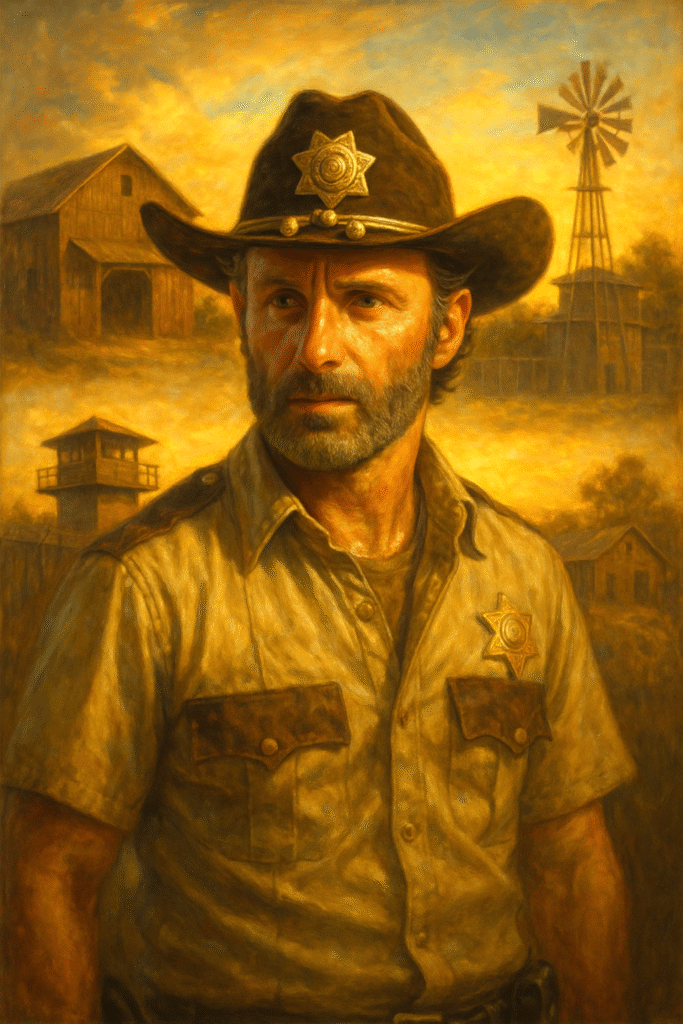

Spoiler warning: this analysis covers major plot points across The Walking Dead (Season 2 barn reveal, Season 3 prison/Governor arc, Season 5 Terminus/Grady, Seasons 6–9 leadership battles). Skip to the “Non-Spoiler Summary” if you want a quick read.
Rick Grimes leadership themes in The Walking Dead — Overview
When Rick Grimes first appears in The Walking Dead, he is a by-the-book sheriff: principled, calm, and committed to law. Yet, as the series progresses, the demands of survival shape him into something more complex — a protector who sometimes looks like a warlord, a moral arbiter forced to improvise, and a leader who makes the audience ask: how do you lead without losing your humanity?
This piece is an empathy-first Rick Grimes character analysis that traces the core Rick Grimes leadership themes in The Walking Dead. We examine turning points, ethical crossroads, the psychological cost of survival, and practical takeaways that apply to managers, community leaders, and fans of narrative ethics.
To ground this study, I add detailed case studies of pivotal episodes, integrate insights from leadership research, and provide step-by-step guidance leaders can apply today. The goal is not to conflate fiction with real-world policy, but to extract transferable lessons about decision-making under extreme stress.
Non-Spoiler Summary
- Rick evolves from sheriff to battle-hardened leader.
- He repeatedly faces moral decisions in apocalypse situations where survival and ethics collide.
- The show asks whether ends ever justify means and what that does to a leader’s soul.
- Key lessons include coalition-building, defining moral boundaries, and tending to followers’ mental health.
- Practical takeaways and a short action plan are provided for managers facing crisis leadership.
Rick Grimes leadership themes in The Walking Dead — Timeline of Turning Points
Rick’s leadership shifts across distinct phases. Briefly:
- Season 1 — The Lawman: leadership born of urgency and order.
- Season 2 (Greene farm / barn incident) — Trust and mercy tested.
- Season 3 (Prison & Governor) — Warfare forces tactical, commanding leadership.
- Seasons 4–5 (Terminus & Grady) — Harsher, preemptive measures to protect the core group.
- Seasons 6–7 (Alexandria & All-Out War) — Coalition-building and wartime strategy.
- Seasons 8–9 — Legacy, rehabilitation, and whether violence cycles can be broken.
Each phase reshapes Rick’s style: servant leader → pragmatic commander → reflective builder. Notice how trauma and context repeatedly pivot his choices.
Key scenes that pivot leadership
- The barn reveal (Season 2): secrecy vs. truth and group safety.
- Shane conflict (Season 2): personal rivalry becomes a test of moral authority.
- Prison vs. Governor (Season 3): community defense turns tactical.
- Terminus/Grady (Seasons 4–5): retribution and necessary brutality.
- All-Out War (Seasons 6–8): collective strategy against coercive power.
These moments anchor our readings of Rick’s moral framework. Below are two short case studies that unpack decisions and outcomes.
Case study — The barn reveal: tactical secrecy vs. psychological harm
The barn incident is a microcosm of trade-offs. Rick chooses to reveal the truth, prioritizing transparency despite immediate risk. The longer-term payoff is restored trust (partial) and shared responsibility. From an organizational perspective, this episode shows how hidden information can fester into collective trauma; transparency may cause short-term pain but preserves social capital.
Case study — Prison defense vs. Governor: limits of militarized leadership
At the prison, Rick adopts a military posture: fortification, chain of command, and decisive force. This protects the group but also normalizes violence as a governance tool. The long-term cost is moral injury and alienation of allies who favor restorative approaches. Leaders should weigh tactical gains against cultural erosion.
Leadership styles, morality and the cost of survival
Rick Grimes’ leadership is best understood as adaptive: he oscillates among servant leadership, authoritative command, and transformational vision depending on the stakes.
Early Rick: servant leadership and moral clarity
- LSI cues: empathy, rule-based decisions, decentralization.
- He trusted process, sought counsel, and modeled moral restraint.
We can compare this to organizational leaders who emphasize psychological safety and participative governance. Research suggests these styles yield higher trust and long-term resilience.
Middle Rick: pragmatic leadership under pressure
- LSI cues: tactical thinking, preemptive strikes, survival-first ethics.
- Trauma narrows options and sometimes justifies brutal choices.
An HBR review of leadership in crisis notes that decision speed often trumps deliberation; however, speed without values leads to erosion of legitimacy — a pattern mirrored by Rick’s arc.
Late Rick: rebuilding and moral repair
- LSI cues: transformational leadership, coalition-building, long-term vision.
- He shifts toward institutional solutions and mercy as governance tools.
The human cost (psychological, social, moral)
- Psychological: hypervigilance, emotional numbing, decision fatigue (see trauma research for parallels) [1].
- Social: fractured relationships, leadership isolation, trust erosion.
- Moral: moral injury — the haunting regret after actions taken for survival.
The American Psychological Association and trauma literature show that chronic high-stress decision-making degrades cognitive bandwidth and social cognition, which the show mirrors in Rick’s arc [1]. Clinically, moral injury requires acknowledgment, apology, and restorative action — a three-step repair process we see hinted at in Rick’s later attempts to rebuild.
Rick Grimes leadership themes in The Walking Dead — Moral dilemmas explained
Rick repeatedly faces these types of ethical crossroads:
- Truth vs. safety (the barn incident): Respecting hope vs. protecting the group.
- Personal loyalty vs. collective good (Shane): When a friend threatens the group’s survival.
- Preemption vs. diplomacy (Governor/Negan eras): Strike before being struck, or risk annihilation.
Ethically, Rick moves among utilitarian calculations, situational ethics, and occasional appeals to duty. These shifts are narratively intentional: they make him morally ambiguous and dramatically compelling.
Comparative note: Rick vs. other leaders on the show
- Governor: authoritarian, uses fear to consolidate power. Short-term efficiency, long-term instability.
- Negan: charismatic coercion, transactional control through terror. Effective at order but brittle under moral opposition.
- Rick: hybrid — gains legitimacy via protection and moral narrative, but wrestles with the cost.
Compared to Governor and Negan, Rick’s authority rests more on moral narrative; when that narrative frays, he loses the advantage. This comparative analysis underscores the importance of legitimacy over coercion for durable leadership.
Rick Grimes quotes on leadership and survival
“We don’t kill the living.” — early Rick; a rule he tests repeatedly.
“This isn’t a democracy anymore.” — the moment consensus gives way to command under pressure.
“My mercy prevails over my wrath.” — a later choice to prioritize rebuilding over revenge.
These lines show the arc from moral certainty to crisis-driven command and, later, to an attempted moral repair.
Expert insight: leadership scholars observe that leaders in prolonged crises often narrate their choices to restore meaning. Rick’s quotes function as moral narratives that justify action and attempt to repair identity.
Lessons in leadership from Rick Grimes for managers
Translating fictional leadership into real-world practice yields useful takeaways:
- Create ethical frameworks before crisis hits; stress reduces bandwidth, so pre-defined rules matter.
- Build coalitions; Rick’s best wins come from alliances, not isolation — a classic leadership lesson in organizational resilience.
- Practice transparency whenever possible; secrecy corrodes trust and long-term legitimacy.
- Attend to mental health; trauma accumulates and undermines performance and empathy.
Actionable 5-step crisis guide inspired by Rick Grimes leadership themes in The Walking Dead
- Establish core principles (non-negotiables). Write them down and communicate them early.
- Set a decision framework: who decides what, and when to escalate. Use simple criteria (safety, rights, long-term viability).
- Build redundancy and alliances: identify partners and back-up leaders to avoid single-point failures.
- Monitor team wellbeing: schedule check-ins, rotate duties, and normalize mental health support.
- Reassess and repair: after each critical incident, conduct an after-action review and repair relationships.
Practical tip: use a “values checklist” in emergencies — 3-5 questions that surface ethical costs before action.
Final reflections: legacy, ambiguity, and questions
Rick Grimes leadership themes in The Walking Dead teach that leadership in catastrophe rarely has clean outcomes. He saved people and built communities — yet at times became what he opposed. The series resists easy moral verdicts, inviting readers to ask: where should leaders draw the line between protection and moral compromise?
Future trends and predictions
- Fictional leadership will increasingly explore restorative and community-based governance post-crisis; audiences crave repair, not just victory.
- Real-world leadership training may incorporate narrative case studies (like Rick’s arc) to teach ethical resilience and moral repair.
- As media reflects complex crises (pandemics, climate disasters), leadership portrayals will emphasize coalition skills and mental health literacy.
What would you do in Rick’s place? Share your thoughts and examples of leadership under pressure.
References & Further Reading
- American Psychological Association — trauma and stress research overview (authoritative source on the psychological cost of chronic stress and trauma) [1].
- Harvard Business Review — leadership in crisis (practical frameworks for decision-making under pressure) [2].
(External links provided in the citations list.)
FAQ
Q: Is Rick Grimes a hero or a villain?
A: He’s intentionally ambiguous — heroic in protection, morally compromised in tactics.
Q: Which episodes are key to his leadership arc?
A: Season 2 (barn/Shane), Season 3 (prison/Governor), Seasons 4–5 (Terminus/Grady), Seasons 6–8 (Alexandria/All-Out War), Season 9 (legacy).
Q: Can real-world leaders learn from Rick Grimes?
A: Yes — especially about crisis frameworks, coalition-building, transparency, and mental health.
Q: Does the show glamorize violence?
A: No. It frames violence as costly and morally fraught.
Q: How can managers apply Rick’s lessons without becoming authoritarian?
A: Use the five-step crisis guide above; emphasize values, shared decision rules, and rotating leadership to prevent power consolidation.
Q: Are there formal leadership models that map to Rick’s arc?
A: Yes — adaptive leadership, situational leadership, and transformational leadership frameworks each illuminate parts of his development.
Tell us which Rick moment stayed with you and why. If you enjoyed this analysis, consider exploring Screenpsyche’s other essays on leadership in fiction.