
Spoiler warning: This article discusses Annie Proulx’s short story “Brokeback Mountain” and Ang Lee’s 2005 film adaptation, including Jack Twist’s death and Ennis’s final choices.
- Ennis Del Mar suppressed identity drives the central tragedy of Brokeback Mountain.
- Trauma, rural homophobia, and toxic masculinity shape his choices and emotional restraint.
- Heath Ledger’s performance and Ang Lee’s craft make that suppression visible through small gestures and image motifs.
A two-decade cowboy love story
Ennis Del Mar (Heath Ledger in the film) meets Jack Twist (Jake Gyllenhaal) during a 1963 summer on Brokeback Mountain. They form an intense emotional and sexual bond, and over the next two decades brief reunions punctuate their separate, socially legible lives—marriage, children, work. Yet Ennis’s persistent fear of being outed, rooted in childhood trauma and amplified by the era’s legal and cultural homophobia, prevents him from choosing a life with Jack. Ultimately, Jack’s death and Ennis’s muted grief reveal a life shaped by what could not be said or shared.
This suppressed identity is not merely an internal secret; it determines where Ennis lives, who he marries, how he fathers his children, and even how he mourns. The label “Ennis Del Mar suppressed identity” encapsulates the behavioral, emotional, and narrative consequences of choosing concealment in a violent social climate.
Suppressed Identity in Historical Context (1960s–1980s rural America)
To read Ennis responsibly, we must situate him in a period when same-sex intimacy could mean legal peril or physical violence. Anti-sodomy laws were enforced across many states; national decriminalization only arrived with Lawrence v. Texas (2003) (see external sources). Moreover, narrow ideals of rural masculinity and economic precarity created conditions where concealment felt necessary. As Meyer (2003) explains in minority stress theory, chronic stigma produces adaptive behaviors—secrecy, hypervigilance, constrained affect—that map directly onto Ennis’s life.
Expanding the historical frame helps explain why Ennis cannot simply “choose” a different life. In the 1960s and 1970s, many rural communities had limited access to queer networks, fewer urban enclaves of safety, and strong police-community enforcement of gender and sexual norms. Oral histories from rural queer elders frequently describe self-preservation strategies that resemble Ennis’s: coded language, itinerant work, and compartmentalized families. These real-world parallels anchor the fictional case in social reality.
Ennis Del Mar Character Arc: Emotional Restraint and Repression
Ennis is taciturn, weathered, and private. Proulx’s prose compresses decades; Lee’s film stretches moments that let us feel the interior cost. A formative childhood memory—hearing of a man murdered and mutilated for perceived effeminacy—anchors a conditioned association in Ennis’s mind: queer desire = mortal danger. So rather than an arc toward openness, Ennis’s trajectory is a retreat, a slow ossification into silence. In short: Ennis’s suppressed identity is both survival strategy and tragic limitation.
Close scene reads: where repression shows
The first night on Brokeback Mountain
Silence dominates. Tent conversations are halting; Ennis’s guarded posture and averted gaze contrast with Jack’s more expansive longing. The mountain becomes a liminal space where rules relax briefly and intimacy can happen.
Motel reunions and the shirts motif
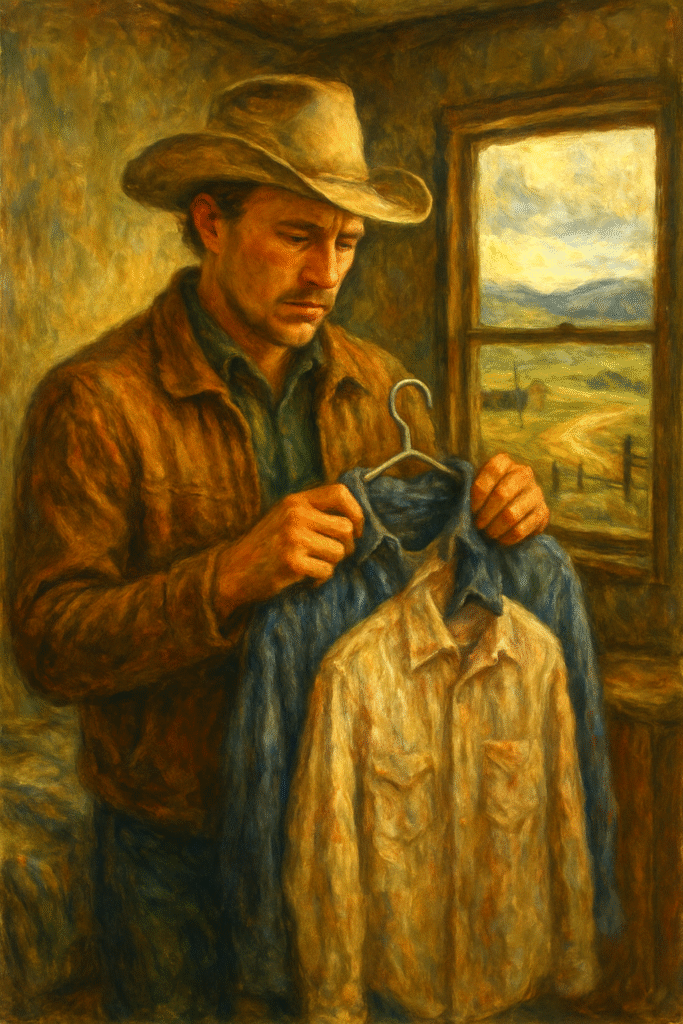
Midlife rendezvous occur in motels and cheap rooms, tender but shadowed by paranoia. After Jack’s death, Ennis finding their shirts folded together becomes one of the film’s most potent images: clothing as tactile proof of intimacy and a surrogate for public recognition.
Home life and family rupture
Ennis’s emotional flatness—brusque parenting, absent explanations, and interrupted affections—shows repression’s collateral damage. He attempts the socially legible life but cannot integrate desire into it, producing alienation for himself and others.
Film analysis: The tragedy of Restraint
Heath Ledger’s Ennis is a masterclass in economy: micro-expressions, small gestures, and withheld words convey a vast inner life. Ang Lee and cinematographer Rodrigo Prieto use wide landscapes, frames that push Ennis to the margins, and close-ups on hands and shirts to externalize his suppression. The film’s pacing lets silence accumulate; silence becomes an aesthetic equivalent of repression.
A comparative note: Whereas many Hollywood dramas rely on dialogue to reveal inner life, Brokeback Mountain often relies on mise-en-scène and duration to show the cost of compartmentalization. Ledger’s physicality—his stiffness around crowds, the way he tilts his head away in public—makes “Ennis Del Mar suppressed identity” legible without didactic exposition.
Psychology: trauma, attachment, and identity conflict
- Trauma and fear conditioning: The childhood episode functions like a conditioned fear response, making risk-taking around intimacy feel existentially dangerous.
- Attachment patterns: Ennis displays anxious-avoidant tendencies—deep longing paired with avoidance, producing chronic grief.
- Minority stress and internalized homophobia: Social stigma becomes internalized, reducing desire to a dangerous secret rather than a legitimate part of identity (see Meyer, 2003).
- Masculinity performance: Stoicism and self-reliance are occupational and cultural requirements that also serve as emotional cages.
Clinical and practical implications arise from these patterns. Affirmative therapies that address minority stress explicitly—combining trauma-focused approaches with group-based peer support—can mitigate the harms of prolonged concealment. For clinicians working with clients who show Ennis-like avoidance: practice trauma-informed assessment, validate the function of secrecy as survival, and gently scaffold steps toward community integration that respect safety concerns.
Symbols and motifs (short)
- Clothing: Jack’s shirts become memory-objects and proof of a life denied.
- Landscape: Brokeback Mountain as refuge; home as containment.
- Silence: Protection that doubles as punishment—unsaid words accumulate into loss.
Comparative analysis: Ennis and other literary/film closeted figures
Comparing Ennis with characters from other eras sharpens what makes his case distinctive. E.M. Forster’s Maurice (published 1971) ends with social hope—its protagonists attain a form of openness within a more permissive personal enclave. By contrast, Ennis’s world offers fewer safe choices and more visible risk. Similarly, films like A Single Man (based on Christopher Isherwood) foreground an urban intellectual milieu where grief and identity play out differently. The contrast emphasizes how class, place, and occupational identity shape the experience of suppression: rural working-class masculinities impose a different set of constraints than urban bohemian spaces.
Practical applications: reading, teaching, and advocacy
- For educators: Use scene clusters (the tent, the motel, the shirts) to teach about subtext and social context. Assign short readings on minority stress theory alongside the film to bridge literary analysis and psychology.
- For therapists and community workers: Incorporate the film into group discussions about secrecy, grief, and safety planning. Use the narrative to normalize fear responses while brainstorming harm-reduction strategies.
- For policy advocates: Ennis’s narrative is an argument for legal protections and visible support networks in rural regions—anti-discrimination laws, hate-crime enforcement, and resource funding reduce the objective risks that make concealment necessary.
Step-by-step guide for educators using the film:
- Begin with historical context (1960s–1980s legal landscape).
- Screen key scenes with subtitles for close analysis.
- Pair with short readings (Proulx excerpt; Meyer 2003 summary).
- Facilitate small-group work: identify symbols and link them to social dynamics.
- Conclude with reflective writing prompts: ask students to consider how place and law shape identity choices.
Expert insights and quotes
Scholars and clinicians studying minority stress repeatedly emphasize that concealment often protects individuals from immediate harm while producing long-term mental health costs. As Ilan H. Meyer (2003) frames it, chronic stigma forces behavioral strategies—secrecy, withdrawal—that exact a psychosocial toll. Film scholars also note that Ang Lee’s direction makes suppression cinematic: a production note often cited by critics is Lee’s insistence on silence as a form of language, allowing gestures and mise-en-scène to speak what Ennis cannot.
Contemporary relevance: what Ennis’s story tells us today
Ennis Del Mar suppressed identity remains a cautionary example of how legal regimes, culture, and masculinity norms can create private suffering. While society has changed significantly since the film’s setting, the psychological dynamics of concealment and minority stress remain informative for discussions about policy, community support, and representation in media. Rural LGBTQ+ advocates still point to stories like Ennis’s when arguing for targeted outreach and accessible mental health care in nonurban areas.
Future trends and representation
Looking ahead, representation of queer rural lives is diversifying. Contemporary media increasingly depicts characters who find support via online communities, rural queer collectives, or intersectional organizing. These trends suggest potential futures where an “Ennis Del Mar suppressed identity” might be less determinative—though structural inequalities (economics, law, enforcement) remain central variables. Continued attention to regional disparities and culturally competent services will shape whether suppression remains a common narrative outcome.
Conclusion: the tragedy of restraint and the cost of concealment
Ennis’s suppressed identity is not merely a personal failing; it is a historically situated outcome of trauma, law, and culture. Brokeback Mountain forces us to ask how societies create secrecy and what that secrecy costs. Importantly, a compassionate reading avoids pathologizing sexuality and centers the structural causes of suffering.
References & further reading
- Annie Proulx, “Brokeback Mountain” (short story) — the original compressed, elliptical account.
- Ang Lee, Brokeback Mountain (2005) — film adaptation and performance insights.
- Meyer, I.H. (2003). Minority stress theory and its implications for mental health (see external links).
- U.S. Supreme Court, Lawrence v. Texas (2003) — context for decriminalization of consensual same-sex activity.