
Spoiler notice: This essay contains measured spoilers for Krzysztof Kieślowski’s Three Colors: Blue (1993). Key plot developments and scene details are discussed to support a close reading of Julie’s emotional journey. If you plan a first-time viewing, stop here and return after watching.
Plot Summary
What does freedom look like after loss? In Three Colors: Blue, Julie (Juliette Binoche) tries a radical answer: erasing attachments to recreate herself. Yet Kieślowski resists a tidy pairing of freedom with liberation. Instead, freedom, detachment, and rebirth operate as braided motifs that the film stages through color, camera, sound, and Binoche’s restrained performance. Briefly, Julie loses her husband and daughter in a car accident, attempts to dissolve ties by destroying objects and withdrawing emotionally, and then negotiates a slow, ambiguous reintegration into relation and feeling.
Expanding this summary with concrete narrative beats helps locate where the motifs repeat: Julie is first shown in the aftermath — hospital corridors, antiseptic light — which establishes detachment as a bodily, spatial condition. The apartment purge includes not only physical destruction but also the dismantling of symbolic anchors: photographs, musical scores, legal ties. As the film progresses, chance encounters, legal testimonies, and the persistence of a musical motif push her toward ethical and emotional choices that complicate her declared freedom.
A focused case study: consider the sequence in which Julie burns her own and her husband’s paperwork. Frame-by-frame, Kieślowski composes the act as both ritual and futility: the camera lingers on the slow, deliberate movement of hands, then cuts to an indifferent street outside. The smallness of the act within the urban world underscores the film’s claim that personal purity through erasure is incomplete.
Julie’s Character Study
Julie’s arc is a practical experiment in autonomy. At first, detachment is methodical: selling the apartment, shredding scores, and ritual purging. Importantly, these actions turn inward as well as outward; they are less theatrical and more a practice of inhibition and containment. Over time, curiosity, the persistence of music (Zbigniew Preisner), and the presence of others complicate that isolation, so rebirth appears not as triumph but as a modest reopening to possibility.
Detailed example: when Julie hires the anonymous woman as a housekeeper and companion, the relationship is at first strictly transactional. Observing their interactions reveals a negotiation of boundaries: Julie tests whether physical proximity forces emotional exposure. The scene functions as a microcosm for how detachment can become a social experiment — autonomy measured against the social demand for reciprocity.
Psychologically, her purge resembles avoidant attachment strategies catalogued in grief literature: extreme efforts to control external reminders of loss, which often fail because memory and sensation are not objects to be disposed of. Clinicians working with bereaved clients might recognize Julie’s behavior as an attempt at symptom management rather than integrative processing.
Key scenes to watch
- Opening crash and hospital aftermath: the film begins with rupture rather than reaction.
- Apartment purge sequence: detachment staged as repetitive labor.
- Musical reprises: memory resists deletion via motif.
- Discovery of husband’s hidden life: betrayal and relief merge.
- Final sequence: ambiguous, relational rebirth.
To deepen a viewing practice, try watching the purge sequence twice: once with the sound up to register Preisner’s score and once muted to see how much of the scene’s emotional logic comes from visual rhythm rather than sonic cueing.
Meaning & Symbolism: Three Colors: Blue themes (Kieślowski analysis)
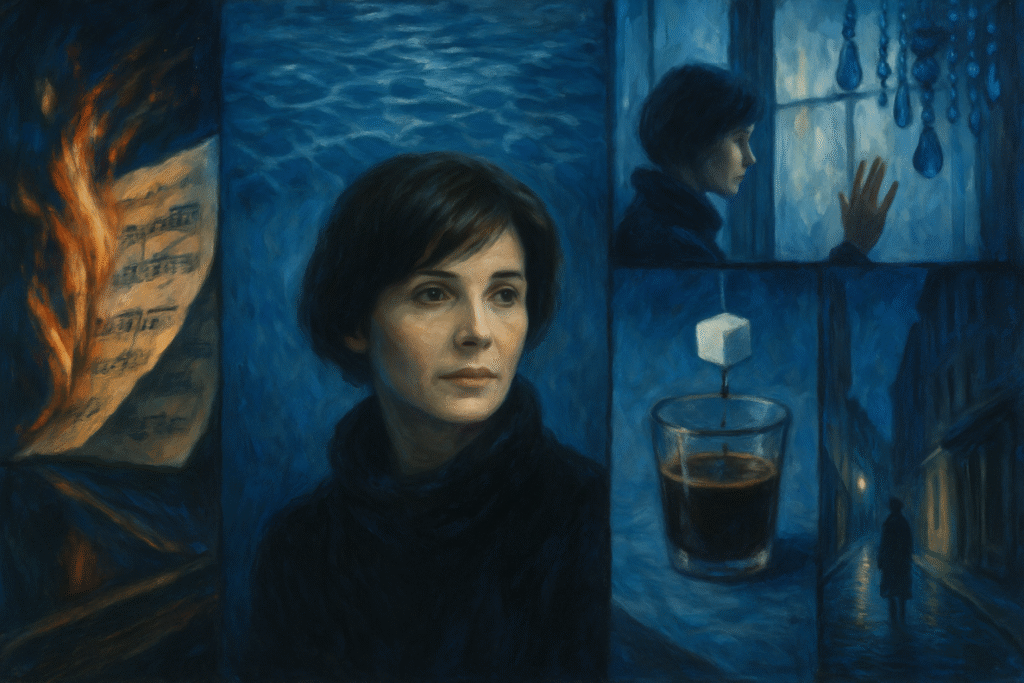
Kieślowski turns blue into a semantic field rather than a single sign. Blue functions as a psychological barometer: at times claustrophobic and bruising, at other times luminous and open. The film’s camera — still, attentive to micro-expressions, and often obstructed — builds a visual grammar of interiority. Preisner’s score loops and fractures motifs, making music a memory-trace that refuses Julie’s attempt at erasure.
- Color symbolism: blue as detention vs. diffusion into water/light.
- Camera & framing: close-ups of hands/faces, off-center compositions that embody separation.
- Sound: recurring motifs, diegetic texture, and silence that map emotional states.
Historical context: the film was made in early 1990s Europe, a moment of political recalibration after the end of the Cold War. While Blue is not an overtly political film, its preoccupation with individual liberty and the ethics of privacy resonates with contemporaneous debates about what modern freedom entails — personal sovereignty versus relational obligations. Kieślowski’s broader Three Colors trilogy staged the French Revolutionary ideals (liberté, égalité, fraternité) as ethical experiments in cinematic form; Blue adapts liberté to a private, ethical terrain.
Comparative note: contrasted with Three Colors: Red, which explores connectivity and fate, Blue interrogates the possibility of solitude as moral freedom. Where Red finds an almost conspiratorial web holding people together, Blue shows solitude as less heroic and more provisional.
Juliette Binoche; Performance analysis
Binoche’s performance is quietly authoritative. She renders massive interior shifts through calibration — a gaze, a small tightening of jaw, the tempo of a hand gesture. Her restraint invites viewers into a psychoanalytic stance: we are allowed to feel with Julie while also observing the mechanisms of her detachment. Supporting roles function as relational mirrors, offering alternate paths back toward engagement.
Expert insight: film critics and scholars often point to Binoche’s economy of motion as crucial to the film’s tonal success. One common reading is that her minimalism resists melodrama, allowing Preisner’s score to occupy the space of overt feeling while the camera records incremental returns to life. Directors and acting coaches cite this performance as an example of internalized technique: the actor constructs a rich interior life while keeping the surface placid.
A brief acting case study: in the scene where Julie listens to her husband’s recorded dictation, Binoche performs a barely perceptible change in breathing that indicates recognition and then shock. This micro-gesture stitches together narrative revelation and affective reality, showing how Kieślowski stages performance as evidence rather than explanation.
Psychological & Philosophical Reading
- Existential liberty: Julie tests radical autonomy, but Kieślowski suggests real freedom is the capacity to choose relationships again.
- Grief and attachment: her purge resembles avoidant coping; the film dramatizes how internal objects persist despite external erasure (see grief research on prolonged grief and attachment literature).
- Interpersonal autonomy: rebirth becomes a reconfiguration of bonds, not their annihilation.
Step-by-step guide to a close reading of a scene
- Identify the formal elements (color palette, camera distance, sound design).
- Note the character’s micro-behaviors (gesture, blink, posture changes).
- Map how motifs recur (a musical phrase, a prop, a camera movement).
- Contextualize the beat within the plot — what choice does it present?
- Synthesize: ask how the formal choices shape the ethical meaning of the character’s action.
Applying this method to the piano reprises in Three Colors Blue reveals how the score functions as an autonomously emotive character: it both marks memory and provokes it.
Where to watch Three Colors Blue online (practical)
As of this writing, the film is available on curated streaming platforms such as The Criterion Channel and may be rented on platforms like Apple TV or Amazon Prime Video. For collectors, the Criterion Collection Blu-ray of the Three Colors box set offers the highest-quality transfer and supplements.
Practical tip: when streaming, check playback settings for color profile and HDR options; Kieślowski’s blue palette benefits from a neutral display calibration that doesn’t oversaturate or clip shadow detail. If teaching, use the Blu-ray supplements for interviews and behind-the-scenes context.
Practical rewatch guide and suggested clips
- Opening crash / emergency response (00:00–00:08): note the film’s collapse of distance.
- Purge sequence (00:20–00:35): watch hands, objects, and tempo.
- Piano motif reprises (00:50–01:05): listen for memory’s persistence.
- Discovery scene (1:10–1:20): observe micro-expressions.
- Final sequence (1:30–1:40): examine framing and sound for relational hints.
Classroom activity (case study format): assign students to watch one of the clips twice and write a short memo connecting one formal element (e.g., sound) to an ethical question (e.g., Can erasure ever be moral?). Compare responses to show interpretive variance.
Interpretive takeaway: the rebirth of the self
In short, Three Colors: Blue stages freedom, detachment, and rebirth as interdependent motifs. Julie’s detachment is at once an attempt at self-sovereignty and an evasion. The film’s formal language — blue tonality, still framing, and recurring music — both performs and resists her project. Rebirth arrives tentatively: a reopened capacity to feel and choose, rather than a clean break.
Actionable recommendations for viewers and teachers
- For personal reflection: use the film as a prompt to journal about what you would ‘purge’ after loss and why — this can reveal avoidant tendencies versus integrative strategies.
- For instructors: pair Blue with a short reading from contemporary grief studies to bridge cinematic representation and psychological research.
- For filmmakers: study Kieślowski’s use of sound motifs as narrative agents — try composing a short scene where a single musical phrase triggers emotional subtext.
Future trends and predictions
Contemporary cinema continues to borrow Kieślowski’s blueprint: color grading as interiority marker, motif-driven scores, and micro-performance-centered acting. Streaming platforms have intensified attention to color palettes in thumbnails and metadata, which may encourage filmmakers to conceive visual identity from pre-production onward. Expect future filmmakers to push the marriage of color and sound further, using immersive audio and color grading tools to map interior states with even greater subtlety.
If this analysis prompted a new insight on rewatch, please share a scene or thought below. For classroom use, choose one scene and map how color, sound, and micro-performance guide psychological interpretation.
References
[1] Criterion Collection film entry for Three Colors: Blue (see external links)
[2] British Film Institute coverage of Kieślowski and the Three Colors trilogy (see external links)
FAQ
Q: Is this essay spoiler-heavy?
A: Yes. The piece contains focused spoilers used to support a close reading. If you haven’t seen Three Colors: Blue, watch it first and return for the deeper analysis.
Q: What scenes best demonstrate Julie’s detachment and rebirth?
A: Rewatch the opening crash, the apartment purge where she destroys possessions, the recurring piano motifs, the discovery of her husband’s secret life, and the final ambiguous sequence.
Q: How does the film use the color blue beyond decoration?
A: Blue functions as an emotional grammar—sometimes imprisoning, sometimes expansive—signaling mood, memory, and psychological weather.
Q: Are Julie’s strategies healthy coping?
A: Not straightforwardly. Her ritualized purge resembles avoidant coping: short-term relief that can impede long-term emotional integration. The film shows the limits and partial utility of that strategy.
Q: Where can I read more about Kieślowski’s intentions?
A: Look for festival interviews and contemporary write-ups in film journals. The Criterion Collection and BFI provide useful contextual material.
Q: How can I use this film in a teaching context?
A: Use short clips for focused close readings, pair the film with readings on grief or film theory, and assign students the step-by-step scene analysis provided above.
Q: How does Three Colors Blue compare to other grief films?
A: It distinguishes itself by combining formal restraint, color symbolism, and motif-driven scoring. Unlike melodramatic grief narratives, Kieślowski emphasizes ambiguity and the ethical complexity of freedom.