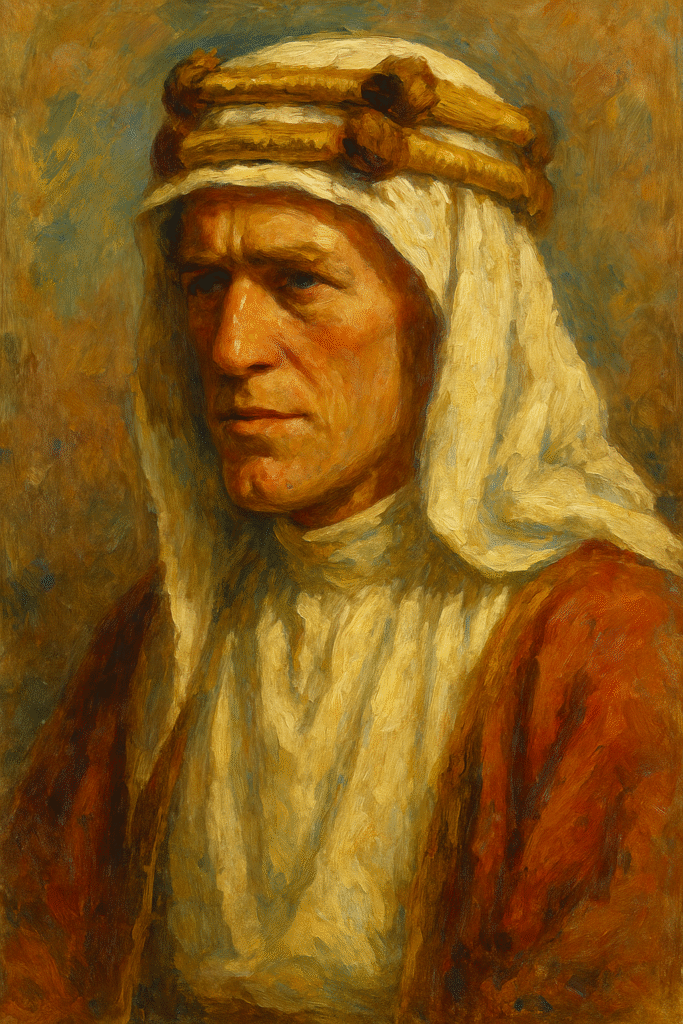

‘A man of many names, several costumes, and one legend — what does T.E. Lawrence idealism and identity tell us about heroism, trauma, and cinematic mythmaking? This concise, viewer-focused analysis pairs archival reading with film study.’
T.E. Lawrence Idealism and Identity: Who was he?
Thomas Edward Lawrence (1888–1935) remains a contested figure: an archaeologist, British intelligence officer, guerrilla strategist, and author who helped shape the Arab Revolt (1916–1918). In short, the Lawrence of Arabia biography is as much a story of self-fashioning as it is of wartime action. Therefore, when we ask how T.E. Lawrence idealism and identity operated, we mean: how did principles, public performance, and private shame interact to make his legend?
Expanding this biographical sketch, consider Lawrence’s background in archaeology and languages — training that both opened cultural doors and fed an intellectual idealism. His prewar work at Carchemish and Tell al-‘Amarna gave him unusual access to Arab culture and an understanding of historical depth that would inform his later romanticism. His Oxford education, combined with a provincial Protestant upbringing, shaped a sensibility that alternated between ascetic self-discipline and a hunger for public recognition. These biographical details help explain why the focus keyword ‘T.E. Lawrence idealism and identity’ threads through both his public deeds and private self-description.
Idealism and Identity in the Arab Revolt
During World War I, British strategy and Arab aspirations intersected uneasily. Lawrence acted as liaison and strategist rather than formal commander, using cultural knowledge, charisma, and sabotage tactics (notably attacks on the Hejaz railway). Later, the Sykes–Picot settlement and broken promises intensified his guilt. In short, the Arab Revolt history is essential to any psychological reading because idealism and betrayal shaped Lawrence’s postwar identity.
A close case study: the Aqaba campaign (1917). Lawrence’s role in persuading the Hashemite Prince Faisal and coordinating a multi-front assault demonstrates his capacity for political vision and pragmatic improvisation. He combined desert mobility, local tribal politics, and symbolic gestures designed to galvanize pan-Arab sentiment. Yet the aftermath — landings of imperial interests, the sidelining of Arab political aims in the Versailles settlements — crystallized his sense of moral failure. Another important episode is the repeated sabotage of the Hejaz railway: tactically limited but symbolically powerful, these attacks exemplify the intersection of idealism (liberation rhetoric) and brutal guerrilla tactics. These real-world events provide concrete anchors for psychological interpretations of identity fragmentation.
Psychological framework
To read Lawrence responsibly, we use accessible theory rather than clinical certainty:
- Narcissistic traits: grandiosity, attention-seeking, and fragile self-worth are observable in public performances and memoiric self-fashioning; however, retrospective clinical diagnosis is inappropriate.
- Idealism: a moral-motivational drive that powered his leadership and produced intense disappointment when political realities failed his ideals.
- The fragmented self: role-switching, assumed names, and alternating public spectacle and private withdrawal signal identity splitting, a concept used in psychoanalytic and social-psychological accounts.
Measured indicators include evidence of grandiosity versus vulnerability, ritualized identity performance (Arab dress, assumed names), and textual self-contradictions in Seven Pillars and letters.
To expand: apply a clear step-by-step analytic method when examining Lawrence’s behavior. Step 1: triangulate primary sources (Seven Pillars, letters) with contemporaneous reports (military despatches, Arab testimony). Step 2: identify recurring behaviors (dress, name changes, public speeches) and assess their tactical versus expressive functions. Step 3: situate behavior within historical outcomes (Sykes–Picot, postwar settlement) to see how moral dissonance might produce psychological splitting. This method reduces speculative leaps while making normative inferences grounded in evidence.
Seven Pillars of Wisdom Analysis
Seven Pillars of Wisdom combines memoir, rhetoric, and selective memory. Its passages oscillate between prophetic idealism and strategic calculation — a key reason it is central to any T.E. Lawrence character study. Cross-referencing Seven Pillars with The Letters of T. E. Lawrence and Jeremy Wilson’s authorized biography helps separate self-fashioning from recurrent expressions of guilt, nightmares, and renunciation.
Key textual signs:
- Celebratory passages that elevate the revolt to moral testing (idealism in action).
- Private letters that reveal shame, sleeplessness, and atonement attempts (moral injury and vulnerability).
- Repeated role performances: Arab robes and name changes that function tactically and affectively, pointing to a fragmented self.
Detailed example: a paragraph-by-paragraph reading of the Aqaba chapter reveals a rhetorical structure: built suspense, moral justification, and a concluding vision of historical redemption. When juxtaposed with a letter written shortly after — which may be terse, anxious, or self-deprecating — a pattern emerges of public myth-making coupled with private doubt. That interplay is a core piece of evidence for any argument about ‘T.E. Lawrence idealism and identity.’
Lawrence of Arabia Film Analysis
David Lean and Robert Bolt crystallized Lawrence into a tragic archetype. From a film psychology perspective, the movie uses widescreen desert vistas versus close, claustrophobic interiors to externalize the fragmented self. Notable cinematic moments include the Aqaba attack, the slap scene with Sherif Ali, and the closing motorcycle crash bookends — all dramatizations that amplify narcissistic-display and inner collapse.
Importantly, film analysis must be balanced with historical critique: Lean’s Lawrence of Arabia movie analysis is powerful but selective, compressing complexity into an intelligible moral arc.
Comparative analysis: compare Lean’s depiction with earlier silent-era representations or later documentaries. Where Lean films psychology through visual contrast and mythic gesture, documentaries often foreground archival contingency and multiple perspectives, including Arab voices. This comparative lens helps viewers understand how cinematic choices shape the popular reception of Lawrence and reinforce certain identities while effacing others.
Practical application for viewers: when watching, pause at key sequences (Aqaba assault, the desert crossing, the climactic desert stare) and read contemporaneous diary excerpts. Note discrepancies: what the film magnifies, what it omits, and how those choices feed the myth of a unified heroic identity versus a fragmented, conflicted self.
Trauma, Moral Injury, and The Fragmented Self
Contemporary frameworks like PTSD and moral injury (see Shay; Litz et al.) help explain Lawrence’s later life: social withdrawal, nightmares, and renunciation. Moral injury — distress from violating one’s own moral standards — maps tightly to his letters about betrayal of Arab allies. Rather than labeling, this approach identifies mechanisms: trauma plus moral dissonance can produce defensive grandiosity and persistent identity splitting.
Expert insight: Jonathan Shay’s work on Achilles and modern veterans argues that moral injury often produces narrative rupture: the soldier can no longer inhabit the same moral universe. When applied to Lawrence, this reading explains recurrent renunciations and attempts to flee public life (enlisting in the RAF under assumed names, for example) as defensive strategies to manage a damaged moral self. Psychiatrist and historian voices in the field increasingly recommend mixed-methods approaches combining textual analysis with clinical theory — a practice followed in this essay.
Actionable tips for researchers: keep a timeline of key events and correlate them with dated letters and drafts of Seven Pillars. This helps locate where idealism was most buoyant and where fractures intensified.
Ethical and postcolonial cautions (was T.E. Lawrence a narcissist?)
First, avoid definitive diagnostic claims. Second, situate psychological readings inside imperial power relations: narcissism in literature and heroic narcissism in biographies should not obscure the realities of colonial violence. A balanced T.E. Lawrence idealism and identity reading respects both the archive and postcolonial critique.
Comparative case: Gertrude Bell and T.E. Lawrence shared language skills and a fascination with Arab politics, but their public identities were constructed differently — Bell as an imperial administrator/intellectual and Lawrence as a wanderer-hero. Comparing them highlights how gender, rank, and institutional position shape public performances and private identifications.
Takeaways for viewers and students (how to watch and read)
- Watch Lean’s film for metaphoric truth: it captures psychological tensions but simplifies history.
- Read Seven Pillars alongside The Letters and Wilson’s biography for archival nuance.
- Consider moral injury as a lens for the postwar persona rather than a clinical verdict.
Practical study guide (step-by-step):
- Begin with the film: note emotional beats and cinematic techniques that emphasize identity conflict.
- Read selected chapters of Seven Pillars (Aqaba, the desert sequences) to compare rhetoric with imagery.
- Consult Jeremy Wilson’s biography for context and archival evidence.
- Read a short piece on moral injury (Shay or Litz) and map those concepts onto dated letters.
- Finish with a postcolonial critique: read Arab perspectives on the Revolt to counterbalance British narratives.
Actionable recommendations for teachers: assign a short reflective essay prompt asking students to analyze a pair of passages — one from Seven Pillars and one film scene — focusing on how idealism is narrated versus enacted.
Suggested further reading and authoritative citations
- T. E. Lawrence, Seven Pillars of Wisdom (1926) — primary memoir and central text.
- Jeremy Wilson, Lawrence of Arabia: The Authorized Biography of T. E. Lawrence (1990) — definitive biography.
- Jonathan Shay, Achilles in Vietnam: Combat Trauma and the Undoing of Character (1994) — foundational on moral injury.
Authoritative external sources consulted (for historical and clinical framing):
- Encyclopaedia Britannica, T. E. Lawrence entry (historical overview)
- Litz NS et al., preliminary model of moral injury (Clinical Psychology Review / PubMed)
FAQ
Q: Can we clinically diagnose T.E. Lawrence with NPD?
A: No. Retrospective clinical diagnosis is speculative. Use a dimensional reading: identify traits consistent with narcissistic patterns while avoiding definitive DSM claims.
Q: Was T.E. Lawrence a narcissist?
A: He displayed narcissistic traits in public performance and memoiric self-fashioning, but private letters show vulnerability and moral torment — supporting a nuanced, not categorical, view.
Q: How accurate is Lean’s Lawrence of Arabia?
A: It is artistically accurate about psychological tensions but simplifies political context; treat it as mythic interpretation, not documentary history.
Q: Where should I start for research?
A: Read Seven Pillars, The Letters of T. E. Lawrence, and Jeremy Wilson. For trauma theory, consult Jonathan Shay and Litz et al.
Q: What primary documents are most useful for tracking identity shifts?
A: Dated letters, military dispatches, and early drafts of Seven Pillars; these reveal changes in tone, recurring motifs of guilt, and moments of public performance. Putting items on a chronological timeline illuminates how events shape self-presentation.
Q: Does postcolonial scholarship alter interpretations of Lawrence’s motives?
A: Yes. Postcolonial work foregrounds Arab agency and critiques imperial frameworks that have historically centered Lawrence. This reshapes readings of idealism as sometimes complicit in larger systems of control.
Q: Can the concept of moral injury be applied to other historical figures?
A: Yes. Moral injury is a useful interpretive tool for historical actors who experienced dissonance between ideals and actions. Use it cautiously alongside primary evidence.