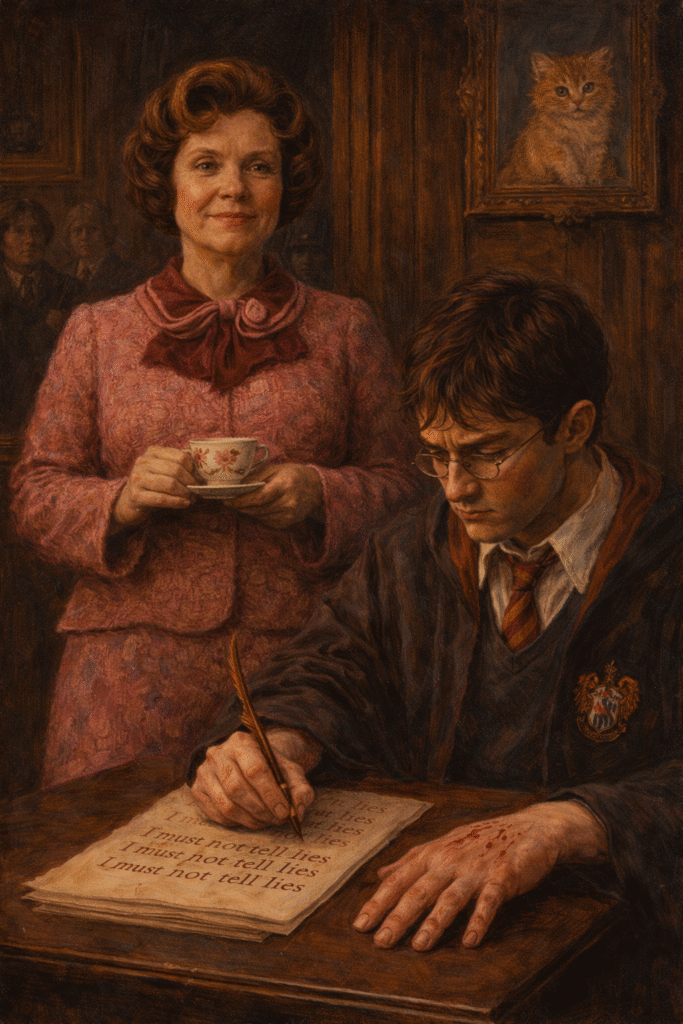

Just World Belief examples in films and TV shows reveal how characters cling to the idea that people get what they deserve. On screen, this bias often fuels victim-blaming, justifies cruelty, and deepens conflict—providing writers with powerful tools for character construction and thematic tension.
Key Takeaways
- Just World Belief drives many victim-blaming authority figures, bullies, and bystanders on screen.
- Understanding this bias helps writers design deeper conflicts and clearer ideological clashes.
- Recognizing these patterns in media can also challenge real-world victim-blaming reflexes.
Umbridge’s Quill: A Perfect Hook into Just-World Belief
Picture Dolores Umbridge forcing students to write lines with a cursed quill that carves “I must not tell lies” into their skin. She smiles sweetly, insists it is “for their own good,” and calmly claims they deserve the pain.
That is Just-World Belief in action: the conviction that suffering is proof of wrongdoing.
In this article, we will use Umbridge and other familiar characters to unpack how Just-World Belief operates psychologically, why it so often leads to victim-blaming, and how you can deliberately build this bias into your characters and conflicts.
What Is Just-World Belief – and Why Does It Lead to Victim-Blaming?
Psychologist Melvin Lerner introduced the idea of the Just-World Belief in the 1960s. In simple terms, it is the comforting story our brains tell us:
Good things happen to good people. Bad things happen to bad people. The world is basically fair.
This belief has two big psychological payoffs:
- It reduces anxiety. If the world is fair, and you are “good,” then you are safer.
- It gives a sense of control. If outcomes are earned, then you can avoid harm by behaving correctly.
The problem is that reality does not cooperate. Innocent people are harmed all the time. When that happens, a strong Just-World Belief creates a painful tension: “Bad things happened, but my world must still be fair.”
One way to resolve that tension is compassion. Another, sadly common, way is victim-blaming:
- “They must have done something to deserve it.”
- “If they were really innocent, this wouldn’t have happened.”
- “If she dressed differently, he wouldn’t have targeted her.”
On screen, this bias shows up in judges, teachers, parents, cops, bosses, and even friends. They reinterpret suffering as evidence of guilt — all to preserve the illusion of a fair world.
Dolores Umbridge: A Case Study in Sweet-Pink Cruelty
Dolores Umbridge in Harry Potter is one of the clearest Just-World Belief characters in popular media. She is not chaotic like Voldemort; she is rigidly moralistic. That makes her ideal for studying how this bias works.
1. Moral Order Above Human Beings
Umbridge talks constantly about “order,” “discipline,” and “the Ministry’s guidelines.” Her moral universe is simple:
- The Ministry is right.
- Anyone opposing it is bad.
- Bad people deserve punishment.
When Harry insists that Voldemort is back, she does not seriously investigate. Instead, she sees his claim as defiance that threatens her orderly worldview. If the Ministry is wrong, then her belief in a just, controlled system cracks — and that is intolerable.
So she reframes Harry as a liar seeking attention. Punishing him becomes restoring justice.
2. Punishment as Proof of Guilt
The blood quill scene is a textbook example. Harry is forced to carve a sentence he knows is false into his own hand. Umbridge never yells. Her calm smile tells us her internal logic:
- If he were innocent, he would not be here.
- If he is suffering, that means he is learning a lesson.
In a Just-World framework, suffering is retroactive evidence of guilt. Once someone is punished, a character like Umbridge feels confirmed: “See? They must have deserved it.”
3. Power, Privilege, and Selective Compassion
Umbridge is deeply biased toward those she sees as “proper” — pure-blood wizards, the Ministry elite — and against “undesirables.” Her Just-World Belief is filtered through prejudice.
- She treats centaurs and “half-breeds” as dangerous by nature.
- She assumes students from certain backgrounds are more likely to lie or misbehave.
For writers, this is crucial: Just-World Belief rarely stands alone. It hooks into classism, racism, speciesism, or other prejudices, and then uses “justice” as a mask for cruelty.
4. Narrative Function: Why Umbridge Hurts More Than Voldemort
From a storytelling perspective, Umbridge is uniquely infuriating because she:
- Embodies institutional victim-blaming (school, Ministry, law).
- Uses kindness as a weapon — kittens, pink cardigans, sweet voice.
- Shows how everyday cruelty is justified as “for your own good.”
Her psychology exposes something uncomfortable: the people who harm us most may truly see themselves as moral guardians.
More Just-World Belief Examples in Films and TV Shows
Once you know what to look for, you see Just-World Belief across genres.
1. Crime Procedurals – The “What Was She Wearing?” Cop
In many police dramas, an officer or detective reacts to a victim of assault with questions like:
- “Why were you walking alone at night?”
- “Had you been drinking?”
On the surface, these are practical questions. Underneath, they often carry a moral judgment: if she broke the “safety rules,” then the harm is partially her responsibility.
Narratively, this does several things:
- Highlights institutional callousness.
- Positions a more compassionate character (often the protagonist detective) as a contrast.
- Forces the audience to confront their own potential victim-blaming reflexes.
2. High School Dramas – Gossip and Social Exile
In teen shows, a character who is humiliated, assaulted, or betrayed often becomes the target of rumor rather than support. Classmates say things like:
- “She must have wanted the attention.”
- “He’s always getting into trouble — no wonder this happened.”
Here, Just-World Belief is used to:
- Maintain the illusion of safety in a chaotic social environment.
- Protect bystanders from the idea that this could happen to anyone.
- Externalize the group’s fear as contempt targeting the victim.
3. Superhero and Vigilante Stories – Collateral Damage Logic
In some superhero narratives, city officials or media pundits blame victims of collateral damage:
- “If they had evacuated when told, they wouldn’t have died.”
- “Those people chose to live in that dangerous neighborhood.”
This frames systemic issues and large-scale harm as the result of individual choice, keeping the world morally neat. It also creates ideological conflict between heroes who protect the vulnerable and institutions that rationalize their suffering.
4. Workplace Comedies and Dramas – The HR Shield
In office shows, when someone reports harassment or bullying, HR or management sometimes responds with:
- “Are you sure you didn’t misinterpret?”
- “You do have a reputation for being difficult.”
Here, Just-World Belief protects the company’s image and the status quo. Admitting real injustice would mean accepting chaos in a system they want to see as fair and merit-based.
Table: How Just-World Belief Shows Up On Screen
| Character Type | Typical Belief Statement | Narrative Function |
|---|---|---|
| Moralistic authority (Umbridge) | “Rules are fair; rulebreakers earn their suffering.” | Embodies institutional cruelty and control |
| Cynical cop / official | “They knew the risks; it’s on them.” | Critiques systems, highlights injustice |
| Gossiping peer | “They must have wanted it somehow.” | Shows social cruelty and fear management |
| Corporate/HR manager | “If you behaved professionally, this wouldn’t happen.” | Protects status quo, exposes power imbalance |
| Media pundit/public figure | “Good citizens don’t end up in that situation.” | Reveals ideological spin and bias |
Why Writers Use Just-World Belief: Conflict, Ideology, and Audience Alignment
1. Instant Conflict Generator
A character in pain meets a character who insists, “You brought this on yourself.” Immediately, you have:
- Emotional conflict (hurt vs. denial).
- Moral conflict (justice vs. compassion).
- Ideological conflict (order vs. complexity).
2. Revealing Deep Ideology Quickly
Just-World Belief lets you show who a character really is in a few lines:
- Do they comfort the victim or interrogate their choices?
- Do they question the system, or assume it is fair by definition?
This bias is like a psychological x-ray: it reveals how a character handles the gap between their values and messy reality.
3. Steering Audience Alignment
Most viewers instinctively bristle at blatant victim-blaming. So when a character does it, audiences often:
- Shift away from that character emotionally.
- Root more strongly for the victim or defender.
For writers, that is strategic. You can control who the audience trusts by showing how they respond to someone else’s suffering.
How to Write Nuanced Just-World Belief Characters
To avoid cliché “evil for evil’s sake” figures, ground your victim-blaming characters in a clear, human logic.
1. Start with Their Core Story About the World
Ask:
- What would it mean for them if the world were unfair?
- What truth are they avoiding by insisting people get what they deserve?
Maybe they grew up in chaos and clung to rules as survival. Maybe they survived something by following “safety” scripts and now believe everyone else could, too.
2. Give Them a Personal Stake
Link their bias to a personal history:
- A parent who drilled in “We are not victims,” shaming any sign of vulnerability.
- A time they did break a rule and suffered — now they see rules as sacred.
- A secret guilt they cannot face, so they project blame outward.
Their Just-World Belief becomes a self-defense mechanism, not just a philosophy.
3. Show How They Rationalize Harm
Let them explain themselves, even if they are wrong:
- “If I go easy on you now, the world will be cruel later.”
- “I’m protecting you from worse consequences.”
- “Society only works if people suffer for their mistakes.”
This keeps them human. They may be harmful, but they are not random.
4. Decide: Arc or No Arc?
Two powerful options:
- Transformative arc: The character witnesses undeniable injustice (an innocent person punished) and their Just-World Belief cracks. They must rebuild a more complex morality.
- Static tragic figure: They double down, even when evidence mounts. Their refusal to adapt makes them the face of systemic cruelty.
The bias should evolve (or stubbornly refuse to) in tandem with the story’s themes.
5. Use Contrasts and Foils
Pair your Just-World Belief character with:
- A compassionate realist who accepts that bad things happen to good people.
- A cynic who believes the world is unjust but does not care.
These contrasts let your audience feel the difference between comforting illusions and uncomfortable truths.
Media, Culture, and Real Life: Why This Matters Beyond Story
When we see Umbridge-like reactions on screen, we are watching exaggerated versions of something that happens in real conversations, news coverage, and institutions.
Recognizing Just-World Belief in media can help us:
- Catch our own reflex to ask, “But what did they do?” when we hear about harm.
- Question systems that treat suffering as proof of guilt.
- Build more compassionate narratives — both on screen and in our lives.
For storytellers, that is a responsibility and a gift. You can reveal how victim-blaming works without endorsing it, and invite audiences to notice when they feel that uncomfortable jolt of recognition.
Frequently Asked Questions
How do just world belief examples in films and TV shows typically depict victim-blaming authority figures?
In many films and TV shows, authority figures with a strong just world belief assume victims must have done something to deserve harm. They minimize suffering, frame punishment as “for your own good,” and defend institutions instead of questioning injustice, which adds moral tension and conflict to the story.
Why is Dolores Umbridge a powerful example of just world belief in popular media?
Dolores Umbridge embodies just world belief by treating student suffering as justified and even necessary. Her cruel punishments, delivered with a sugary smile, show how a conviction that “people get what they deserve” can rationalize abuse, bureaucratic violence, and relentless victim-blaming in a believable, chilling way.
What are some well-known just world belief examples in films and TV shows besides Harry Potter?
Common examples include characters who blame assault survivors in crime dramas, teachers who say bullied kids must “toughen up,” or officials in dystopian stories who insist oppressed groups “brought it on themselves.” Such characters appear in series like Law & Order, Glee, and The Handmaid’s Tale.
How can writers use the just world belief to build stronger story conflict?
Writers can create conflict by pitting a character with a strong just world belief against one who sees injustice clearly. When harm occurs, one character blames the victim while the other challenges that logic. This moral clash fuels arguments, plot obstacles, and turning points where characters must confront evidence that the world is not fair.
What patterns can viewers look for to recognize just world belief in a story?
Viewers can watch for lines that equate suffering with guilt, assumptions that “rules are always fair,” and scenes where bystanders side with systems instead of victims. Repeated hints that characters “earned” their pain or “had it coming” often signal a just world belief is shaping the plot and character choices.
Further reading & authoritative sources
From screenpsyhce
- Daria Morgendorffer’s cynicism — Discover how cynicism serves as emotional armor in high school settings, parallel to the teen dramas discussed here.
- Sherlock Holmes’ isolated genius — Learn more about how superior intellect and isolation shape a character’s moral worldview in this character study.
Authoritative sources
- Just World Theory — Explore the psychological roots and ethical implications of the belief that people get what they deserve.
- victim-blaming — Learn more about how victim blaming shifts responsibility away from perpetrators and affects survivors.
- systematic errors in thinking — Discover the cognitive bias that leads us to attribute people’s suffering to their character rather than their circumstances.