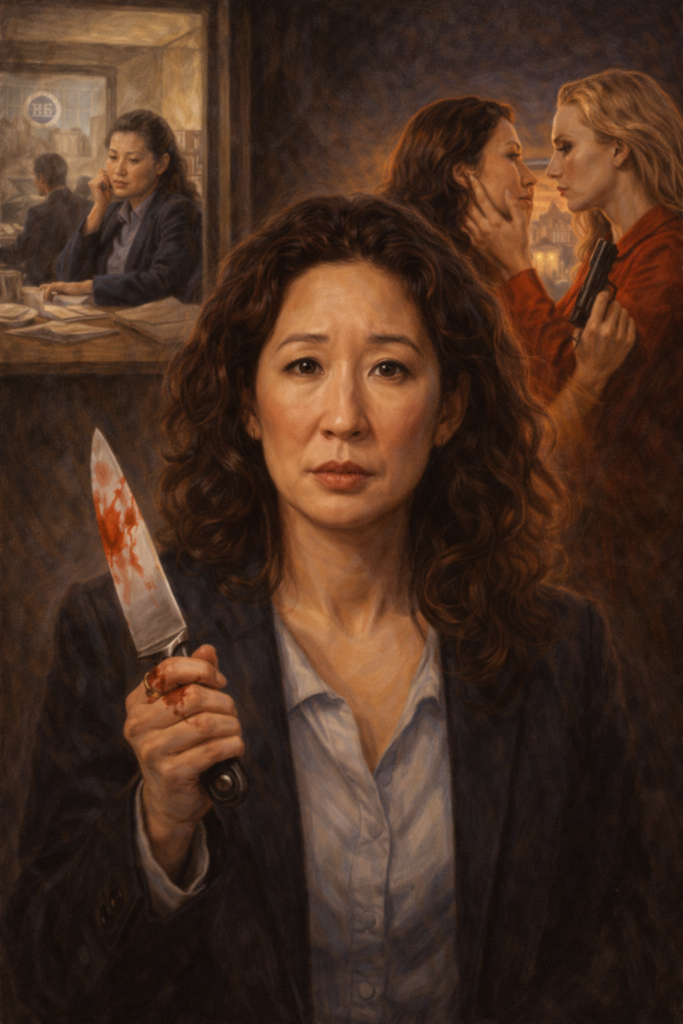

Killing Eve themes civilian to dangerous center on Eve Polastri, an apparently ordinary woman whose boredom, shadow desires, and fascination with transgression meet the perfect storm of permission: MI6 authority, Villanelle’s attention, and a narrative that slowly licenses her to become dangerous.
Key Takeaways
- Eve begins as a civilian, but the desire to be dangerous is already present.
- MI6 and Villanelle act as powerful sources of psychological permission.
- The show mirrors our own hidden fascination with risk, rule-breaking, and power.
From Civilian Fantasy To Dangerous Reality
Eve’s first appearance frames her as the last person who would chase an assassin. She is in a stable marriage, working a bureaucratic security job, complaining about sore knees and hangovers. Yet the woman who later pursues Villanelle across Europe is already there, just deeply buried.
Eve does not become dangerous from scratch; she has always wanted permission to be dangerous. Killing Eve uses her as a case study in how an apparently safe civilian can slide into risk, obsession, and violence when context, validation, and opportunity align.
The Ordinary Mask: How The Show Frames Eve As Civilian
At the beginning of the series, Eve Polastri is:
- Employed in a desk-based security role in British intelligence
- Married to Niko, a caring but slightly exasperated husband
- Socially awkward, self-deprecating, often overlooked
Her life is built around routine: office snacks, small talk, and low-stakes investigations. The mise-en-scène reinforces this ordinariness—fluorescent office lighting, sensible clothes, cluttered kitchen counters.
Yet there are cracks. Eve is late, distracted, irreverent in meetings. When a colleague mentions a female assassin, Eve lights up. The show quietly signals that this “civilian” has a taste for something sharper than policy papers and departmental briefings.
A Simple Psychological Framework For Eve’s Transformation
To understand Eve’s journey from civilian to dangerous, it helps to introduce a few psychological ideas in simple language:
- Shadow self: The parts of us we hide or deny—aggression, envy, thrill-seeking—that often appear in fantasies, dreams, or the characters we obsess over.
- Repression: Pushing uncomfortable desires or feelings out of awareness to stay acceptable and “good.”
- Moral disengagement and moral licensing: The mental tricks we use to justify crossing lines (e.g., “It’s for the greater good”), and the sense that doing something right gives us credit to do something risky.
- Thrill-seeking: The desire for intensity, novelty, and danger—sometimes psychological rather than purely physical.
- Identity experimentation: Using new roles, relationships, or contexts to try on different versions of ourselves.
Eve represses her shadow self under the mask of a responsible wife and civil servant, then gradually uses her MI6 role, her obsession with Villanelle, and the language of justice to license herself to play with danger.
Eve’s Baseline: Boredom, Restlessness, And Early Hints Of Danger
Even in early episodes, Eve’s so-called normality is restless. She jokes about assassination in a way that is too quick, too fluent. She is visibly animated by the possibility of a female killer operating with elegance and precision.
Some revealing early patterns:
- Fascination with female assassins: Eve’s interest predates Villanelle. She is already theorizing, collecting fragments, and treating the idea less as horror and more as a thrilling puzzle.
- Casual comments about violence: The way she talks about injuries, methods, and motives has an ease that surprises even her colleagues.
- Body language and micro-choices: She leans in when others pull back, lingers over crime-scene images that others glance away from, stays late chasing leads no one asked for.
These are small acts, but they signal an inner world that finds safety insufficient. The “civilian fantasy” of Killing Eve lies here: the suggestion that many of us, placed in the right story, might feel the pull of danger more strongly than we expect.
When Permission Arrives: MI6, The Case, And First Contact
Eve’s life shifts when she is drawn into the MI6 investigation. Suddenly, the system that once constrained her is inviting her to go further.
Psychologically, several permissions click into place:
- Institutional permission: Working officially on the case means she can indulge her obsession under the label of duty. Asking detailed questions about murder is now “professional.”
- Moral permission: Chasing Villanelle can be framed as justice, public safety, and national security. This makes risk feel righteous.
- Narrative permission: Eve steps into a story archetype—the dedicated investigator chasing the elusive killer. That story has room for rule-breaking and obsession.
First contact with Villanelle deepens this. Being noticed and toyed with by someone so glamorous, capable, and unrestrained sends a potent message: I see the dangerous you, and I’m interested. It is both seduction and validation.
How Eve And Villanelle Co‑Create Each Other’s Dangerousness
Killing Eve is not just about an assassin corrupting an agent. It is about two people acting as mirrors and amplifiers.
Key elements of their mutual construction:
- Villanelle teases out Eve’s shadow: Through notes, gifts, and transgressive encounters, Villanelle repeatedly invites Eve to drop the civilian act. She flirts, threatens, and jokes in ways that assume Eve is not squeamish but thrilled.
- Eve legitimizes Villanelle: By obsessing over her, praising her skill, and treating her as uniquely fascinating, Eve confirms Villanelle’s self-concept as special, almost mythic.
- Obsession as shared project: Both of them rearrange their lives to continue this dance. That is not passive corruption—it is collaborative identity-building.
Eve does not simply slide downhill; she climbs toward danger with Villanelle’s hand extended. The assassin becomes both Eve’s fantasy of freedom and her externalized shadow self.
Moral Crossings: When Eve Chooses Danger Over Safety
The shift from civilian to dangerous shows up most clearly in the moments Eve actively chooses risk, rule-breaking, or harm. These are decisions that reveal her evolving self.
Some illustrative types of crossings:
- Professional boundaries: Ignoring protocols, sidelining colleagues, and withholding information from superiors, all justified as necessary to understand or protect Villanelle—or to get closer to her.
- Personal betrayal: Lying to Niko, disappearing without explanation, and prioritizing the chase over the marriage. Danger becomes more energizing than emotional safety.
- Legal and ethical lines: Participating in operations that endanger bystanders, tampering with evidence, or pushing situations toward violence rather than away from it.
These actions reflect moral licensing (“I’m doing this to stop her”) and moral disengagement (“They knew the risks,” “This is how the game works”). Eve is not cartoonishly evil, but she learns how to talk herself into each step.
Pros And Cons Of Eve’s Transformation (Psychological Lens)
| Aspect Of Transformation | Potential Psychological “Pro” | Psychological “Con” |
|---|---|---|
| Increased risk-taking | Sense of aliveness and purpose | Higher harm to self and others |
| Owning her shadow | Greater self-honesty and complexity | Loss of previous moral anchors |
| Breaking routines | Escape from numbing boredom | Destabilized relationships and identity |
| Intense connection with Villanelle | Deep emotional and erotic charge | Dependency on a dangerous dynamic |
The same movement toward danger can feel like growth and destruction at once.
The Civilian Myth: Was Eve Ever Simply “Good” Or “Normal”?
One of the most unsettling Killing Eve themes civilian to dangerous is the dismantling of the “good civilian” myth. Eve’s journey suggests that civility often masks, rather than erases, impulses toward aggression, control, and transgression.
Signs that her goodness was always complicated:
- Her humor about violence is too practiced to be entirely new.
- Her boredom with domesticity is not gentle dissatisfaction; it carries a quiet contempt.
- Her excitement in the investigation often outweighs her distress about victims.
Instead of a good woman gone bad, we see a complex person whose dangerous streak finally has room to breathe. The show asks a provocative question: If many of us lived in safer, more ordinary contexts, would our shadow selves simply be dormant—or just waiting?
Why Viewers Feel Both Drawn To And Unnerved By Eve
Eve’s transformation is compelling because it edges so close to home. Most viewers are not assassins or spies—but many know the ache of boredom, the pull of a crush that feels wrong, or the fantasy of breaking every rule for once.
Psychologically, Eve embodies:
- Our wish to be less restrained: To speak freely, chase obsession, and prioritize desire over duty.
- Our curiosity about taboo power: What would it feel like to be feared, desired, and morally unbound like Villanelle—and, by extension, like the later versions of Eve?
- Our reliance on permission: Many of us wait for a role, a crisis, or another person to say, “It’s okay, you can be different now.”
Watching Eve can feel uncomfortable. Her choices are extreme, but the underlying emotions—boredom, longing, resentment of limits—are familiar.
A Gentle Invitation To Self‑Reflection, Not Self‑Judgment
If you found yourself rooting for Eve, or at least deeply fascinated, that does not mean you secretly want to harm people. It does mean the show touched parts of your psychology that crave intensity, power, or escape.
A few questions worth sitting with:
- Which version of Eve do you relate to more—the desk-bound civilian or the rule-breaking pursuer?
- When have you waited for some kind of permission to change your life, even in small ways?
- Which stories, characters, or ships do you return to when you want to feel alive?
Those answers are not diagnoses. They are data points about what you hunger for—adventure, autonomy, recognition, or a break from being the “good one.” Fiction gives us a space to explore that without acting it out in real life.
Eve Polastri As A Case Study In Dangerous Permission
Seen through this psychological frame, Killing Eve’s themes of civilian to dangerous are less about corruption and more about revelation.
Eve starts as a seemingly ordinary civilian whose life is defined by restraint, routine, and being responsible for others’ comfort. Underneath, she carries a hungry shadow self: fascinated by violence, drawn to transgressive women, resentful of her own smallness.
MI6 offers institutional and moral permission. Villanelle offers erotic, emotional, and narrative permission. Together, they give Eve the context and validation to step over line after line until the word “civilian” no longer fits.
What her journey ultimately reveals is not that any of us are destined to become dangerous, but that our identities are far less fixed than they appear. Under the right conditions, ordinary people can move toward extraordinary risk—especially when the story around them says they’re finally allowed to.
Killing Eve holds up a mirror and quietly asks: if you were given that kind of permission, how far would you go?
Frequently Asked Questions
How do the Killing Eve themes civilian to dangerous manifest in Eve Polastri’s psychological evolution?
Eve Polastri’s shift is driven by a long-suppressed fascination with transgression and violence. Initially bound by domestic stability, she experiences a psychological awakening when her boredom meets the extreme stakes of espionage. These themes demonstrate how her latent desires for power eventually override her “good civilian” identity and moral boundaries.
Which psychological theories explain the Killing Eve themes civilian to dangerous regarding the shadow self?
Jungian psychology suggests Eve’s “shadow self” contains repressed aggression and a craving for chaos. While maintaining a civilian facade, her preoccupation with violent women reveals an internal darkness. Once she encounters Villanelle, these latent traits are validated, causing her dangerous side to surface and replace her previously law-abiding personality.
How do MI6 and Villanelle provide permission within the Killing Eve themes civilian to dangerous?
MI6 provides institutional “moral licensing,” giving Eve the authority and resources to pursue her dark obsessions under the guise of work. Villanelle offers the personal validation and attention Eve craves. Together, they act as permission givers, dismantling Eve’s civilian inhibitions and making her dangerous transition feel both justified and inevitable.
What specific behaviors in the pilot episode foreshadow the Killing Eve themes civilian to dangerous?
Eve’s early restlessness—seen in her chronic lateness and her excitement over a female assassin’s skill—foreshadows her descent. These small acts of defiance and her specific interest in murder methods reveal a woman already primed for risk. Her civilian life is merely a fragile mask for a character seeking intensity and danger.
How does cinematography support the Killing Eve themes civilian to dangerous as Eve changes?
The series uses lighting and costume to chart Eve’s descent, moving from the flat, fluorescent brightness of MI5 offices to shadowy, European landscapes. Her wardrobe also shifts from cluttered, sensible layers to more utilitarian pieces, visually mirroring her psychological loss of civilian safety as she embraces a more primal and dangerous reality.
Further Reading & Authoritative Sources
From screenpsyhce
- Killing Eve themes — This article directly analyzes the themes of charm and chaos within ‘Killing Eve’ and Villanelle’s character, highly relevant to the ‘civilian to dangerous’ transformation.
- Eve Polastri’s dangerous bond — Explores trauma bonding, a psychological framework that explains the toxic and dangerous dynamic between civilian Eve and assassin Villanelle.
Authoritative Sources
- Consorting with Criminality: The Female Detective — Peer-reviewed feminist media analysis exploring how Eve Polastri, initially a civilian-like investigator, becomes entangled with criminality and danger, directly addressing themes of transformation from ordinary to deadly within Killing Eve.
- The Construction of Female Anti-Hero Identities: A — Academic journal article examining Eve and Villanelle as female anti-heroes, focusing on moral ambiguity and the shift from conventional, civilian femininity to violent and dangerous identities in Killing Eve.