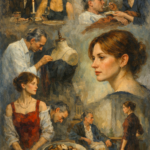

Loyalty and rage sits at the burning center of Ozark. Her devotion to family and found family collides with years of poverty, trauma, and class contempt. That clash creates a character whose anger is both shield and signal, making her one of television’s most haunting working-class portraits. (Julia Garner as Ruth Langmore, an insignificant loyalist in Ozark)
⚡ Key Takeaways
- Ruth’s loyalty is a coping strategy shaped by unstable family systems and class precarity.
- Her rage works as a survival language, boundary, and protest against systemic disrespect.
- Ruth embodies a complex working-class archetype, balancing stereotype, subversion, and deep vulnerability.
Why Ruth Langmore Still Haunts Us
Ruth lingers in our minds because she is both wound and weapon.
She is sharp, funny, profane, and constantly on edge, yet her eyes always carry that flash of hurt she cannot quite hide. Screenpsyche is returning to her now because she represents exactly what many viewers are hungry for: a messy, complex working-class woman whose pain is taken seriously, even when her choices are terrifying.
Her emotional resonance comes from this tension: Ruth is capable of brutal violence and unwavering tenderness, often in the same scene. Rather than flattening her into a one-note “tough girl,” Ozark gives us a Character Arc driven by two forces—loyalty and rage—that constantly battle for control of her life. (‘Ozark’: Why Ruth Langmore Is Such a Conflicted Character)
Ruth’s Origin: Working-Class Roots, Family Systems, And Survival Mode
Ruth does not enter the story as a blank slate. She arrives already shaped by generational poverty, a chaotic family system, and the constant grind of economic precarity.
She grows up in a world where:
- Money is scarce and unstable.
- Adults are unreliable, self-destructive, or outright dangerous.
- The state and the law appear more as threats than sources of protection.
In that environment, survival mode becomes second nature. Ruth learns early that:
- Trust is conditional and fragile.
- Affection is often tied to usefulness.
- You protect your own, even when “your own” harms you.
Psychologically, this creates a blueprint: loyalty equals safety. If she can keep her people close—by pleasing them, defending them, or fixing their mistakes—maybe she can control the chaos just enough to survive.
This is where working-class representation matters. Ozark doesn’t just give us a “rough” background as color. It anchors Ruth’s worldview in class reality: the trailers, the hustles, the low expectations placed on her intelligence. She is constantly navigating spaces where others assume she is less capable, less worthy, or less human.
Loyalty As Identity: Family, Marty, And Self-Protection
Ruth’s loyalty is not a cute character trait; it is her entire operating system.
We see three main layers of that loyalty:
Loyalty To Blood Family
Her devotion to her uncles and cousins is complicated and painful. They exploit her, betray her, and often endanger her. Yet she keeps circling back to them.
Why? Because abandoning them would mean tearing up the last roots she has. In a life with very few constants, family—even toxic family—anchors her identity. “I am a Langmore” is not just a name; it is a shield against a world that dismisses people like her.
Loyalty To Found Family (Especially Marty)
When Marty enters her orbit, he becomes an unexpected emotional anchor. He sees her competence. He trusts her with real responsibility. That kind of validation is new and intoxicating.
Her loyalty to Marty is not just about money or power. It is about the emotional resonance of being finally seen as more than “trailer trash.” At the same time, that loyalty pulls her into dangerous moral territory, where protecting him sometimes means betraying others—or herself.
The Slow Emergence Of Self-Loyalty
Across her Character Arc, there is a subtle but powerful shift: Ruth begins to ask, “What do I owe myself?”
Self-loyalty shows up when she:
- Pushes back on being used.
- Wants her own financial security and space.
- Demands respect, not just survival.
That tension—between devotion to others and the emerging need to protect herself—drives some of the most intense Narrative Catharsis in the series. Every time she chooses herself, it feels both victorious and heartbreaking, because it usually requires giving up someone she loves.
Rage As Language: Anger, Boundaries, And Survival
Ruth’s rage is iconic: the cursing, the yelling, the explosive confrontations. But underneath the profanity is a sophisticated emotional language.
For Ruth, anger is:
- A boundary: “You will not talk down to me.”
- A shield: “If I scare you first, you can’t hurt me.”
- A protest: “This entire system is built to keep people like me crushed.”
Her outbursts often come when someone:
- Underestimates her competence.
- Dismisses her pain.
- Betrays her trust or plays with her loyalty.
Seen through a trauma-informed, non-clinical lens, her rage is not random. It is a survival strategy shaped by years of being powerless. When you have few tools—no institutional leverage, no safety net—anger becomes a way to push back and reclaim a sliver of power.
At the same time, the show does not glamorize her violence. It shows the cost: the isolation, the grief, the irreversible choices. Screenpsyche’s lens invites us to hold both truths—to understand where that rage comes from, without pretending it doesn’t hurt people.
The Working-Class Archetype: Stereotype Vs. Subversion
Ruth clearly fits into an American television archetype: the tough, foul-mouthed, working-class white woman from a rural background. But Ozark complicates this familiar template.
Here’s a quick way to see where the show leans into stereotype and where it subverts it:
| Aspect | Stereotype Version | Ruth Langmore’s Version |
|---|---|---|
| Intelligence | Streetwise but not “smart” | Strategically brilliant, learns complex financial systems |
| Emotional Range | Loud, angry, one-note toughness | Deep vulnerability, tenderness, grief, and humor |
| Ambition | Wants quick cash, no long-term vision | Desires stability, ownership, a future beyond crime |
| Relationship To Authority | Purely rebellious, chaos-driven | Calculated defiance; knows when to play along or push back |
| Class Representation | Used for comic relief or moral contrast | Treated as a central moral and emotional core of the narrative |
This is where representation becomes powerful. Ruth is not a side character orbiting upper-middle-class protagonists. She is the emotional gravity of the show, forcing us to confront how class, gender, and trauma intersect.
Her working-class identity is not just an aesthetic. It shapes every choice, from whether she trusts the police to how she reads a condescending tone from someone in a nicer house.
Emotional Resonance And Narrative Catharsis
Why do so many viewers say Ruth’s scenes are the ones they remember most? Emotional resonance.
Some of the most cathartic moments come when her loyalty and rage collide in painful clarity:
- Confrontations With Marty: When she names the ways he has used her, we feel both the love behind her anger and the heartbreak of realizing she was never fully protected.
- Moments Of Grief: Her breaking-point scenes—where the mask slips and her voice cracks—deliver an intense Narrative Catharsis. We see the child underneath the armor, finally allowed to mourn.
- Small Acts Of Care: The quiet moments when she protects younger family members or offers a rare, gentle gesture remind us that her ferocity is rooted in love as much as fear.
These scenes work because they refuse to flatten her into just “the angry girl.” They let us sit with her contradictions: ruthless and loving, exhausted and relentless, terrified and brave.
As viewers, we experience a kind of shared catharsis. Her willingness to say the unsayable—about class, betrayal, and disrespect—can feel like she is voicing the anger and heartbreak many people carry silently.
Mental Health And Trauma Lens: Coping, Resilience, And Silence
Without using clinical labels, we can say this: Ruth is a trauma survivor living in a world that offers her almost no healing spaces.
Her coping strategies include:
- Hyper-independence: She rarely asks for help, because help has so often come with strings or disappointment.
- Humor And Sarcasm: Her acidic wit is a defense; if she can make you laugh, maybe you won’t look too closely at her pain.
- Control Through Competence: Learning Marty’s business, mastering the numbers, and running operations give her a sense of power she has never had.
Yet there are deep costs:
- Emotional numbness around violence.
- Difficulty trusting anyone long term.
- A constant readiness for disaster, even in relatively calm moments.
Ozark often leaves the question of healing off-screen. We don’t see therapy, support groups, or systemic interventions. That absence is its own commentary: people like Ruth are rarely offered accessible, non-judgmental mental health care.
From a Screenpsyche perspective, that gap matters. It invites us to imagine what her life could look like if she had:
- Safe spaces to process grief.
- Community support not tied to crime or obligation.
- Systems that treated her as worthy of care, not just containment.
What Ruth Langmore Teaches Us About Power, Pain, And Self-Loyalty
Ruth Langmore loyalty and rage form a map of a life lived on the edge of survival. She shows us that anger is often a story about pain, that devotion can both save and endanger us, and that working-class lives deserve nuanced, compassionate storytelling.
Her Character Arc does not offer neat closure or easy redemption. Instead, it invites us into uncomfortable but necessary questions: Who gets forgiven? Who gets written off? Who is allowed to be complicated?
If you carry Ruth with you after the final credits, you’re not alone. Many of us see parts of ourselves in her boundaries, her mistakes, and her stubborn hope for something better.
From the Screenpsyche lens, maybe the most radical lesson Ruth offers is this: self-loyalty is not about abandoning others; it is about finally including yourself in the circle of people you are willing to fight for.
And now, over to you: Which Ruth moment hit you hardest? Where did you feel seen—or challenged—by her story? Your insights are part of this ongoing conversation about representation, empathy, and the power of emotionally honest storytelling.
Frequently Asked Questions
How does generational poverty define Ruth Langmore’s sense of loyalty?
Ruth’s loyalty is a survival response to generational poverty and unstable family systems where traditional institutions offer no protection. In a world of financial insecurity, she views absolute devotion to her inner circle as her only reliable safety net. This trauma-informed loyalty prioritizes immediate group security over moral or legal systems that have historically failed her.
How does Ruth Langmore’s loyalty to Marty Byrde differ from her family ties?
Loyalty to the Langmores is driven by shared trauma, blood obligation, and the weight of the “Langmore Curse.” Conversely, her bond with Marty Byrde is built on professional recognition and merit. While her family exploits her intelligence, Marty recognizes her strategic potential, offering a path to power and respect that her own relatives repeatedly deny her.
Why does Ruth Langmore use rage as a survival tool in Ozark?
Ruth utilizes rage as a “survival language” to project strength and establish boundaries against those who underestimate her. This persistent anger serves as a psychological shield, masking deep-seated vulnerabilities. By remaining volatile, she ensures her safety in high-stakes environments where appearing soft or compliant would invite exploitation or physical harm from more powerful players.
What working-class stereotypes does Ruth Langmore subvert throughout the series?
Ruth subverts the “trailer park troublemaker” stereotype by exhibiting superior strategic intellect, financial acumen, and high emotional perception. Unlike caricatures of poverty, Ruth is given deep interiority. Her journey demonstrates how intelligence and ambition coexist with class-based trauma, proving she is a complex individual trapped by systemic circumstances rather than a simple product of her environment.
Who played Ruth Langmore and what awards did the performance win?
Julia Garner portrayed Ruth Langmore, delivering a transformative performance characterized by a distinct Missouri accent and intense emotional range. For this role, Garner won three Primetime Emmy Awards for Outstanding Supporting Actress in a Drama Series. Her portrayal is widely credited with turning Ruth into the emotional core and breakout star of the entire series.
Further Reading & Authoritative Sources
From screenpsyhce