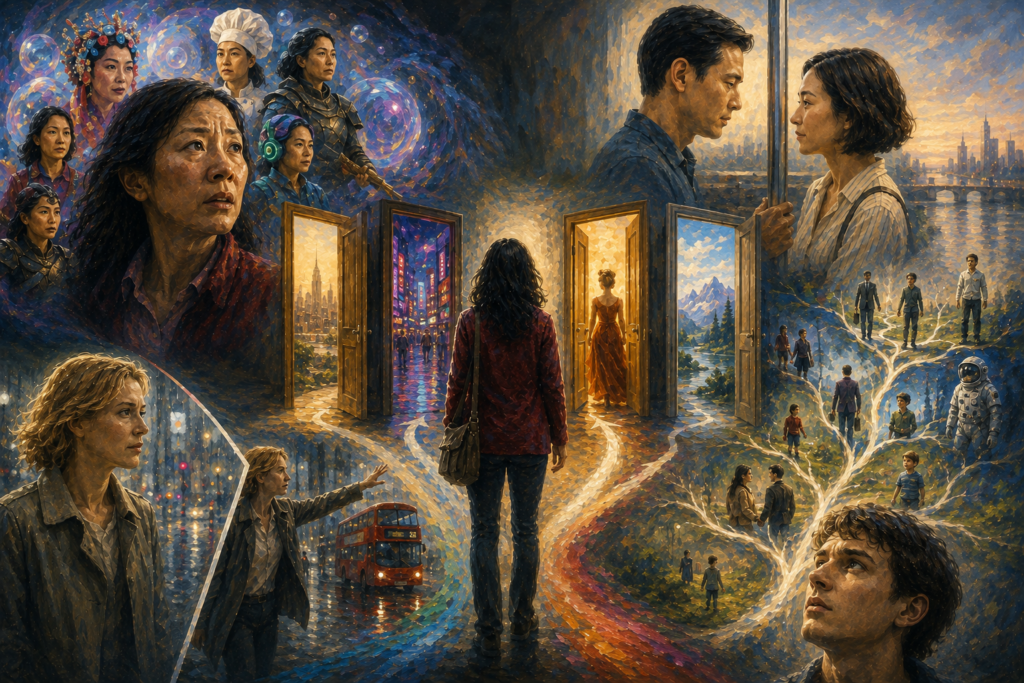

When More Choices Feel Like A Trap, Not Freedom
We grow up hearing that more options mean more freedom. More careers, more cities, more relationships, more selves to try on. Yet emotionally, it often feels like the opposite: we stand in front of too many open doors and feel frozen.
Modern cinema has become obsessed with this paradox. Films like Everything Everywhere All at Once, Past Lives, Sliding Doors, and Mr. Nobody all circle the same unsettling truth: sometimes we are not suffering from a lack of options, but from an excess of emotionally-loaded possibilities.
These stories tap into something many viewers quietly feel: life is no longer a single track but a web of “what ifs” we can see and almost touch, and that visibility can hurt.
What Is Choice Overload, Emotionally Speaking?
In psychology, choice overload describes what happens when too many options make decisions harder and less satisfying. More possibilities can mean:
- More effort to compare and evaluate
- More anxiety about making the “wrong” choice
- More regret afterward, because you can imagine better alternatives
Decision fatigue adds another layer: the more decisions we make, the more drained we become, and the more we avoid or delay choosing at all.
But the films we are looking at go deeper than supermarket-style choice overload. They show existential choice overload:
- You are not just choosing a breakfast cereal; you are choosing a self.
- Every option you do not take becomes a haunting ghost life.
- The question shifts from “Which is better?” to “Who am I if I choose this and not that?”
That is where characters like Evelyn, Nora, and the protagonists of Sliding Doors and Mr. Nobody live: in the emotional storm where every path not taken feels like a verdict on who they are allowed to be.
Evelyn And Infinite Selves In Everything Everywhere All At Once
In Everything Everywhere All at Once, Evelyn is thrown into a multiverse where she can experience every version of the life she could have lived. She sees herself as a movie star, a kung fu master, a chef, and countless other selves.
Her problem is not a lack of opportunity. If anything, she has too much. Her multiverse powers literally depend on her unrealized potential. Every path she did not walk becomes a skill, a power, a fully fleshed-out version of who she might have been.
The psychological wound is sharp:
- Every unrealized possibility reminds her of what she is not.
- Each alternate Evelyn becomes a mirror, reflecting her perceived failure.
- Choice stops being practical and becomes existential.
In this way, the film externalizes a familiar feeling: standing in a messy laundromat life while your mind runs a highlight reel of every glamorous road you did not take. Choice overload here is about identity fragmentation—Evelyn is pulled apart by the pressure of so many possible selves.
Evelyn’s healing comes not from finding the “best” universe, but from committing to her own small, imperfect life with Waymond and Joy. The film quietly suggests: Everything Everywhere All at Once Is a New Kind of Multiverse Movie
Freedom is not having all universes open; it is saying, “Out of all the selves I could be, I am choosing this one, with love.”
Past Lives And The Gravity Of One Unchosen Life
If Everything Everywhere is a storm of infinite options, Past Lives is a single, steady ache.
Here, Nora is not overwhelmed by dozens of choices. Instead, she is haunted by one meaningful alternative—the life she might have lived with Hae Sung. This is not an explosion of possibilities; it is a slow, quiet pull toward a path she did not walk.
The film shows how one unchosen path can occupy as much psychological space as a thousand available ones. Nora has, in many ways, already chosen: she lives in New York, married, pursuing her work. Yet the emotional significance of her childhood connection with Hae Sung stretches across oceans and years.
Unlike Evelyn, Nora’s mind is not jumping across timelines. It is circling one specific “what if.” The emotional logic looks like this:
- This one relationship embodies a different version of her identity (language, culture, history).
- Letting it go feels like letting go of a whole self.
- The question is less “Which life is better?” and more “Which self is truly mine?”
Here we see a crucial insight: choice overload is not always about quantity; it is about emotional significance. One door you did not walk through can feel as heavy as a hallway of infinite doors.
Nora’s acceptance carries a quiet, cathartic power. She does not “solve” her life by rewinding or magically combining both paths. Instead, she grieves the unlived life and still stays with the one she chose. The film honors the pain of that loss without undoing it.
Sliding Doors, Mr. Nobody, And The Architecture Of “What If”
Sliding Doors and Mr. Nobody visualize parallel lives and branching timelines, turning inner rumination into visible narrative.
- In Sliding Doors, a single missed train splits the story into two parallel versions of Helen’s life. The film shows how tiny contingencies reshape relationships, careers, and even survival.
- In Mr. Nobody, we follow Nemo across sprawling alternate timelines, each branching from different childhood choices. The structure is almost labyrinthine, mirroring the overwhelming feeling of standing before every possible future at once.
Both films embody choice overload as narrative structure:
- Parallel timelines act like on-screen intrusive thoughts: “If I had done X instead of Y…”
- The audience is invited to compare lives, silently scoring which version seems “better.”
- The characters become unstuck in time, and identity feels contingent rather than stable.
We, too, replay and re-edit our own stories, imagining alternate cuts where we stayed, left, confessed, or stayed silent. These films just make the editing visible.
How These Stories Mirror Real Psychological Patterns
These films might seem fantastical, but they echo everyday psychological patterns many of us know: regret, fear of missing out, rumination, and the inability to commit.
Here is how they line up:
| Film / Character | Form Of Choice Overload | Real-Life Parallel |
|---|---|---|
| Everything Everywhere – Evelyn | Infinite alternate selves and lives across the multiverse | Comparing every possible career, lifestyle, identity |
| Past Lives – Nora | One powerful, emotionally-charged unchosen relationship | “The one that got away” haunting current commitments |
| Sliding Doors – Helen | Two parallel lives from one tiny everyday decision | Obsessing over “If I had only done that one thing…” |
| Mr. Nobody – Nemo | Many timelines branching from early life choices | Feeling paralyzed by big life decisions (school, love) |
The core psychological themes include:
- Regret and rumination: mentally replaying choices and imagining alternative outcomes.
- FOMO (fear of missing out): feeling that any choice closes off better possibilities.
- Maximizing vs. satisficing: the pressure to find the “perfect” option instead of a “good enough” one that fits our real life.
Modern culture intensifies this. We scroll through other people’s locations, careers, relationships, aesthetics—endless alternative selves. The narrative of infinite potential quietly whispers: “You could be anything. So if you are not everything, maybe you are failing.”
These films do something powerful in response: they externalize that pressure, let us sit with it, and then gently point toward a different way of thinking about freedom.
Is Freedom About Open Doors Or Courageous Commitment?
Modern culture teaches that more options mean more freedom. But psychology—and these films—suggest something subtler: freedom also requires limitation.
Evelyn’s journey hints that too many universes can become a prison of self-comparison. Nora shows us that even a single unchosen path can hold us hostage if we cannot accept its loss. Helen and Nemo demonstrate how living in mental parallel timelines keeps us from inhabiting the only timeline we can actually touch: the present.
So what if freedom is not measured by how many doors are open, but by:
- Our ability to choose one door in alignment with our values
- Our willingness to accept that every choice involves real loss
- Our courage to stop constantly looking back at the hallway
Meaningful lives are built by choosing one path, accepting the loss of others, and not endlessly rehearsing unlived lives. That is not settling; it is an act of emotional bravery.
Walking Through One Door
Across Everything Everywhere All at Once, Past Lives, Sliding Doors, and Mr. Nobody, a question quietly echoes: Is freedom about having every door open, or about walking through one without constantly looking back?
Evelyn’s infinite universes show how overwhelming limitless potential can be. Nora’s singular, haunting alternative life proves that even one unchosen path can fill our inner world. Helen and Nemo remind us how easily we become spectators of our own hypothetical timelines instead of participants in our real one.
The psychology of choice overload suggests a different formula: freedom emerges when we dare to commit, accept our losses, and live fully inside the life we actually have.
If you feel yourself pulled between unlived lives and the one in front of you, you are exactly the kind of viewer these stories are speaking to. And if you would like to keep exploring how film can help you navigate choice, regret, and emotional closure, you can gently get started with screenpsyche for more cinematic-psychology insights.
Frequently Asked Questions
What is the relationship between the multiverse trope and choice overload?
The multiverse trope acts as a narrative vessel for choice overload, externalizing the internal struggle of decision-making. By depicting infinite versions of a protagonist, films visualize the “tyranny of choice.” This allows audiences to confront the anxiety of potentiality, showing that having every option available can be more paralyzing than having none at all.
How do movies like Everything Everywhere All at Once illustrate decision fatigue?
These films illustrate decision fatigue by using the “multiverse” as a metaphor for the modern digital experience. By showing a character overwhelmed by the skills and lives of alternate selves, cinema mirrors the real-world exhaustion of constantly comparing one’s current reality to an infinite array of potentially better, yet ultimately unchosen, paths and possibilities.
What is the difference between “maximizing” and “satisficing” in the context of choice?
Maximizers seek the absolute best possible option by weighing every variable, which often leads to regret and choice overload. Satisficers look for an option that meets their threshold of “good enough.” Cinematic narratives often transition characters from maximizing—trying to live every life—to satisficing, where they finally find peace in one imperfect, concrete reality.
Why do “ghost lives” in films like Past Lives create emotional choice overload?
Ghost lives are the vivid, unlived paths that haunt a character’s present. In films like Past Lives, choice overload stems from the emotional weight of a single, significant “what if” rather than infinite options. This specific longing creates a heavy psychological burden, making the character feel that their current, lived reality is somehow incomplete or secondary.
How can watching alternate timeline stories help reduce real-life choice anxiety?
These stories reduce anxiety by modeling the acceptance of loss and the beauty of commitment. By witnessing characters grieve their unchosen lives and eventually embrace their current path, viewers learn that limitations provide meaning. This narrative arc encourages “commitment-based freedom,” where satisfaction comes from the depth of one choice rather than the breadth of options.
Further Reading & Authoritative Sources
From screenpsyhce