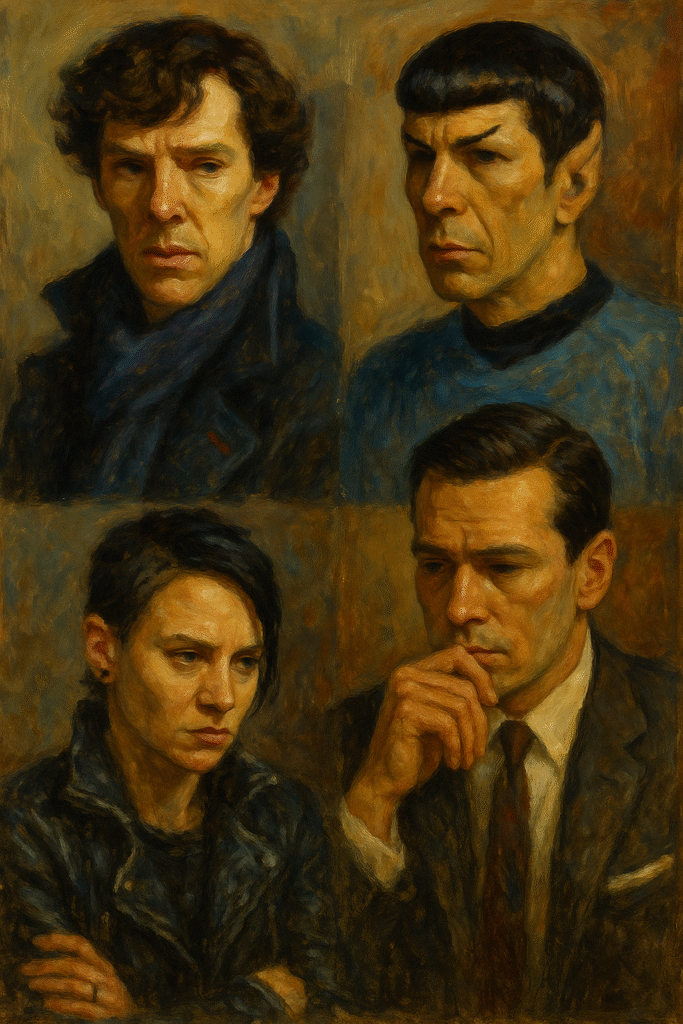

From Sherlock’s clinical logic to Don Draper’s ritualized distraction, alexithymia appears again and again in film and TV. This practical guide explains alexithymia, surveys on-screen portrayals, and gives craft-forward, ethical techniques for writers who want believable characters who can’t name what they feel.
What is alexithymia? A clinical primer for writers
Alexithymia is a personality construct marked by difficulty identifying feelings, difficulty describing feelings to others, limited imaginative capacity, and an externally oriented thinking style. In short: the person feels bodily shifts but often cannot label them with an emotion word. Understanding this helps you show, not tell.
Writers should know alexithymia is dimensional (a trait that varies in degree), not categorical like a binary diagnosis. People with high levels of alexithymia still feel; they experience sensations and needs but lack the easily accessible vocabulary or cognitive scaffolding to map those sensations to discrete emotional labels. This produces characteristic patterns of behavior—avoidance of metaphor, concrete speech, a reliance on routines—that are fertile territory for nuanced characterization.
Historical context: where the concept came from
The term alexithymia was introduced in the 1970s by psychiatrists Peter Sifneos and John Nemiah to describe psychosomatic patients who had trouble verbalizing feelings. Early clinical observations linked the phenomenon to difficulties in psychosomatic medicine, but the idea has since broadened into personality and affective neuroscience research. Over the decades, researchers moved from case-series observations to validated self-report tools (like the TAS-20) and neuroimaging studies that explore interoceptive and limbic processing differences. For writers, this history matters because it roots alexithymia in both clinical observation and ongoing science rather than a pop-psych label.
Core features and LSI terms
- Difficulty identifying feelings / difficulty identifying emotions
- Difficulty describing feelings / externally oriented thinking
- Limited imaginal capacity and reduced use of metaphor
- Emotional awareness disorder (related LSI)
Transition: before you write a scene, read this short checklist so your portrayal avoids clichés.
Alexithymia symptoms writers should show (not state)
When you depict alexithymia, focus on observable behavior and interoception rather than naming. Show these alexithymia symptoms:
- Precision of language about facts but vagueness about inner life (“I’m fine” or “It’s okay”).
- Confusing bodily sensations for emotional labels (“My stomach’s been off” when actually anxious).
- Rituals and routines that regulate affect (repeating actions to settle a body-state).
- Sparse metaphor and little daydreaming.
Use transitions like “for example” and “in contrast” to guide readers through comparisons.
Expanded examples:
- In a dinner scene, an alexithymic character may describe the food’s temperature, the timing of the courses, or the other person’s breath patterns rather than explaining why they feel awkward. The camera lingers on small, regulatory gestures—stroking a napkin, refilling a glass—with little explicit talk about feelings.
- During a breakup, instead of saying “I’m devastated,” the character might report a headache or focus on choosing which items to keep from a shared apartment. That physical anchoring signals internal turmoil without naming it.
Alexithymia test and assessment: what writers should know
The Toronto Alexithymia Scale (TAS-20) is the most used alexithymia assessment questionnaire in research and helps map the trait’s facets. While you should not diagnose fictional people, the TAS-20 can inform believable behaviors and dialogue (e.g., items probing difficulty identifying feelings or externally oriented thinking).
Practical tip: read the TAS-20 items and translate them into beats. If an item asks whether someone has trouble distinguishing “anger from sadness,” write a scene in which the character misreads physiological cues and treats both as a stomach ache or tension.
Authoritative sources (for research and sensitivity checks): see PubMed reviews and major mental-health organization guidance when researching (external links in this article’s resources).
Portrayal of alexithymia in film and TV: common tropes and pitfalls
Portrayals of alexithymia in film and TV often fall into misleading patterns. Avoid these traps:
- The “Cold Genius” (intelligence + no feelings) — flattens character and confuses alexithymia with immorality.
- The “Sociopath Shortcut” — using emotional-naming difficulty as shorthand for villainy.
- The “Instant Cure” — a single scene, lover, or breakthrough that magically teaches emotion labeling.
Instead, aim for nuance: slow change, sensory detail, and behaviors that reveal rather than explain.
Comparative analysis: alexithymia vs. archetypal tropes
- Unlike the silent antihero who simply chooses not to speak, an alexithymic character cannot easily map sensation to language. This distinction changes the arc: the story may follow learning or scaffolding rather than moral conversion.
- Versus the emotionally stoic villain, an alexithymic protagonist can be sympathetic because their challenge is recognizable and remediable rather than inexplicable cruelty.
TV characters with alexithymia: 4 case studies (not diagnoses)
Note: do not clinically diagnose fictional characters. Below are narrative analyses of traits consistent with alexithymia.
Sherlock Holmes (BBC’s Sherlock) — externally oriented thinking on screen
Selected trait: treats feeling like data, often unable to name or narrate internal states directly. Writers use clinical phrasing, observational camera work, and pointed silences to signal alexithymic-like processing.
Expanded example: in scenes where Sherlock misses social cues, the script substitutes forensic description for emotion. He recounts heart rate, temperature, and breathing patterns when others seek reassurance. This substitution—naming physiology instead of affect—gives the audience a way to understand his internal experience without him employing emotional language.
Takeaway: a character can care deeply but still lack the vocabulary to express it.
Spock (Star Trek) — suppression vs. naming difficulty
Selected trait: cultural suppression (Vulcan discipline) contrasts with visible internal conflict. This highlights the difference between learned suppression and inherent difficulty identifying feelings.
Expanded example: Spock’s choices often look like deliberate suppression, but scenes that show him alone or in crisis reveal a mismatch between physiological signs and expressed affect. Where suppression implies a choice to hide, alexithymia implies an absence of mapping between sensation and label.
Takeaway: clarify whether a character suppresses feelings or genuinely cannot label them.
Lisbeth Salander (The Girl with the Dragon Tattoo) — action over affect
Selected trait: blunt literalism, minimal metaphor, and internal logic shown through routines and sensory details rather than named emotions.
Expanded example: Lisbeth’s reactions are procedural—she fixes a computer, cleans a wound, checks locks—actions that regulate arousal. Her sparing speech and concrete thinking create an aura of control, while interoceptive cues (restlessness, sleeplessness) indicate unresolved affect.
Takeaway: action and sensory focus can convey depth when words fail.
Don Draper (Mad Men) — secondary alexithymia after trauma
Selected trait: ritual, storytelling, and substitution manage unnamed affect. His case models how trauma can produce alexithymia-like defenses.
Expanded example: Draper frequently uses advertising language to externalize feeling: he crafts metaphors for others but avoids naming his own. Scenes where he repeats routines—sliding a cigarette from the pack, adjusting a tie—function as affective stimming and show how ritual replaces emotional vocabulary.
Takeaway: backstory can justify naming difficulty without simplifying the character.
How to write an alexithymic character: craft techniques (how to write an alexithymic character)
- Show, don’t tell. Use micro-actions: a finger tracing the rim of a glass, a breath held too long, a repeated route home.
- Use interoceptive detail rather than emotion labels. Describe a hollow throat, a clench in the abdomen, or a pressure behind the sternum.
- Point of view: limited third-person or constrained first-person with free indirect style lets the audience infer emotion from sensation and action.
- Dialogue and silence: let other characters try to name emotions. Use silence, factual rebuttals, or pragmatic redirects as meaningful responses.
- Avoid cures. If your character grows, show incremental skill-building (therapy, learning labels, cultivation of metaphor) rather than an overnight transformation.
- Writing prompts: Draft two versions of a scene where the character receives surprising good news: one that names the emotion and one that uses only body, action, and sensory detail. Compare which feels truer.
Step-by-step guide for a scene rewrite (practical application)
- Step 1: Identify the emotional beat you want the audience to sense (e.g., shame, longing, pride).
- Step 2: List three bodily correlates of that emotion (tight chest, warm face, slowed breath).
- Step 3: Replace any explicit emotion words in the scene with sensory and action beats tied to those correlates.
- Step 4: Add a routine or ritual the character uses to regulate (e.g., making tea, checking a watch).
- Step 5: Insert another character who attempts to label the feeling and is gently rebuffed or misinterpreted; this creates dramatic friction without medicalizing.
Expert insight (practical): clinicians who work with alexithymic traits emphasize scaffolded labeling—introducing a small, concrete emotional word paired with a bodily sensation. On screen, the first successful label might be a minor victory: the character says “nervous” instead of nothing, and a beat later recognizes the associated breath pattern.
Practical applications for actors and directors
- Directors can use close-ups of hands and throat, sound design emphasizing heartbeat or breathing, and editing rhythms that mimic a character’s internal tempo.
- Actors should work with interoceptive coaching—tracking breath, jaw tension, and posture—so emotional truth is expressed physically rather than rhetorically.
Portraying related themes: alexithymia vs autism vs suppression
- Alexithymia is distinct from autism (though co-occurrence exists) and distinct from intentional emotional suppression. Use accurate LSI phrases: “alexithymia vs autism in characters” and “difficulty identifying feelings” when planning scenes.
Comparative nuance:
- Autism involves differences in social communication and sensory processing; alexithymia specifically involves the labeling and identification of affect. A character may show both sets of traits, but each requires different narrative treatment.
- Suppression is often motivated (a character decides to hide feelings); alexithymia is an experiential gap. Showing the difference matters for stakes: suppression is about consequence, alexithymia is about awareness.
Ethical considerations and sensitivity (portraying alexithymia without stereotyping)
- Use non-stigmatizing language: prefer “difficulty identifying feelings” or “traits consistent with alexithymia”.
- Avoid equating alexithymic traits with immorality or danger.
- Add content warnings if portraying trauma or self-harm and consult lived-experience sources.
Sensitivity checklist for writers
- Seek input from people with lived experience and from clinicians when depicting therapy scenes.
- Avoid making alexithymia a plot device that excuses abuse or criminality.
- Show diversity: alexithymia exists across genders, cultures, and ages; don’t confine it to a narrow stereotype.
Resources and further reading for creative research
- Look up TAS-20 validation papers and reviews on PubMed for clinical grounding.
- Consult mental-health organizations and clinical experts when developing trauma-linked backstories.
- Seek first-person accounts and interviews to understand the felt experience of alexithymia; these lived-experience perspectives often highlight small, repeatable behaviors that make good scene material.
Conclusion: make characters human, not cartoons
Alexithymia is a rich narrative resource when used responsibly. By focusing on sensory details, behavior, POV, and slow character work, you can write unforgettable characters who can’t name what they feel — and do so without stereotyping.
FAQ (short answers)
- What is alexithymia in simple terms?
Difficulty identifying and describing emotions; more about labeling than absence of feeling. - Can I diagnose a fictional character with alexithymia?
No. Describe patterns consistent with alexithymia and avoid clinical labeling in fiction criticism. - How do I show alexithymia on screen?
Use actions, bodily sensations, ritual, silence, and concrete sensory details rather than explicit emotional language. - Useful search terms for further reading?
“alexithymia symptoms”, “alexithymia test”, “Toronto Alexithymia Scale (TAS-20)”, and “portrayal of alexithymia in film and TV”.
Additional FAQs (practical concerns)
- Q: Can alexithymia be treated or changed?
A: Many clinicians view alexithymia as malleable; treatments focus on interoceptive awareness training, emotion labeling practice, and trauma-informed therapy. On screen, show gradual gains rather than instant cures. - Q: How do I keep an alexithymic character sympathetic?
A: Give them competence in other domains, clear values, and small, recognizable moments of care. Make their struggle intelligible—show what they do to cope and the costs of those strategies. - Q: Is alexithymia the same as being unromantic or unemotional?
A: No. Alexithymia affects labeling and expression but not the capacity to experience attachment, love, or grief. Portray the inner life through behavior and ritual. - Q: Should I consult experts when writing therapy scenes?
A: Yes. Therapists can advise on realistic timelines and techniques (e.g., grounding, labeling, DBT-informed skills) so your depiction respects therapeutic boundaries. - Q: Where can I find firsthand accounts?
A: Look for blogs, interviews, and forums where people discuss living with difficulty identifying feelings. These narratives are invaluable for capturing small, reliable behavioral markers.