Skip to content
screenpsyche.com
  • Home
  • Categories
    • Film Character Analysis
    • TV Character Analysis
    • Psychological Concepts via Characters
  • About Us
Subscribe

Posts by Screen Psyche

  • Home
  • Screen Psyche
  • Page 4
About Screen Psyche
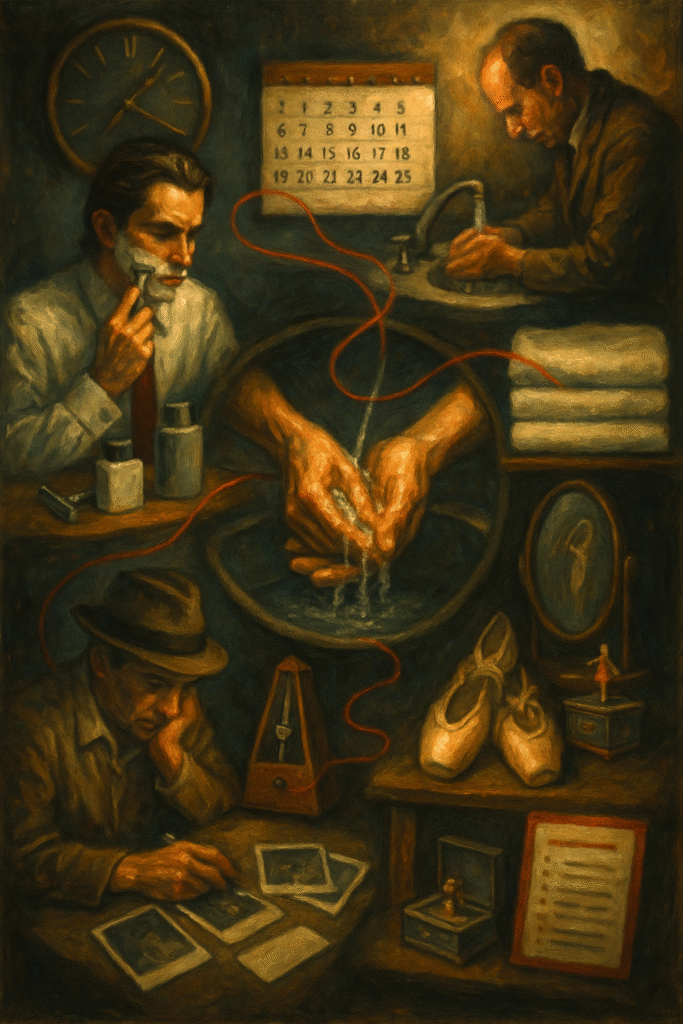
Oil painting of a person executing meticulous morning rituals—aligned toiletries, folded towels, ticking clock—symbolizing control addiction and anxiety relief.
Posted inPsychological Concepts via Characters

Control Addiction: How Routines Act as an Anxiety Sedative

Content warning & spoiler notice This article discusses anxiety, compulsive routines, and may describe scenes from films and TV shows that include disturbing or triggering material. Spoilers for the works…
Posted by Screen Psyche November 26, 2025
Oil painting of a love triangle: three figures in tense dialogue, red thread, chess pieces, phones, envelope, hourglass, mirror shards, dove.
Posted inPsychological Concepts via Characters

Triangulation: Love as a Three-Sided Battlefield

Spoiler warning: This article contains a deep love triangle analysis with TV characters and film scenes to explain triangulation as a relationship dynamic. I avoid diagnosing real people; scenes are…
Posted by Screen Psyche November 24, 2025
Vertical oil painting of Lucifer Morningstar at Lux, silhouetted shadow-wings behind him, cracked mirror and therapy chair symbols—ego, punishment, and identity.
Posted inTV Character Analysis

Lucifer Morningstar; Ego and Identity

Spoiler warning: This article contains moderate-to-heavy spoilers for the TV series Lucifer. If you prefer a spoiler-free read, skip sections labeled "SPOILERS". The Public Persona and Defensive Armor Lucifer Morningstar's ego…
Posted by Screen Psyche November 22, 2025
Oil-painted blue tableau echoing Julie’s grief, detachment, and quiet rebirth in Kieślowski’s Three Colors: Blue.
Posted inFilm Character Analysis

Three Colors: Blue – Freedom, Detachment, Rebirth

Spoiler notice: This essay contains measured spoilers for Krzysztof Kieślowski’s Three Colors: Blue (1993). Key plot developments and scene details are discussed to support a close reading of Julie’s emotional journey. If you…
Posted by Screen Psyche November 20, 2025
Oil painting of a man moving between four rooms, each symbolizing separate lives and roles, visualizing psychological compartmentalization.
Posted inPsychological Concepts via Characters

A Practical Guide to Compartmentalization

He walks into a conference room, pitches a campaign with an easy smile, then later sits alone in a dim apartment, peeling an orange and thinking of the boy he…
Posted by Screen Psyche November 18, 2025
Claire Underwood–like figure in black dress, seated in an armchair, calm and poised, embodying controlled silence and authority.
Posted inTV Character Analysis

Claire Underwood (House of Cards): Control, Silence, and the Power of Stillness

Claire Underwood remains one of television’s most quietly magnetic figures. In a genre built on rhetoric and spectacle, her restraint feels radical. This Claire Underwood character analysis shows that her…
Posted by Screen Psyche November 16, 2025
Jesse Pinkman drives a bright El Camino through sunlit desert highway, dust trailing, hinting at fragile freedom and possible redemption.
Posted inFilm Character Analysis

Does Jesse find redemption in El Camino?

Spoiler warning: This analysis discusses major plot points in Breaking Bad and El Camino to examine Jesse Pinkman's psychological arc and the film's final moments. Quick answer: Does Jesse find…
Posted by Screen Psyche November 14, 2025
Oil portraits of Sherlock, Spock, Lisbeth, and Don Draper, each tense and inward—icons of characters who can’t name what they feel.
Posted inPsychological Concepts via Characters

Alexithymia on Screen: Characters Who Can’t Name What They Feel

From Sherlock's clinical logic to Don Draper's ritualized distraction, alexithymia appears again and again in film and TV. This practical guide explains alexithymia, surveys on-screen portrayals, and gives craft-forward, ethical…
Posted by Screen Psyche November 12, 2025
Catherine de’ Medici sits on a throne in black gown holding an infant, palace window behind—royal motherhood as political power.
Posted inTV Character Analysis

Psychology of Political Motherhood: Catherine de’ Medici in The Serpent Queen

Introduction Catherine de' Medici remains one of history's most debated figures. In this piece we examine the psychology of political motherhood as depicted in the Starz series The Serpent Queen, and…
Posted by Screen Psyche November 11, 2025
Ennis Del Mar stands by his small trailer holding Jack’s shirt, distant mountain under soft sky—quiet grief and suppressed identity.
Posted inFilm Character Analysis

Ennis Del Mar: Suppressed Identity and the Tragedy of Restraint

Spoiler warning: This article discusses Annie Proulx’s short story "Brokeback Mountain" and Ang Lee’s 2005 film adaptation, including Jack Twist’s death and Ennis’s final choices. Ennis Del Mar suppressed identity…
Posted by Screen Psyche November 10, 2025

Posts pagination

Previous page 1 2 3 4 5 6 … 22 Next page

Recent Posts

  • Silent Power: Alma Elson Phantom Thread Analysis
  • Addictive Nostalgia: Why We Keep Returning to Perfect Memories
  • Dexter: Control, Morality, and the Myth of the “Good Monster”
  • Barton Fink: Creative Paralysis And The Pressure To Produce
  • Catastrophizing in Relationships: Is Your Mind the Villain?

Recent Comments

  1. Wearing The Mask: Study Of The False Self - screenpsyche.com on Identity and Reality in ‘The Truman Show’
  2. Killing Eve Themes: From Civilian To Dangerous - screenpsyche.com on The Trauma Bond: Why Characters Stay in Toxic Relationships
  3. Killing Eve Themes: From Civilian To Dangerous - screenpsyche.com on Charm and Chaos in Killing Eve: A Deep Dive into Villanelle
  4. Parasocial Attachment: Loving a Person Who Doesn’t Know You on The Double Life of Severus Snape: Love, Bitterness, and Redemption in Harry Potter
  5. Kendall on Peggy Olson in Mad Men: A Symbol of Feminism and Ambition

Archives

  • April 2026
  • March 2026
  • February 2026
  • January 2026
  • December 2025
  • November 2025
  • October 2025
  • September 2025
  • August 2025
  • July 2025

Categories

  • Film Character Analysis
  • Psychological Concepts via Characters
  • TV Character Analysis
Search
Categories
  • Film Character Analysis
  • Psychological Concepts via Characters
  • TV Character Analysis
Archives
  • April 2026
  • March 2026
  • February 2026
  • January 2026
  • December 2025
  • November 2025
  • October 2025
  • September 2025
  • August 2025
  • July 2025
Copyright 2026 — screenpsyche.com. All rights reserved. Bloghash WordPress Theme
Scroll to Top