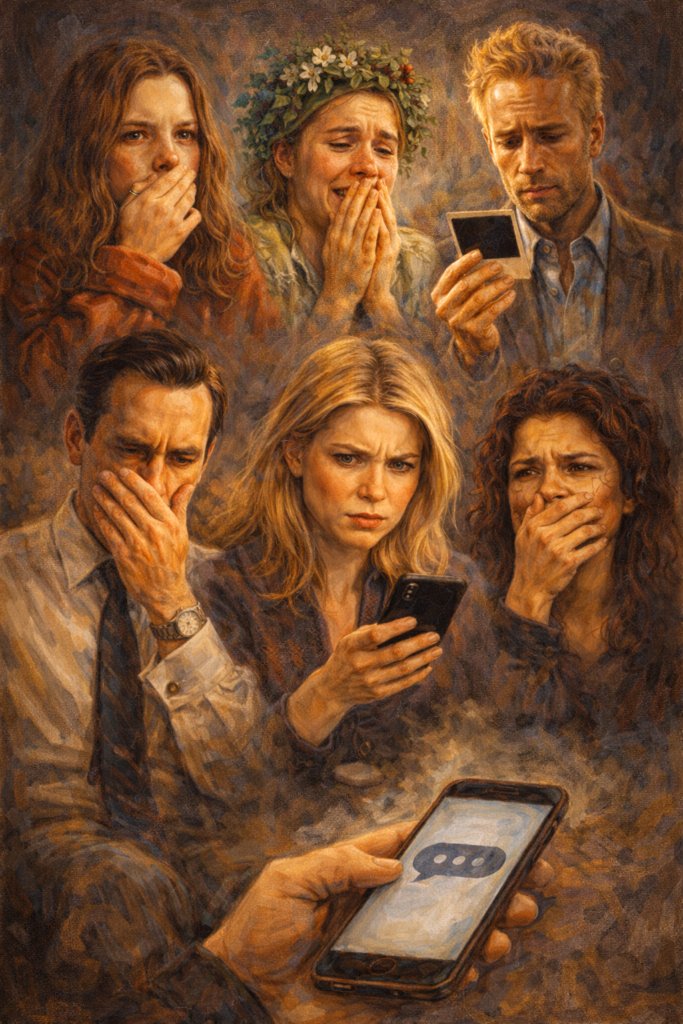

Catastrophizing in relationships is a thinking pattern where our minds leap to worst‑case scenarios, especially around love, loyalty, and safety. Over time, those fears can start to shape our choices, turning imagined disasters into real emotional distance, conflict, and self‑sabotage. (Relationship Catastrophizing: Emotional Distortions and Communication)
- Catastrophizing is a mental spiral that turns anxious forecasts into felt reality.
- Film and TV characters mirror our worst‑case love stories, making our patterns visible.
- Recognizing the spiral is a powerful first step toward gentler, more grounded relationships.
The Spiral That Creates Its Own Disaster
If you have ever texted someone you care about, watched the typing dots vanish, and instantly imagined they hate you now—you already know the flavor of catastrophizing. The Realism of Carrie Mathison’s Bipolar Disorder on Homeland
It is the inner narrator that whispers, “If something can go wrong, it absolutely will—and it will destroy everything.” In relationships, that looks like:
- “They did not respond. The relationship is over.”
- “I messed up once. I will always ruin everything.”
- “If I show how I feel, I will be abandoned.”
On screen, this spiral becomes incredibly vivid. Characters like Charlie, Dani Ardor, Leonard Shelby, Don Draper, Carrie Mathison, and Rue Bennett don’t just think catastrophe—they live inside it. Screenwriters turn their anxious inner worlds into full-blown plots, and that is where Screenpsyche loves to live: at the intersection of story, psyche, and emotional resonance.
Welcome in. Let us walk into the spiral together—not to scare ourselves—but to understand it so we can soften it, on screen and in our own relationships.
What Catastrophizing Really Is
In simple terms, catastrophizing is a cognitive pattern where the mind:
- Overestimates threat – Expecting the worst possible outcome.
- Underestimates coping – Assuming we will not be able to handle it.
- Loops the forecast – Replaying the imagined disaster until it feels true.
In relationships, this becomes a self-fulfilling loop:
- You imagine your partner, friend, or family member pulling away.
- Your body reacts as if that is already happening—anxiety, panic, withdrawal, overpleasing.
- Your behavior changes: you test them, cling, retreat, or attack.
- The relationship actually becomes strained, which looks like “proof” your fear was right.
The key thing: the catastrophe often starts in the mind, but our reactions give it real-world weight.
The Spiral In Storytelling And Character Arcs
Why do writers love catastrophizing so much?
Because it builds:
- Tension – The character’s inner alarm system keeps us on edge.
- Relatability – Many of us recognize our own anxious thoughts in exaggerated cinematic form.
- Archetypal energy – Catastrophizing fuels archetypes like the tragic spiral, the anxious hero, the self-saboteur.
Audiences keep watching to see if the disaster in the character’s head becomes real—or if they find a way out.
Character Spotlights: Six Spirals, One Pattern
Charlie: When Guilt Turns Every Choice Into Doom (Hereditary)
Charlie lives inside a family soaked in unspoken terror. While Hereditary is supernatural horror, Charlie’s world is also an emotional horror story about belonging and guilt.
Her inner logic seems to be: “If something goes wrong, it will be my fault.” That catastrophizing shapes her relationships:
- She clings to her mother in a way that says, “Without you, I am unsafe.”
- She reads social situations (like the party) as hostile, amplifying isolation.
- Her mere presence feels like a curse—to her and to others.
The film externalizes this spiral: what Charlie fears (that she is a walking disaster) is mirrored in the literal disasters around her. Her arc shows how a child can internalize family chaos and imagine themselves as the core problem.
Dani Ardor: The Breakup Spiral That Becomes A Cult (Midsommar)
Dani’s story begins with unimaginable tragedy, but her relationship with Christian is where catastrophizing in relationships really lights up.
Her thoughts echo:
- “If I ask for what I need, he will leave.”
- “If I don’t hold on, I will have nothing.”
Because she expects abandonment:
- She shrinks her needs and over-apologizes.
- She scans every interaction for signs that Christian is already halfway out.
- She tolerates emotional neglect because losing him feels like the ultimate catastrophe.
In a haunting twist, the film turns Dani’s inner catastrophes into ritual and spectacle. Her worst fear—being utterly alone in her grief—pushes her toward a community that “never leaves.” The folk horror genre amplifies what happens when catastrophizing meets a desperate desire for belonging.
Leonard Shelby: Catastrophizing As A Narrative Puzzle (Memento)
Leonard’s memory loss shapes his reality, but there is also a familiar cognitive pattern underneath: a refusal to tolerate not knowing.
His catastrophic thinking sounds like:
- “If I don’t find the person who hurt us, my life has no meaning.”
- “If I am confused, I am in danger.”
That fear of uncertainty drives him to:
- See every gap in memory as a threat to be eliminated.
- Trust his own written “truths” over any new nuance or emotional connection.
- Turn people around him into tools in his mission, not full humans with complex motives.
Each new clue should bring closure, but really just deepens his entrapment. Leonard’s spiral shows how clinging to one catastrophic story about the past can block other paths to healing or connection.
Don Draper: The Self-Saboteur in a Suit (Mad Men)
Prestige drama gives us room to linger inside subtle catastrophizing in relationships.
Don’s core belief might be read as:
- “If anyone sees the real me, they will reject me.”
From that single catastrophic thought flow so many of his choices:
- He cheats before he can be left.
- He numbs with work, alcohol, and affairs instead of risking vulnerability.
- When someone loves him, he subtly or overtly pushes them away, then mourns being alone.
Don is an archetype of the self-saboteur. His worst fear—being unlovable—is “proven” again and again, largely through his own defenses.
Carrie Mathison: The Anxious Hero In Overdrive (Homeland)
Carrie embodies a different archetype: the anxious hero whose catastrophizing is laser-focused on danger.
Her internal soundtrack:
- “If I miss one sign, countless people will die.”
- “If I relax, I will fail everyone.”
Relationally, that means:
- Work always outruns love; safety of the world outruns safety of self.
- She struggles to trust others’ judgment because her mental alarm is constantly set to red alert.
- Emotional connection feels fragile next to mission-driven catastrophe.
The thriller genre amplifies her anxiety into global stakes, but the underlying pattern is deeply human: when you carry a sense that disaster is always imminent, it is hard to stay present with the people right in front of you.
Rue Bennett: “I Am The Catastrophe” (Euphoria)
Rue’s spiral is both internal and relational. Her catastrophizing often takes the form of identity:
- “I ruin everything I touch.”
- “If people rely on me, they will get hurt.”
This leads to:
- Using substances to escape crushing self-judgment.
- Pulling close to people like Jules, then panicking at the thought of losing them.
- Behaviors that strain or break the very bonds she clings to for survival.
Many viewers recognize how shame and catastrophizing merge into a single story: “I am the problem.”
How Different Genres Frame The Same Spiral
Here is a quick look at how genres shape the catastrophizing pattern:
| Character & Genre | Core Catastrophic Belief | How The Genre Amplifies It | Relationship Impact Summary |
|---|---|---|---|
| Charlie – Horror | “I am a curse to my family.” | Turns family fear into literal horror | Deep isolation, rupture of family bonds |
| Dani – Folk Horror | “If I am left, I will not survive.” | Ritualizes dependency and grief | Clings to any ‘family,’ even dangerous |
| Leonard – Thriller | “If I do not solve this, nothing makes sense.” | Non-linear puzzle around memory and truth | Uses others as tools, blocks closeness |
| Don – Prestige Drama | “If I am known, I will be rejected.” | Slow-burn character study of self-sabotage | Repeats betrayal, ends up emotionally alone |
| Carrie – Political Thriller | “If I relax, people will die.” | High-stakes crises mirror inner panic | Strains love, prioritizes mission over self |
| Rue – Teen Drama | “I ruin everything I love.” | Stylized intensity of teen emotion | Push–pull between intimacy and escape |
Across horror, thriller, and drama, the script changes—but the spiral is familiar.
Why We See Ourselves In These Spirals
We do not just watch these characters—we feel them.
Many of us have quieter versions of these thoughts:
- “If they really know me, they will leave.” (Don)
- “If I do not hold on tightly, I will lose everything.” (Dani)
- “I am too broken; I hurt people.” (Rue)
Pop culture gives us language and images for inner experiences we often do not know how to name. Suddenly, your fear of texting twice feels like a mini version of a grand, cinematic pattern.
Stepping Out Of The Script
Catastrophizing in relationships can feel like being trapped inside a script you did not write. But every time you notice the spiral, you are already stepping into a new role: the observer and co-writer of your own character arc.
Film and TV give us dramatic, heightened versions of our inner lives. Through Charlie, Dani, Leonard, Don, Carrie, and Rue, we see how worst-case thinking can shape destinies—but also how deeply human these patterns are.
Let these stories be mirrors, not verdicts. Let recognition be a doorway, not a sentence.
If you feel yourself living in anxious plotlines, you are not alone. Together, we can turn “I am the catastrophe” into “I am the main character who learns, grows, and finds gentler ways to love.”
Frequently Asked Questions
What are the most common signs of catastrophizing in romantic relationships?
Catastrophizing manifests as intense anxiety over minor events, such as a delayed text message or a brief change in tone. These spirals often lead to “fortune-telling,” where one assumes abandonment is inevitable. Such behaviors frequently result in hyper-vigilance, constant reassurance-seeking, or preemptive emotional withdrawal to avoid perceived future pain or rejection.
Why do screenwriters use catastrophizing to drive character development?
Writers utilize catastrophizing to externalize a character’s internal struggles and create high-stakes emotional conflict. By showing a protagonist spiral into worst-case scenarios, the audience witnesses how distorted thinking drives dramatic plot twists and self-sabotage. This technique makes invisible psychological patterns visible, providing a clear path for eventual character growth and emotional resolution.
How does observing fictional spirals help reduce personal catastrophizing?
Observing fictional characters provides a psychological distance known as “distanced self-reflection.” When you identify a character’s irrational spiral on screen, it becomes easier to recognize similar patterns in your own life. This awareness creates a necessary “mental pause,” allowing you to label the catastrophizing in real-time and choose grounded responses over impulsive reactions.
Which film genres most effectively illustrate the impact of relationship catastrophizing?
Psychological thrillers heighten catastrophizing to create suspense, while romantic dramas use it to explore the fear of intimacy and loss. Sitcoms frequently employ these spirals for “cringe comedy,” exaggerating a character’s over-analysis for humor. Each genre highlights different facets of the behavior, ranging from the destructive nature of mistrust to the absurdity of overthinking.
How does the “self-fulfilling prophecy” cycle work in relationship catastrophizing?
Catastrophizing triggers a physiological stress response that prompts defensive behaviors, such as accusing a partner or shutting down. These actions often frustrate or alienate the partner, creating the very distance or conflict the individual feared. Consequently, the relationship suffers genuine damage, which the person then interprets as definitive proof that their original negative forecast was accurate.
Further Reading & Authoritative Sources
Authoritative Sources
- Cognitive Distortions in Relationships — CBT-focused clinical article from a psychotherapy practice that defines catastrophizing, includes a dedicated section on catastrophizing in relationships, and explains how this distortion impacts partners and relationship dynamics.
- Why Partners Who Catastrophize Are Abusive — Nonprofit educational resource that specifically addresses catastrophizing in relationships, with detailed relational examples and discussion of how catastrophic thinking can function in emotionally abusive dynamics.