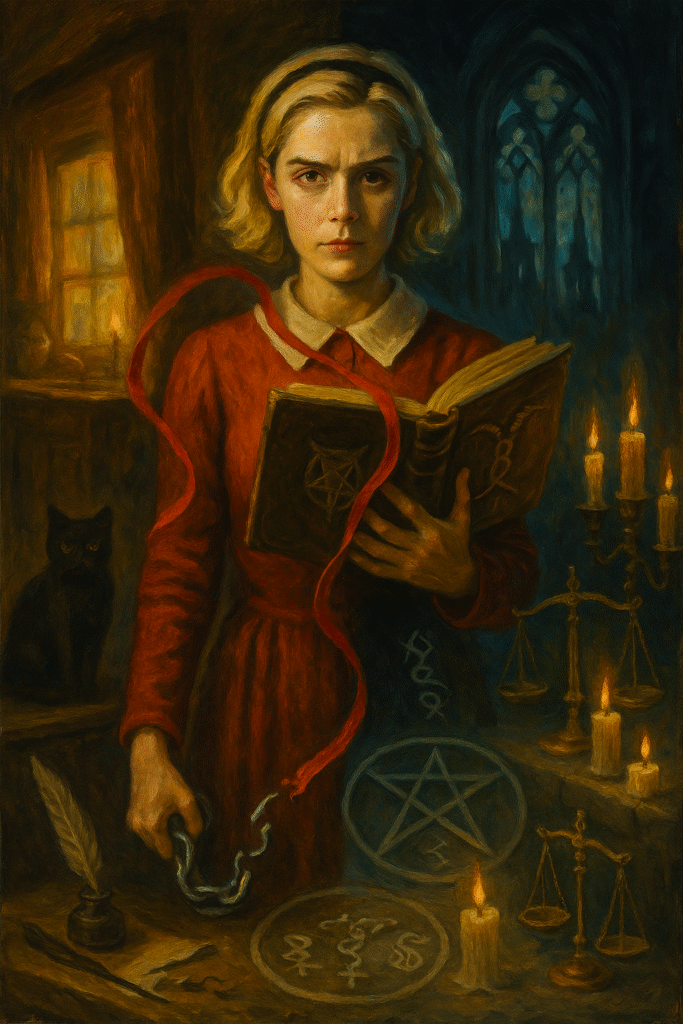

A focused, reader-friendly character study that traces how rebellion against patriarchal power, the tension of dual identity, and the search for autonomy shape The Chilling Adventures of Sabrina themes and symbolism.
Sabrina Spellman: Rebellion, Duality, and the Search for Autonomy
- Rebellion as feminist practice drives Sabrina Spellman’s arc and reframes consent as political action.
- Duality (half-witch, half-mortal) is visual and narrative symbolism that forces ethical ambiguity.
- The search for autonomy shows that agency often carries heavy relational and moral costs.
- The show uses mise-en-scène, score, and ritual imagery to make inner conflict legible.
- Case studies across Parts 1–4 reveal that small acts of refusal accumulate into systemic change or radical exile.
Sabrina Spellman Character Arc
Kiernan Shipka’s portrayal makes Sabrina Spellman feel lived-in: impulsive, principled, and often morally fraught. Across four parts the arc moves from novice resistance to revolutionary redefinition.
The performance grounds the show’s metaphysical stakes in a teenager’s emotional life. Shipka manages the tonal shifts—dark humor, grief, righteous anger—so that thematic claims about power and selfhood never feel merely topical. Academic readings have noted how Shipka’s facial economy (a single look held during rituals or confrontations) often signals the inner calculus of autonomy.
Part 1: Dilemma of choice
Sabrina hesitates to sign the Book of the Beast, marking the first major test of her divided loyalties between human life and coven doctrine.
To analyze this scene step-by-step: observe camera framing (close-up on hands and the book), listen to the score that mixes choral motifs with suburban ambient noise, and consider the social stakes (her guardians’ expectations vs. her human friends). These techniques make the decision both intimate and institutional.
Part 2–3: Escalation and consequence
Her early defiance generates fallout: fractured friendships, betrayals, and moral compromises that complicate any neat heroic reading.
A useful case study is the sequence in which Sabrina protects a mortal at the cost of violating coven law. Notice how the script stages competing rhetorics—legalism from coven leaders and an ethics of care from Sabrina—to show that rebellion is not a single act but a pattern of choices.
Part 4: Reimagining power and autonomy
In the end the series asks whether autonomy requires exile, institutional reform, or sacrifice — and it refuses tidy closure.
Part 4 functions almost as a civic trial: judges, witnesses, and community debate are all staged in gothic registers. This structural choice turns private identity work into public, procedural questions about who gets to set moral terms.
Sabrina Spellman Rebellion: A Feminist Interpretation
Rebellion in this series is iterative and costly. Sabrina’s refusals are often small, concrete acts: hiding allies, breaking ritual protocol, defending mortals. These accumulate into a political practice that contests a male-dominated Church of Night.
- Early refusal: In the premiere, Sabrina delays a deterministic initiation, making refusal itself a theme.
- Protecting mortals: She repeatedly chooses mortal ethics over coven mandates.
- Confronting authority: Her open battles with coven leadership read as a challenge to patriarchal governance.
Expert insight: Cultural commentators have linked Sabrina’s arc to broader feminist debates about bodily autonomy and medical consent. As Variety’s review observed, the show situates these debates inside ritualized institutions, which amplifies their political urgency.
Practical application: For classroom discussion, teachers can use Sabrina’s refusal scenes to prompt debates about civic disobedience and moral responsibility. A short assignment could ask students to map legal rules in the series and propose reforms grounded in care ethics.
The Symbolism of Sabrina Spellman’s Duality
Sabrina’s half-witch, half-mortal status is the show’s central symbol. Visual devices — mirrors, doubled compositions, and chiaroscuro — literalize inner splitness. Narrative foils like Prudence and friends such as Harvey and Roz map possible futures, showing the stakes of conformity versus empathy.
Comparative note: Unlike Buffy the Vampire Slayer, which externalizes adolescence as monster-hunting, The Chilling Adventures of Sabrina often internalizes conflict, making moral choices the monsters. Where Buffy mobilizes high school as a battleground allegory, Sabrina makes ecclesiastical procedure and domestic ritual the sites of ideological struggle.
The Chilling Adventures of Sabrina: The Search for Autonomy
Autonomy in CAOS appears across legalistic, moral, and emotional registers.
- Legal: The coven’s ritual statutes function as quasi-legal constraints; Sabrina’s refusal to sign exposes ritualized coercion.
- Moral: Her use of morally ambiguous magic raises the question: can the exercise of power to protect others still undermine true autonomy?
- Emotional: Independence often costs intimacy; the series shows loneliness as a recurring price of self-definition.
Step-by-step guide to reading autonomy in an episode:
- Identify constraints (laws, rituals) on the protagonist.
- Note moments of refusal and their immediate consequences.
- Trace relational fallout over subsequent scenes.
- Analyze visual symbolism (lighting, costume) that marks change.
- Reflect on whether the outcome reforms institutions or isolates the rebel.
- Situate the episode in the series arc to judge long-term impact.
Actionable tip: When discussing autonomy with a study group, create a two-column chart: “Institutional Demands” vs. “Sabrina’s Ethics” and populate it across episodes to see patterns empirically.
Cultural Impact and Readings of The Chilling Adventures of Sabrina
- Feminist reading: The show stages a young woman resisting ecclesiastical patriarchy and articulating care-based alternatives.
- Religious critique: The Church of Night parallels real institutions that use ritual to normalize control.
- Queer and trans-inclusive readings: Chosen family, trans and queer characters, and gender plurality invite readings of the coven as both oppressive and potentially liberatory.
Case study: Episodes that foreground chosen-family rituals (shared meals, clandestine rites) can be read as counter-institutions—sites where community ethics resist doctrinal authority. This invites activists and scholars to use the series as a cultural text in organizing discussions about inclusion and consent.
Form and Style: How Visuals and Sound Reinforce Themes
The series aligns form and theme: Gothic set design and ecclesiastical iconography sit next to domestic interiors; the score blends choral motifs with contemporary teen songs, reflecting Sabrina’s split worlds.
Expert perspective: Film scholars often point to mise-en-scène as a narrator in its own right. In CAOS, spatial juxtapositions (the warm kitchen vs. the cold sacristy) encode moral alternatives: nourishment versus doctrine.
Series Critique: Successes and Limitations
Successes:
- Tonal bravery and sustained metaphor.
- Complex protagonist whose moral ambiguity is narratively productive.
- Cohesive visual symbolism that supports thematic claims.
Limitations:
- At times plot scatter sidelines interior life for spectacle.
- The series occasionally softens consequences, complicating ethical clarity.
Comparative critique: When compared to serialized prestige television where consequences are prolonged (e.g., The Handmaid’s Tale), Sabrina sometimes compresses repercussions into melodramatic beats. This can heighten immediacy while lessening realism.
Conclusion:
Sabrina Spellman reframes coming-of-age as political practice. Her small acts of refusal model how individuals contest institutions that treat consent as ritual. For viewers, the show supplies a rich vocabulary for thinking about identity, power, and the costs of autonomy in an era of contested institutions.
Future trends: Expect subsequent witch-centered narratives to borrow Sabrina’s blend of domesticity and institutional critique. Streaming platforms will likely continue investing in darker YA adaptations that foreground political themes embedded in supernatural frameworks.
FAQ
Q: What is the core argument of this piece?
A: That The Chilling Adventures of Sabrina themes and symbolism center on rebellion against institutional authority, duality of identity, and the search for autonomy — and that the series dramatizes these with sustained visual and narrative strategies.
Q: Which episodes best show Sabrina’s rebellion?
A: The premiere (Part 1, ‘Chapter One: October Country’) sets up refusal; later episodes across Parts 1–3 dramatize direct confrontations and consequences. Notable moments include her first public confrontation with the coven elders and the courtroom-style sequences in Part 4.
Q: How does the show represent duality visually?
A: Mirrors, shadowed compositions, religious iconography placed in domestic contexts, and mirrored character arcs literalize Sabrina’s split identity.
Q: Is the show a feminist text?
A: It contains clear feminist elements — critiques of patriarchal religious power and emphasis on bodily autonomy — though it complicates triumphalist readings by showing relational costs of autonomy.
Q: Can this show be used in teaching?
A: Yes. Use it for modules on contemporary myth-making, gender studies, or media and law. Assign a scene analysis using the six-step guide above and pair it with a short reading on civil disobedience.
Q: Who are comparable shows or texts?
A: Buffy the Vampire Slayer (adolescence-as-battle metaphor), The Handmaid’s Tale (institutional control and women’s bodies), and the original Archie Comics-based Chilling Adventures comics (tone and lore).
Q: Any recommendations for further reading?
A: Start with critical reviews in major outlets (NYT, Variety, The Guardian) and pair episodes with essays on ritual and governance in pop culture.
If you loved this breakdown, tell us which Sabrina moment felt most rebellious to you. Share on social and tag #SabrinaSpellman #ScreenPsyche.