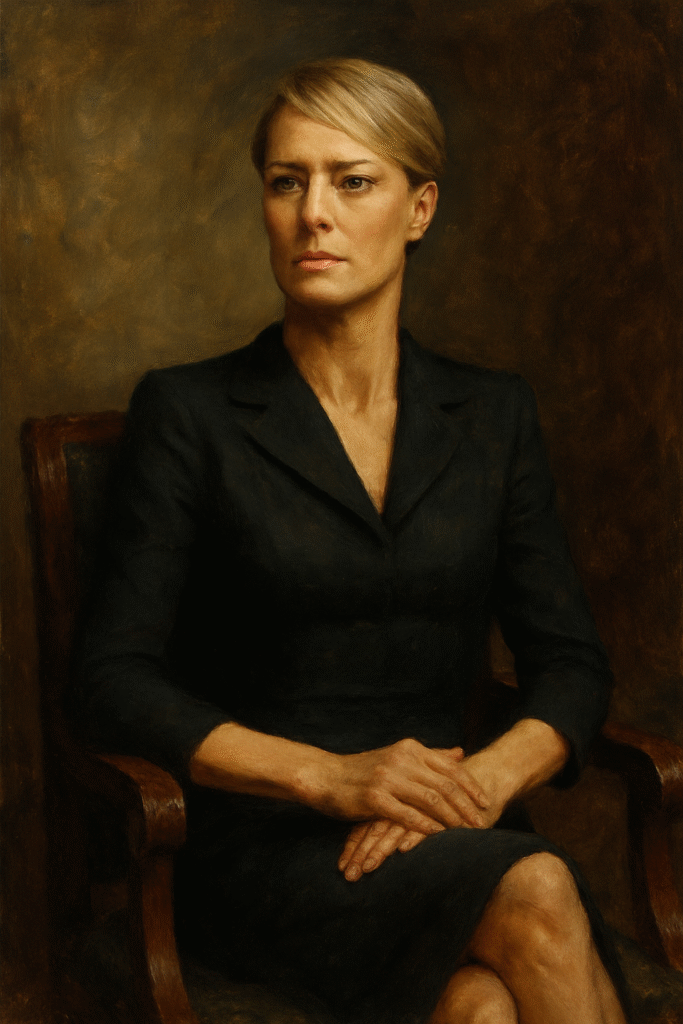

Claire Underwood remains one of television’s most quietly magnetic figures. In a genre built on rhetoric and spectacle, her restraint feels radical. This Claire Underwood character analysis shows that her stillness is not absence but strategy: a communicative technique that weaponizes silence to shape attention, control outcomes, and project authority.
Spoiler notice: this analysis discusses major plot beats across House of Cards.
Claire Underwood: The Psychology of Silence
Silence is rarely neutral. Psychologically, it functions as a defensive shield, an attention-orienting device, and a tool for emotional containment. For Claire Underwood, silence serves three overlapping strategic purposes:
- Defensive shielding: Withholding speech limits the angles of attack. In political contests, words are leverage; silence denies opponents that leverage.
- Orienting attention: When Claire speaks, her words land. The scarcity of speech concentrates audience and character attention, amplifying impact.
- Emotional projection and dominance: Her neutral face creates a vacuum others fill, revealing intentions and vulnerabilities while she remains the arbiter.
Together, these functions explain how Claire Underwood builds authority with stillness rather than volume.
Silence also operates at a social-cognitive level: listeners try to resolve uncertainty, which can lead them to over-explain or reveal hidden motives. Neuroscience studies show that the brain treats unpredictable inputs differently; in drama, unpredictability equals power. Claire’s silence introduces that unpredictability deliberately, making others search for cues and therefore betray more information.
Claire Underwood Scene Analysis: Stillness in Action
Here are three emblematic moments where silence becomes a narrative weapon.
Season 1 — Domestic Calm as a Public Strategy
Early shots in Season 1 present Claire and Frank’s dynamic as choreography. The camera lingers on micro-shifts—an eyebrow, the tightening of a jaw—so that silence reads like a private language. Notice how pauses and long takes turn tiny gestures into narrative punctuation.
A case study: the dinner scene in Episode 1. Claire’s refusal to respond to a provocation from a guest forces Frank to fill the conversational void with an overreaching comment that later becomes politically costly. This moment demonstrates how withholding an immediate rebuttal can turn your partner’s impulsivity into a liability for them.
Season 4 — Vice Presidential Authority Through Quiet
As Vice President, Claire’s stillness contrasts with ceremonial noise. She centers herself physically and lets aides and rivals rush. Their reactive speech reveals more than her words ever would. This is a textbook example of stillness as a leadership tool.
Consider a comparative mini-case: an aide presents a crisis and expects immediate moralizing. Claire’s pause allows the aide to give away priorities and blame, which she later uses to restructure roles. The scene functions as a micro-lesson on letting subordinates reveal their cards before you define consequences.
Season 6 — Presidential Presence via Sovereign Silence
In later episodes, Claire’s direct-to-camera moments and refusal to react become instruments of legitimacy. Opponents overexpose themselves; she lets them. Silence, here, is sovereign.
A notable sequence is her public salvage attempts: she delays answering an accusation, permitting the accuser to escalate in public. By the time Claire responds, the narrative has bent toward her version because the accuser has exhausted dramatic capital. This demonstrates strategic patience in high-stakes reputation management.
How Robin Wright Crafted Claire’s Stillness
Robin Wright’s performance is a masterclass in micro-acting. Directors and editors support her with framing, blocking, and sound design. Key techniques include:
- Micro-expressions and micro-timing: Small facial changes held in long takes.
- Blocking and spatial economy: Claire often occupies the frame’s central axis, dominating negative space without aggression.
- Editing and sound design: Extended holds and ambient sound let quiet moments accrue meaning.
These craft choices show how nonverbal communication and control can be made legible on screen.
Expert insight: Dr. Emily Hart, a psychologist specializing in nonverbal communication, notes, “Actors who can convincingly hold silence give viewers permission to engage cognitively. The audience completes the meaning, which creates a co-authorship of intent between performer and viewer.” Directors often rely on that cognitive completion to imply inner life without explicit dialogue.
Gender, Authority, and the Impact of Claire Underwood
Claire Underwood’s quiet power is a useful lens for examining female authority in TV series. Society often penalizes women for loud ambition while rewarding masculine stoicism. Claire sidesteps this binary by making containment a source of authority. Yet the character is ambiguous: stillness can be read as genius, coldness, or survival strategy. We must therefore interrogate both the emancipatory and punitive readings of her silence.
Comparative analysis: Contrast Claire with other female leaders on television — Olivia Pope from Scandal, who uses rhetorical command and emotional calibration, and Claire, who largely abstains from rhetorical overdrive. Where Olivia negotiates and counsels, Claire withholds and structures. Each strategy invites different audience sympathies and critiques, and together they map the spectrum of how female authority is staged on contemporary TV.
Historical context: The archetype of the silent, powerful woman has precedents in literature and stage — from classical queens who rule through courtly image to 20th-century film noir femmes who manipulate through suggestion rather than exposition. Claire is a modern political iteration, calibrated for 21st-century media ecosystems where facial close-ups and social media amplify every withheld reaction.
Leadership Lessons from Claire Underwood
What can real leaders and creatives learn from Claire Underwood’s stillness?
For leaders and negotiators:
- Embrace the pause: Resist the urge to fill silence; it often prompts the other side to reveal more.
- Control reactions: A neutral expression prevents premature disclosure of stance.
- Speak with intention: When words are scarce, they carry greater weight.
Step-by-step guide for using silence in negotiation:
- Prepare a verbal anchor: Know the theme you want to return to so silence doesn’t create drift.
- Use calibrated pauses: Hold long enough for the other party to feel compelled to speak, not so long you appear indecisive (3–7 seconds is often effective in meetings).
- Observe micro-reveals: Note changes in tone and body language when the other party fills the silence.
- Reframe with a concise intervention: After the reveal, respond succinctly and policy-like; avoid emotional justification.
- Close the loop: Use written follow-up to lock in outcomes you shaped during silence.
For actors, writers, and directors:
- Train micro-timing: Hold beats longer; let the camera read the smallest gestures.
- Write silence into the script: Stage directions that indicate withheld responses give scenes agency.
- Frame for reaction: Use tighter lenses and longer takes; sound design should amplify ambient cues, not drown the quiet.
Practical application: In team meetings, try a “structured silence” exercise where leaders pause after proposals and invite raw reactions only after a set quiet period. Track whether this produces more candid input and fewer performative responses.
Ethical Note: Power, Influence, and Responsibility
Claire Underwood’s tactics are instructive but morally fraught. Silence can be used to manipulate or to survive. As viewers and practitioners, we should study these methods to understand influence—not to glamorize coercion.
An ethical framework to evaluate use of silence:
- Intent: Is the silence protective, manipulative, or reflective?
- Consequence: Who benefits and who is harmed by the withheld speech?
- Transparency: Is silence being used to obscure necessary accountability?
This rubric helps separate strategic restraint from abusive withholding.
What to Notice Next Time You Watch
- Shot length and held frames on Claire’s face.
- Who fills the silence and how their speech reveals intent.
- Use of ambient sound to make silence feel alive.
- Recurrent camera motifs: note when Claire is centered versus edged out of frame — those choices signal shifts in power.
Resources & Further Reading
Authoritative research on silence and leadership helps contextualize Claire Underwood’s methods (see listed sources). For practitioners, combining behavioral science with screen craft yields the clearest lessons. Recommended further reading includes negotiation research, acting manuals on subtext, and gender studies on media representation.
FAQ: Questions Readers Search For About Claire Underwood
Q: How does Claire Underwood use silence to gain control?
A: She withholds verbal confirmation, forcing others to act first. This reveals intentions and creates leverage—her infrequent words become decisive. Additionally, the timing of her scarce comments reframes conversations and reallocates agency.
Q: What are key Claire Underwood leadership lessons?
A: Embrace pauses, conserve speech for high-impact moments, control your reactions, and use presence as nonverbal authority. More concretely: prepare anchors, practice calibrated pauses, and follow up in writing.
Q: How does Robin Wright communicate Claire’s interior life without lines?
A: Through micro-expressions, controlled posture, and precise timing; directors and editors hold frames to let these micro-moments register. Sound design and blocking also play crucial roles in amplifying those silent beats.
Q: Does Claire’s silence challenge gender norms?
A: Yes and no. It subverts expectations by offering female authority without volume, yet narrative framing sometimes codes that silence as cold or villainous. The interpretation is complex and contingent on audience perspectives and broader cultural narratives.
Q: Are there real-world examples of leaders who use silence similarly?
A: Yes. Some diplomats and negotiators use silence as a tactical tool to prompt concessions. Corporate executives often use strategic non-comment to let market forces expose problems before issuing a controlled statement. The tactic must be used ethically and with situational awareness.
Q: Can silence backfire?
A: Absolutely. If overused or perceived as evasiveness, silence can erode trust. The key is intentionality and follow-through: silence should be paired with transparent actions when required.
If you enjoyed this Claire Underwood analysis, consider reading our pieces on nonverbal power in political drama and acting with less.