
Content warning & spoiler notice
This article discusses anxiety, compulsive routines, and may describe scenes from films and TV shows that include disturbing or triggering material. Spoilers for the works discussed appear below. Reader discretion advised.
The sedative of certainty
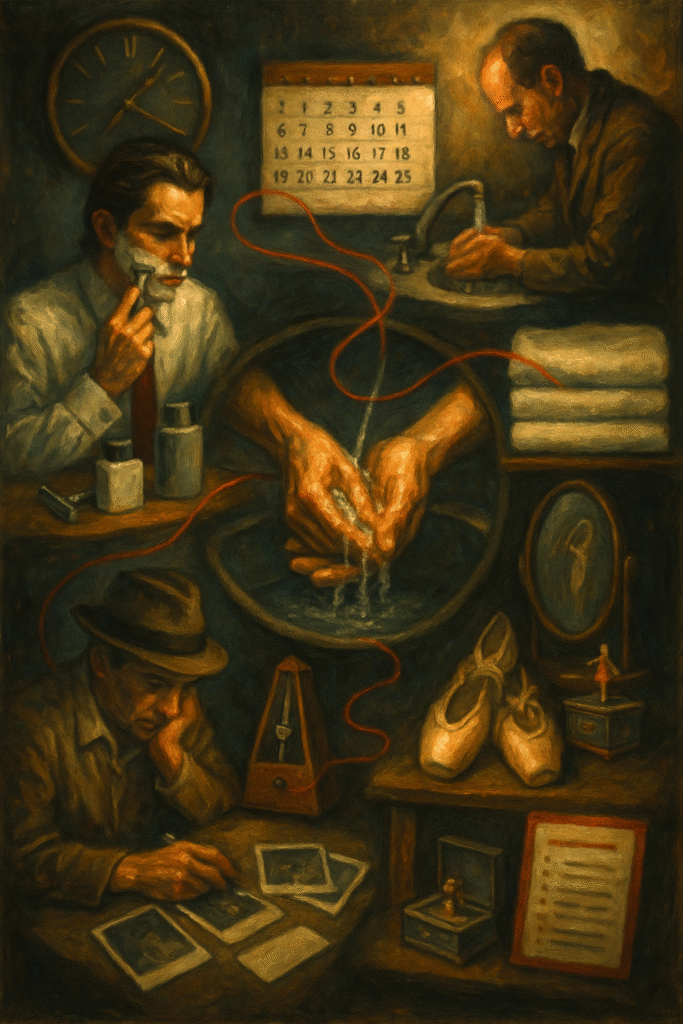
On screen, we are often drawn to characters who seem to rearrange the world to keep fear at bay. From Patrick Bateman’s clinically curated morning checklist in American Psycho to Adrian Monk’s ritualized hand-washing and towel folding, routines become more than habit: they act as a sedative for anxiety. I call this dynamic control addiction — a compulsive reliance on predictability and ritual to blunt uncertainty. It is a recurring dramatic tool that tells us about motivation, power, and fragility while giving viewers a recognizable shorthand for inner turmoil.
This long-form analysis unpacks the psychology and craft behind control addiction in film and television. We define terms, explain mechanisms with research-backed sources, perform close readings of characters and scenes, and consider narrative and ethical implications for writers and viewers.
Definitions: control addiction vs. habit vs. OCD vs. anxiety
- Control addiction (as used here): a descriptive, non-clinical term for an individual’s persistent reliance on routines or rituals to regulate distress and manage uncertainty. Not a formal diagnosis; a narrative construct to analyze behavior on screen.
- Habit: an automatic behavior formed by repeated practice and cued by context; often neutral in valence and governed by procedural learning (basal ganglia circuits) [Graybiel, 2008].
- Obsessive-Compulsive Disorder (OCD): a clinical diagnosis characterized by obsessions (intrusive thoughts) and compulsions (repetitive behaviors performed to reduce distress). Diagnosis requires impairment and meets criteria in the DSM-5 (American Psychiatric Association).
- Anxiety: an umbrella term for a range of conditions marked by excessive worry and hypervigilance. Anxiety can coexist with habit formation and compulsive rituals but is distinct from compulsive disorders when frequency and function differ.
Clear boundary: on-screen ritualized behavior can resemble clinical OCD or habits without being a literal depiction of any diagnosis. Responsible analysis avoids definitive on-screen diagnoses.
Psychological primer: why rituals soothe
Ritualized routines reduce uncertainty through predictable action sequences. The mechanisms include:
- Negative reinforcement and anxiety relief: Performing a ritual often reduces immediate anxiety, reinforcing the behavior through negative reinforcement. This cycle is central to compulsive patterns (Salkovskis, cognitive-behavioral models).
- Habit and procedural memory: Repetition shifts behavior from goal-directed to habitual; the basal ganglia encode routines so they can be executed with minimal deliberation (Graybiel, 2008).
- Perceived control: Research shows perceived control over stressors reduces physiological and psychological distress. Even illusory control (superstitious actions or rituals) can lower cortisol and subjective anxiety in short-term contexts (Langer, 1975 and subsequent experimental work).
- Memory and checking: Repeated checking rituals may paradoxically increase doubt (Van den Hout & Kindt, 2003), demonstrating how rituals can both soothe and entrench insecurity.
Credible sources: National Institute of Mental Health (NIMH), DSM-5 (APA), Graybiel 2008 on habit circuits, and Van den Hout & Kindt 2003.
Character case studies: close readings (5 examples)
Each study highlights behavior, a key scene, and narrative consequence. I avoid diagnosing — instead I describe how routines function narratively and psychologically.
- Adrian Monk (Monk, 2002–2009)
- Signature routines: stringent cleanliness, alignment of objects, counting and checking.
- Scene example: Opening sequences often show Monk performing meticulous sequences before leaving his apartment; a disruption (a messy room or an unclean towel) precipitates panic and drives plot stakes.
- Narrative function: Routines externalize internal vigilance and give him investigative advantages (heightened observation), while also making him vulnerable, creating obstacles that fuel episodic conflict.
- Patrick Bateman (American Psycho, 2000)
- Signature routines: obsessive grooming, a strict morning regimen, detailed lists of products, and ritualized violence framed as methodical practice.
- Scene example: Bateman’s monologue about his morning routine (voiceover over a montage) fetishizes control and aesthetic polishedness; the pristine routine camouflages emotional emptiness.
- Narrative function: Routines are performative masks of control that underscore moral vacuity; control addiction becomes an index of sociopathic detachment.
- Howard Hughes (The Aviator, 2004)
- Signature routines: germ-avoidant behaviors, repeated hand-washing, ritualistic cleaning sprees.
- Scene example: Hughes isolates in a hotel room, compulsively covering furniture and disinfecting surfaces. The mise-en-scene compresses his world into ritual zones.
- Narrative function: Routines mark escalation from eccentricity to incapacitating fear; cinematic choices make inner deterioration visible.
- Leonard Shelby (Memento, 2000)
- Signature routines: tattoos, notes, Polaroids — systems to preserve continuity after traumatic memory loss.
- Scene example: The ritual of taking and cataloguing Polaroids provides him a scaffold of identity; inverted chronology forces viewers to witness ritual as survival technique.
- Narrative function: Routines here are adaptive rather than pathological — they are narrative devices converting amnesia into plot architecture.
- Nina Sayers (Black Swan, 2010)
- Signature routines: obsessive training rituals, mirror-checking, ritualized dieting and rehearsal sequences.
- Scene example: Rehearsal montages paired with mirror work and ritualized stretching become a rhythmic decline into perfectionism-fueled psychosis.
- Narrative function: Routines visualize the cost of perfectionism and how control addiction can be weaponized by external pressures.
Scene breakdowns: filmmaking that accentuates ritual
Rituals are made palpable on screen through a set of craft choices:
- Editing rhythm: Repeated cuts or looped sequences create a sense of compulsive repetition. In American Psycho, quick cuts to product labels and facial close-ups mimic obsessive focus; in Monk, longer takes highlight the ritual unfolding.
- Camera framing: Tight close-ups on hands, objects, or routine gestures foreground ritual mechanics. The Aviator frames Hughes within claustrophobic spaces, reinforcing containment.
- Sound design: Recurrent ambient sounds (water running, ticking clocks, footsteps) form a sonic metronome. Black Swan uses amplified rehearsal sounds and heartbeat scores to sync viewer anxiety to the character.
- Mise-en-scene: Repetition of objects (identical towels, aligned cutlery, rows of Polaroids) visualizes the pattern. Production design often mirrors psychological neatness with sterile color palettes.
These tools convert private acts into cinematic motifs, letting the audience feel the soothing and suffocating aspects of ritual simultaneously.
Narrative analysis: what routines reveal
Why do writers give characters rituals? Several storytelling functions:
- Economy of exposition: Rituals quickly communicate backstory, values, and vulnerability without exposition-heavy dialogue.
- Symbolic shorthand: Repetitive actions symbolize larger themes: control vs. chaos, order vs. trauma, performative identity.
- Conflict engine: Routines can be the obstacle (prevents action) or the key to resolution (habit becomes adaptive). They create internal stakes that complement external plots.
- Pacing and suspense: Ritual repetition can build tension by delaying outcomes or by creating foreboding through predictable escalation.
Routines often serve dual roles — they empower the character and simultaneously create narrative fragility, giving writers dramaturgical leverage.
Accuracy and ethics: realistic, reductive, or stigmatizing?
Screen portrayals walk a line: rituals can humanize a character but also risk caricature.
Where media get it right:
- Showing both relief and impairment: Realistic portrayals show rituals as temporarily anxiety-reducing but also as sources of dysfunction.
- Contextualizing behavior: When creators link rituals to trauma, stress, or narrative pressure, viewers get a richer understanding.
Where media go wrong:
- Conflating violence and mental illness: Linking ritualized behavior to violence reinforces stigma (e.g., implying compulsion equals danger).
- Exaggeration for laughs or horror: Comedic or monstrous exaggerations flatten nuance.
Ethical guidance for writers and critics:
- Avoid equating ritual behavior with moral failing or villainy by default.
- Use sensitivity reads and consult clinical experts when depicting impairments.
- Provide context in promotional materials and include trigger warnings when necessary.
Comparative mini-section: across genres and eras
- Procedural TV (Monk, Criminal Minds): Routines often grant investigative advantages and create serialized empathy.
- Psychological thrillers (Black Swan, American Psycho): Routines are aestheticized and linked to identity disintegration.
- Biopics (The Aviator): Routines are dramatized as symptomatic progression.
Protagonists vs. antagonists: Protagonists’ rituals often humanize and invite empathy; antagonists’ rituals are used to unsettle and otherize. Modern media are shifting toward more nuanced, empathetic portrayals across both sides.
Audience implications & empathetic framing
What viewers learn: Audiences may internalize a simplified link between visible routines and clinical pathology. Responsible viewing practices include:
- Read with curiosity, not judgment: Rituals in a story are a symbol, not a diagnosis.
- Be mindful of triggers: Routines may model checking or avoidance; viewers with related experiences should use discretion.
- Seek context and resources: If a portrayal resonates personally, consult reputable sites before self-diagnosing.
Resources
- National Institute of Mental Health (NIMH): https://www.nimh.nih.gov
- Anxiety and Depression Association of America (ADAA): https://adaa.org
- International OCD Foundation: https://iocdf.org
Practical takeaways for writers and creatives
- Show function before label: Demonstrate what rituals do for the character rather than naming a disorder.
- Use craft to embody feeling: Employ sound, editing, and production design to make rituals felt viscerally.
- Avoid one-note depiction: Give rituals narrative consequences and change over time.
- Consult experts: To avoid stigmatizing misrepresentations, involve clinicians or people with lived experience as consultants.
Conclusion: hope, nuance, and the human need for order
Routines on screen are a powerful shorthand: they can convey vulnerability, concealment, agency, or collapse. The idea of control addiction helps critics and creators discuss the sedative quality of ritual without flattening characters into diagnoses. The healthiest portrayals treat routines as part of a larger psychological landscape — sometimes adaptive, sometimes destructive, always telling.
As viewers, recognizing the narrative function of ritual can deepen empathy and encourage critical thinking about how media shapes perceptions of mental health. For creators, balancing craft with ethical responsibility ensures that ritualized behavior enlightens rather than exploits.
Citations & further reading
- American Psychiatric Association. Diagnostic and Statistical Manual of Mental Disorders, Fifth Edition (DSM-5). 2013.
- National Institute of Mental Health. “Obsessive-Compulsive Disorder (OCD)” and “Anxiety Disorders” pages. https://www.nimh.nih.gov
- Graybiel, Ann M. “The basal ganglia and the chunking of action repertoires.” Nature Reviews Neuroscience, 2008.
- Van den Hout, Marcel & Tom Kindt. “Repeated checking causes memory distrust.” Behaviour Research and Therapy, 2003.
- Salkovskis, P. M. Cognitive-behavioral models of OCD. Clinical Psychology Review (various reviews).
- Langer, Ellen J. “The illusion of control.” Journal of Personality and Social Psychology, 1975.
- International OCD Foundation. https://iocdf.org
- Anxiety and Depression Association of America. https://adaa.org
- Screenpsyche related pieces: see our analysis hub at https://screenpsyche.com/articles/ for more media-focused mental health writing.