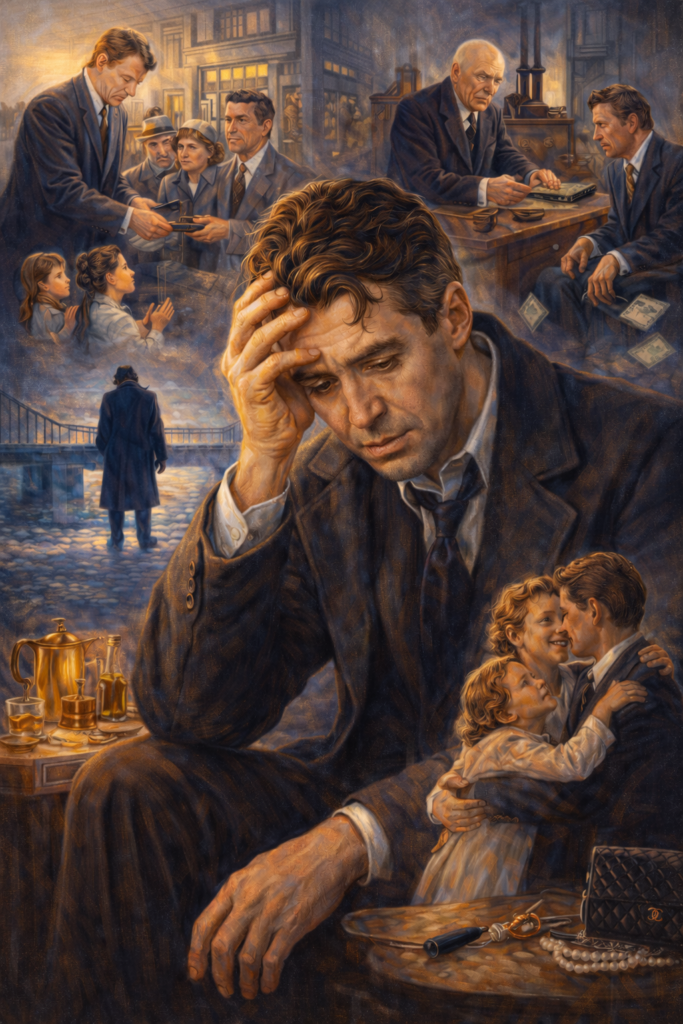

The emotional burden of being everyone’s safety net is the hidden psychological cost of constantly supporting others while neglecting your own needs. Through George Bailey in It’s a Wonderful Life, we see how chronic self‑sacrifice can lead to burnout, resentment, depression, and a crisis of self‑worth.
Key Takeaways
- George Bailey embodies the self-sacrificing caregiver who becomes his community’s safety net.
- Unseen emotional labor and people-pleasing fuel his burnout, despair, and loss of self.
- The film gently models reframing, boundaries, and shared support instead of lonely heroism.
When You Are Everyone’s Rock And Secretly Crumbling
If you have ever felt like the “strong one” in your family, friendship group, or workplace, George Bailey’s story hits close to home. Everyone leans on him. Everyone is grateful for him. And underneath the smiles, he is exhausted, trapped, and quietly falling apart.
This is the emotional burden of being everyone’s safety net: you are there for everyone, but no one really sees how heavy it is to hold everything up.
Who George Bailey Is To Bedford Falls
In It’s a Wonderful Life, George Bailey grows up dreaming of college, world travel, and building great things. Instead, a series of emergencies slowly locks him into a different life.
He becomes the head of the Bailey Building and Loan after his father’s death, staying to protect the townspeople from Mr. Potter’s predatory control. He gives up his college money for his brother. He uses his honeymoon savings to stop a run on the bank. He is the person Bedford Falls turns to when things go wrong.
To the town, George is dependable, generous, and endlessly resourceful—a classic self‑sacrificing caregiver who believes other people’s needs always come first, and that his own desires are negotiable at best.
The Psychology Behind Being The Caregiver And Safety Net
George’s character illustrates several real psychological patterns that many caregivers and “rocks” will recognize.
Caregiver Burden And Emotional Labor
Caregiver burden describes the emotional, mental, and sometimes financial strain of constantly caring for others. It is often used for family caregivers, but it also fits people like George: the one who manages everyone else’s crises.
On top of that is emotional labor—the invisible work of staying calm, reassuring, and kind while suppressing your own fear or anger. George does this repeatedly: talking panicked depositors down, keeping up a brave face for his family, and carrying the town’s anxiety on his shoulders.
People‑Pleasing And The Self‑Sacrifice Schema
George’s choices also mirror people‑pleasing and what schema therapists call a self‑sacrifice schema.
- He says yes when it costs him dearly (giving up college, travel, and business opportunities).
- He tolerates disrespect from Potter because he feels responsible for protecting others.
- He often minimizes his own dreams as “silly” or “unrealistic” compared to the town’s needs.
A self‑sacrifice schema is a deep‑rooted belief that good people put others first, even at their own expense. Over time, that belief can breed resentment, burnout, and a painful sense that your life is not your own.
The Martyr Complex Without Villainizing Altruism
It is tempting to label George as having a “martyr complex.” But the film—and this analysis—are more compassionate than that. George’s drive to help genuinely saves lives and improves his community. The problem is not his kindness; it is the lack of boundaries, support, and shared responsibility.
The lesson is not “stop caring.” It is: caring without caring for yourself is unsustainable and dangerous.
Scenes That Show The Slow Build Of Psychological Strain
Rather than one big decision, George’s emotional burden accumulates over years. Several scenes showcase this buildup in a way that feels familiar to real‑life caregivers.
Giving Up His Dreams For Family
When his father dies, George plans to leave Bedford Falls. Instead, the board will only keep the Building and Loan open if George stays. In a quiet, devastating moment, he looks out the window at the travel posters and chooses duty over desire.
Psychologically, this is an early example of self‑neglect: he internalizes the message that other people’s stability is more important than his own growth.
The College Fund Sacrifice
Later, George offers his own college money so his brother Harry can attend instead. The plan is that Harry will return and take over, freeing George. But life intervenes: Harry comes back with a wife, a job offer, and a different future.
Here we see chronic disappointment for the caregiver. George’s sacrifices are treated as natural and expected. The dependable one often becomes the default backup plan.
The Honeymoon Money And Financial Crisis
During the bank run, George and Mary give away their honeymoon savings to keep the Building and Loan afloat. Another personal milestone is surrendered to crisis management.
Each of these scenes deepens his identity as the town’s safety net and erodes his sense of autonomy.
Gender And Social Expectations
Set in the 1940s, the film also reflects strong social and gender expectations. As a man, husband, and son, George is expected to be the provider, protector, and unshakeable rock.
Those expectations still echo today: many men feel they must never show vulnerability, and many women feel obligated to be emotional caregivers at home and at work. The “reliable one” role may be praised, but it rarely allows space for burnout or breakdown.
The Breaking Point: Despair And Suicidal Ideation
Content note: This section discusses suicidal thoughts in the film, handled gently. If this is activating for you, feel free to skim to the next heading.
When Uncle Billy misplaces the Building and Loan’s money, the entire institution—and George’s freedom—are at risk. For George, this is not just about cash; it is about a lifetime of sacrifice seeming to collapse overnight.
He faces potential criminal charges, the loss of his business, and the risk of failing the very people he has always protected.
The result is a spiral into despair and suicidal ideation. On the bridge, George believes everyone would be better off without him. This is a chillingly accurate picture of how caregivers can reach a point where their own existence feels like a burden.
From a mental health perspective, this reflects:
- Depressive thinking: believing you are worthless and others would be happier without you.
- Crisis fatigue: after years of stress, one more blow feels impossible to survive.
- Invisible suffering: the town sees a cheerful helper; the audience sees the private unraveling.
“What If I Never Existed?” Distorted Thinking Versus Actual Impact
Clarence’s intervention—showing George a world where he never existed—is both fantasy and a powerful psychological metaphor.
George’s belief: “I am a failure; my life has not mattered.”
The alternate Bedford Falls (now Pottersville) reveals the truth:
- The town is harsher, more predatory, and less humane.
- People he helped avoid poverty, humiliation, or ruin are suffering.
- His family and friends are diminished or lost without his presence.
In therapy terms, this sequence challenges cognitive distortions, especially all‑or‑nothing thinking and discounting the positive. George has been filtering out the evidence of his impact because his internal metric for success was personal achievement and escape.
The vision does not erase the cost of his sacrifices, but it reframes his narrative: his life has always had value, even when he could not feel it.
⚡ Key Takeaways
- Being a community safety net can hide intense internal suffering and self-neglect.
- Crisis often exposes how long-standing sacrifices and unspoken expectations have piled up.
- Reframing your story means honoring both your impact and your need for support.
How George’s Story Mirrors Real‑Life Caregivers
Many viewers who relate to George are not running small-town banks, but they are:
- The sibling everyone calls in a family emergency
- The friend who mediates every conflict
- The manager who absorbs stress so their team can cope
- The partner who always “keeps it together” while the other falls apart
Common themes include:
- Chronic tiredness that sleep does not fix
- Guilt when saying no—or even thinking of saying no
- Resentment toward people they love, followed by shame for feeling it
- Identity confusion: not knowing who they are outside of helping roles
The emotional burden of being everyone’s safety net is that your worth can start to feel conditional: you exist to serve. George’s crisis speaks to anyone who has secretly wondered, “Would anyone care about me if I stopped being useful?”
Quick Reference: Caregiver Themes In George Bailey
| Psychological Theme | How It Shows Up In George Bailey | Real-Life Parallel For Viewers |
|---|---|---|
| Caregiver Burden | Running the Building and Loan, fielding every crisis | Being the default problem-solver at work or home |
| Self-Sacrifice Schema | Giving up college, travel, and business opportunities | Always shelving your plans for others’ emergencies |
| Emotional Labor | Staying calm during bank run, reassuring townspeople | Managing others’ feelings while hiding your own pain |
| People-Pleasing | Agreeing to stay, avoiding disappointing others | Saying yes to requests to avoid guilt or conflict |
| Distorted Self-Worth | Believing the world is better without him | Feeling only as good as your latest “good deed” |
A Healthier Reframe: Caring Without Losing Yourself
The beauty of It’s a Wonderful Life is that it does not end with George becoming selfish or cold. Instead, it models a shift in how support and responsibility are shared.
Seeing Your Value Beyond Usefulness
The town’s outpouring of love at the end is not just about paying back money. It is a moment where George is finally seen as a human being, not just a helper.
For real people, this can mean:
- Letting friends know when you are struggling, not only when they are
- Accepting help offered, instead of saying, “I’m fine, don’t worry”
- Reminding yourself that you are worthy of love even when you are not fixing anything
Boundaries As Acts Of Care
Healthy boundaries do not mean abandoning people; they mean telling the truth about your limits.
This might look like:
- “I care about you and I am exhausted. Can we talk tomorrow instead of tonight?”
- “I cannot take this on alone. Who else can we involve?”
- “I want to help, but not in that way. Here’s what I can realistically do.”
Boundaries protect both your mental health and your ability to show up sustainably.
Shared Responsibility Instead Of Lone Heroism
At the end of the film, the community comes together to support George. The load finally becomes collective.
In modern life, this could mean:
- Distributing caregiving duties among siblings instead of one person doing everything
- Encouraging mutual emotional support in friend groups (everyone gets a turn to be vulnerable)
- At work, pushing for systems that do not rely on one “super employee” to prevent burnout
The emotional burden of being everyone’s safety net lightens when more people are allowed—and encouraged—to hold a share of the weight.
Frequently Asked Questions
What specific signs indicate the emotional burden of being everyone’s safety net?
Signs include chronic exhaustion, persistent resentment, and a fading sense of personal identity. Individuals in this role often experience “compassion fatigue” and “caregiver burnout” from absorbing others’ crises while neglecting their own dreams. Like George Bailey, they frequently feel trapped by the very responsibilities that give them a sense of purpose and worth.
How does “caregiver burden” manifest in the character of George Bailey?
Caregiver burden manifests through George’s chronic self-sacrifice, where he repeatedly abandons his aspirations for travel and education to stabilize Bedford Falls. This psychological pressure builds over decades, leading to a loss of self-worth and deep-seated despair when he realizes that his identity is entirely tied to his utility as a financial and emotional protector.
What is the psychological link between people-pleasing and the safety net role?
People-pleasing fuels the safety net role by conditioning an individual to tie their value to their ability to rescue others. This pattern leads to the suppression of anger and personal needs to maintain a “strong” exterior. Over time, the inability to say no creates an unsustainable emotional load that eventually results in a total internal collapse or “silent crumbling.”
What specific scenes in It’s a Wonderful Life highlight George’s emotional burnout?
Burnout is most visible when George uses his honeymoon savings to prevent a bank run and when he faces the loss of the $8,000 deposit. These scenes illustrate the tipping point where the cumulative weight of everyone’s expectations becomes unbearable, showing that even the “strongest” individual can break when they lack a reciprocal support system to catch them.
How can someone transition from being a “lone hero” to practicing shared support?
The transition requires reframing vulnerability as a strength rather than a failure. Practical steps include setting firm boundaries on emotional labor, communicating personal needs clearly, and allowing others to take responsibility for their own crises. By moving toward reciprocal relationships, individuals can dismantle the lonely “hero” complex and build a more sustainable, collective safety net for everyone.
Further Reading & Authoritative Sources
Authoritative Sources
- It’s a Wonderful Life: A Cinematic Journey Through — In-depth analysis of George Bailey’s mental health, focusing on the emotional toll of constant responsibility, fear of letting others down, and neglect of self-care—directly aligned with the theme of being everyone’s safety net.
- Caregiving: Emotional and physical effects of bein — National Cancer Institute article detailing the emotional burden, stress, and burnout experienced by people who act as the primary support or ‘safety net’ for others, offering an authoritative psychological and medical perspective.