
Trigger warning: This article discusses adolescent violence, murder, and mental health. It examines the 1954 Christchurch case involving Pauline Parker and Juliet Hulme and Peter Jackson’s film Heavenly Creatures (1994). If you are sensitive to material about violence or mental illness, please proceed with caution. This analysis aims to be responsible, evidence-based, and non-sensational.
Fantasy and Control in Heavenly Creatures: Key Takeaways
- Shared fantasy can amplify risk. The girls’ collaborative world of Borovnia functioned as both refuge and echo chamber, increasing emotional intensity and reducing reality-testing.
- Power is relational. Control in the Parker–Hulme dyad is fluid: Juliet appears assertive while Pauline shows dependency; however, their actions are mutually reinforcing rather than the result of simple, unilateral dominance.
- Film technique shapes interpretation. Peter Jackson’s cinematography, editing, and sound design invite viewers into the girls’ interiority, which makes the psychological mechanisms feel immediate and urgent.
- Practical implications: Early social support, attentive educators, and non-stigmatizing clinical outreach matter for isolated adolescents.
These takeaways foreground the article’s focus on fantasy and control in Heavenly Creatures while connecting cinematic representation to psychological concepts such as insecure attachment, dissociation, and shared delusional processes.
The True Story Behind Heavenly Creatures (Heavenly Creatures true story)
The 1954 Parker–Hulme murder in Christchurch, New Zealand, is the historical event behind Heavenly Creatures. In June 1954, Pauline Parker and Juliet Hulme lured Honora Parker into a public place and killed her. Both girls were tried as juveniles, convicted, and detained; they were released after serving roughly five years.
This section separates verifiable facts from cinematic interpretation. For primary records, consult New Zealand archival court documents and contemporary reporting; for clinical frameworks see authoritative mental health sources listed at the end.
Expanded context: postwar New Zealand was a socially conservative environment in the 1950s, with strong influence from church and community norms that shaped parental expectations, schooling, and adolescent behavior. This background helps explain both the social pressures the girls faced and why their relationship was pathologized at the time. The publicity around the trial also reflected mid-century anxieties about juvenile delinquency and changing gender roles.
Fantasy and Control in Heavenly Creatures: Movie Synopsis (Heavenly Creatures movie analysis)
Peter Jackson’s Heavenly Creatures interleaves realist suburban scenes with lavishly imagined sequences in Borovnia, the fantasy kingdom created by Pauline and Juliet. Notable narrative beats include:
- The meeting that sparks an exclusive attachment.
- The steady construction of private language, ritual, and myth (Borovnia).
- Growing friction with families, school, and church.
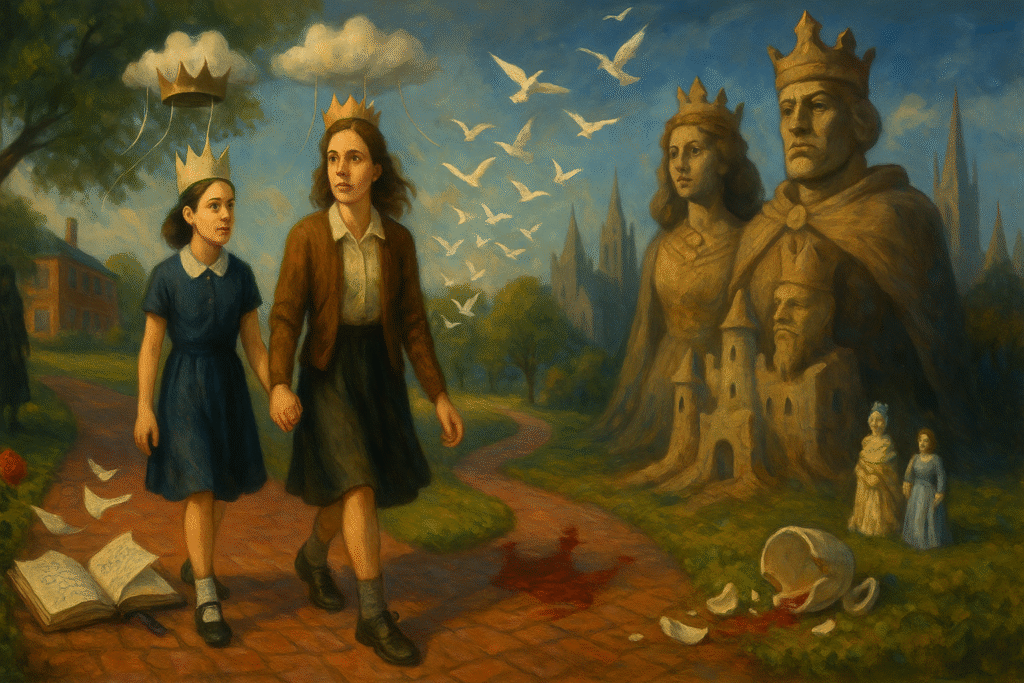
- The murder scene contrasted with a victorious fantasy coronation.
Consequently, the film asks us to consider how co-created imagination can transition from consolation to instrument.
Expanded synopsis detail: Jackson’s sequencing places increasing screen time on Borovnia as external pressures mount, so viewers experience the fantasy’s growth as proportional to the girls’ real-world constriction. This structural choice aligns with the theme of fantasy and control in Heavenly Creatures: as outside control encroaches, inner control over a private world grows more totalizing.
Pauline Parker Psychological Profile (Pauline Parker psychological profile)
This interpretive profile draws from filmic cues and historical context; it is not a clinical diagnosis.
Attachment and social isolation
Pauline (as portrayed) shows signs of intense dependency and social isolation. Attachment theory suggests insecure attachments can make adolescents more vulnerable to single-point dependencies, especially when corrective relationships are absent.
Case example: In analogous clinical case studies, adolescents who lose a primary caregiver or who experience repeated social rejection may form extreme dyadic attachments that substitute for broader social networks. In Pauline’s case, her bond with Juliet appears to fill multiple relational needs—intellectual, emotional, and identity-forming—that would typically be distributed across family and peers.
Shared psychotic processes and dissociation
Clinical concepts that help explain the filmic portrayal include dissociation and the phenomenon historically called folie à deux (shared psychotic disorder). Modern psychiatry frames these as emergent from close, isolated relationships rather than a discrete illness. In the film, Borovnia acts as a co-constructed reality that gradually undermines external reality-testing.
Historical reference: The term folie à deux was first systematically described in the late 19th century by French psychiatrists Charles Lasègue and Jules Falret. Their work remains a useful historical touchstone for understanding how delusional or imaginative systems can propagate between closely bonded individuals.
Family and institutional dynamics
Honora Parker’s attempts at control, combined with moral pressure from school and church, created external constraints that the girls experienced as existential threats to their shared world. Such environmental stressors, together with secrecy and mutual reinforcement, are risk correlates in developmental literature.
Expert insight: Developmental clinicians emphasize that punitive or shaming responses to adolescent secrecy can worsen secrecy and entrench alliances. A nonjudgmental, curious approach from caregivers and teachers often opens opportunities for de-escalation.
Fantasy as Co-Construction: How Borovnia Worked (Heavenly Creatures themes)
- Shared language and ritual produced strong in-group cohesion.
- Sensory and symbolic immersion (Jackson’s visuals and sound) gave fantasy a felt legitimacy.
- Mutual validation created an echo chamber that eroded dissent and reality-testing.
Thus, fantasy was simultaneously identity-making and, ultimately, an amplifier of grievance when the imagined world appeared endangered.
Detailed mechanism: The girls used storytelling rituals—letters, invented lexicon, enacted coronations—to make Borovnia tangible. Psychologically, ritualizing imagination anchors it in habit, which raises the barrier to outside correction. The more a fantasy is enacted rather than merely verbalized, the harder it becomes for participants to treat it as symbolic rather than ontological.
Fantasy and Control in Heavenly Creatures: Dynamics of Control (control and dominance in adolescent relationships)
Analyzing control requires nuance:
- Within the dyad: power is relational and fluctuating; agency appears distributed rather than simply imposed.
- External control: parental and institutional authority can paradoxically intensify internal attempts to control the immediate social world.
- Agency and culpability: the film compels viewers to see both vulnerability and moral responsibility. Ethically, we should avoid absolution or reduction to single-cause explanations.
Comparative analysis: Contrast Pauline and Juliet with other cinematic portrayals of intense adolescent bonds—e.g., The Virgin Suicides (isolation leading to tragedy) or Heathers (peer conformity weaponized). Unlike those films, Heavenly Creatures centers co-created fantasy as the vehicle for control, rather than social popularity or moral nihilism.
Practical note: When educators notice rigid pairings that exclude others, the goal is not immediate separation but measured expansion of social opportunities—facilitating additional friendships, creating supervised group activities, and involving mental health professionals when necessary.
Peter Jackson Heavenly Creatures Analysis: Film Technique (Peter Jackson Heavenly Creatures analysis)
Jackson’s formal choices function as a “visual psychology”:
- Cinematography moves between tight realism and painterly fantasy.
- Editing cross-cuts destabilize chronology and causal clarity.
- Sound design foregrounds the inner life during fantasy sequences.
- Performances by Melanie Lynskey and Kate Winslet create a believable, intense dyadic chemistry.
Consequently, these techniques persuade the audience to feel the internal logic that drives the girls’ decisions.
Technical case study: The coronation sequence is a masterclass in aligning mise-en-scène with psyche: costume, light, and camera movement synchronize to give the fantasy a triumphant, tactile quality. For viewers, this sequence is persuasive: the coronation “feels” real within the film’s aesthetic economy, which is why the final violence hits with such dissonant force.
Ethics, Sensitivity, and Why This Matters (media ethics, psychology of teenage killers)
We should approach such material with care:
- Avoid glamorizing the violence; maintain empathy for victims.
- Distinguish cinematic interpretation from historical fact.
- Refrain from definitive retrospective diagnoses; instead, use clinical concepts as heuristics.
Why this matters: the film invites reflection on how imagination, exclusion, and control can interact in adolescence. Therefore, the story has contemporary relevance for educators, clinicians, and storytellers.
Practical application: For schools, adopt policies that balance privacy with safety. Examples include training teachers to recognize signs of extreme co-dependence, establishing confidential referral pathways to school counselors, and running restorative group activities that dilute dyadic exclusivity.
Further reading and authoritative sources
For readers who want to verify facts or explore clinical frameworks, consult these authoritative sources:
- American Psychiatric Association — DSM resources (for nosology and clinical framing).
- National Institute of Mental Health (NIMH) — adolescent mental health resources.
- National Library of New Zealand — archival records and contemporary reporting on the Parker–Hulme trial.
(External links are provided in the article metadata.)
Added recommendations: For film analysis, the British Film Institute (BFI) has useful essays on cinematic technique and representation of mental states. For historical context, look for scholarly treatments of mid-20th-century juvenile justice in New Zealand.
Conclusion: From Refuge to Rupture
Heavenly Creatures stages an unsettling question: when two people build a world together, what happens when that world is threatened? The film’s rendering of Pauline Parker reveals how fantasy can be both a humane refuge and a dangerous amplifier when it becomes impermeable to outside correction. Practically, early social support, attentive guardianship, and compassionate, non-stigmatizing clinical outreach are crucial responses to similar patterns of adolescent isolation.
Actionable tips (quick-list):
- Observe changes in ritualized behavior and private language as potential red flags.
- Encourage supervised, structured group interactions to broaden social networks.
- Use non-shaming curiosity in conversations—ask open-ended questions about imaginary worlds rather than condemning them.
- When safety concerns arise, follow mandated reporting laws and engage mental health services promptly.
FAQ
Q: Is it appropriate to analyze real people through films?
A: Yes, but only with clear separation between documented facts and artistic interpretation. Films are interpretive works; consult primary records for factual claims.
Q: Was Pauline Parker clinically insane?
A: No definitive public clinical diagnosis should be asserted here. The film illustrates psychological processes; modern clinical labels applied retrospectively are speculative.
Q: What is folie à deux and how does it relate?
A: Historically a label for shared delusional disorder, it helps describe how delusional or quasi-delusional systems can form in close, isolated dyads. Contemporary psychiatry treats this as relational rather than a single nosological category.
Q: Where can I learn more or find primary sources?
A: See the National Library of New Zealand archives for trial reporting, and consult DSM resources and NIMH materials for clinical context.
Expanded FAQ additions:
Q: How can teachers spot unhealthy co-dependence?
A: Warning signs include excessive secrecy, ritualized shared language, sudden withdrawal from peers, and disproportionate distress when separated. Keep records of observations and consult school mental health staff.
Q: Can fantasy ever be therapeutic?
A: Yes. Imaginative play and shared storytelling can foster creativity, resilience, and emotional processing. The difference is whether fantasy remains permeable to reality and whether it contributes to overall functioning or impairs it.
Q: Does the film excuse the crime by explaining the psychology?
A: No. Explaining mechanisms is not exoneration. Understanding the interplay of fantasy and control in Heavenly Creatures is intended to illuminate, not absolve.
Additional resources for professionals
Step-by-step guide for a basic risk assessment in school settings:
- Document behavioral observations (dates, settings, specific behaviors).
- Interview the adolescent(s) using open-ended, nonjudgmental questions.
- Check for safety concerns (self-harm, threats to others).
- Consult with a school counselor or psychologist and plan direct parent contact if appropriate.
- If imminent risk is present, follow local emergency and reporting protocols immediately.
Comparative future trends: In today’s digital environment, the dynamics of fantasy and control in Heavenly Creatures can play out in online spaces—private messaging groups, role-playing forums, and tightly moderated social networks. Digital echo chambers may accelerate co-construction of alternative realities, making early detection and digital literacy programs more important. Educators should thus combine traditional observation with an awareness of students’ online lives and create safe ways for adolescents to disclose problematic online experiences.
Concluding recommendation: Use the film and its historical case as a prompt for conversation, training, and policy that prioritize holistic adolescent well-being while recognizing the complex roles that fantasy and control can play in developing minds.