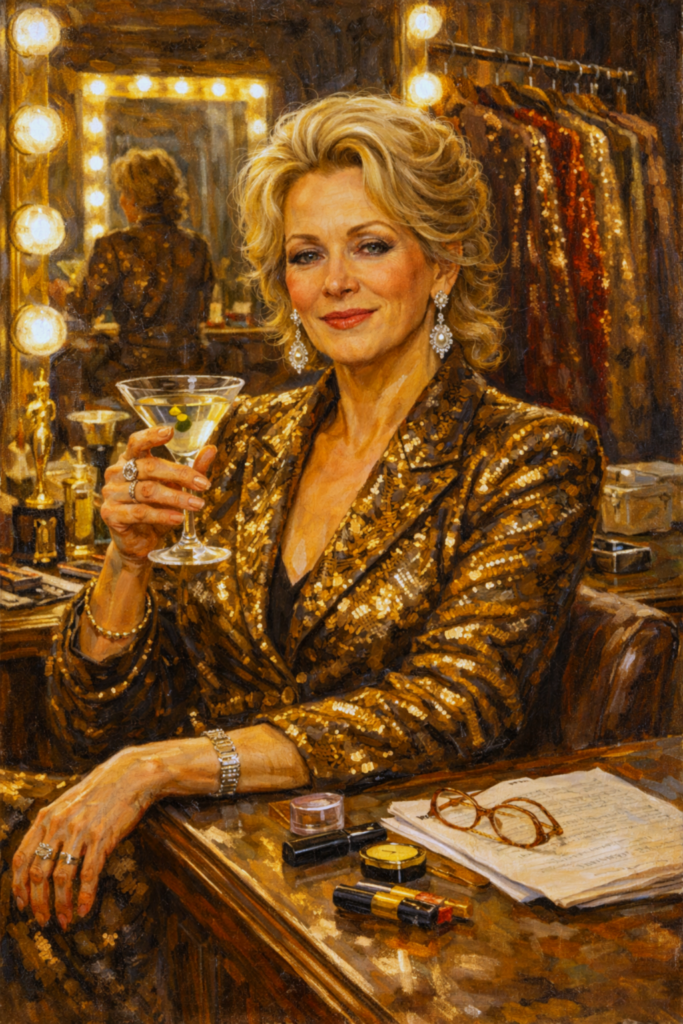

Hacks’ Deborah Vance age and career together form a sharp lens on how a female comedian fights to stay central to her own story in a media industry shifting from Vegas stages and network gatekeepers to streaming-era ecosystems, data-driven monetization, and audiences drowning in content.
The Comedian Who Refuses to Age Out of Her Own Story
Deborah Vance enters Hacks already a legend: decades into her career, queen of a long-running Las Vegas residency, wealthy, sharp, and very aware that the industry has decided she is past her sell-by date.
From her first scenes, she embodies a central tension: she has survived, but she refuses to be reduced to survival. She wants authorship.
The show kicks off when casino management threatens to push her out for a younger, more “relevant” act. This is not just a plot device; it becomes a thesis statement. The question is not whether Deborah is still funny. The question is whether a woman of her age is allowed to keep writing her own narrative in a system obsessed with youth, novelty, and short-term metrics.
From Vegas Showrooms To OTT Media Services
Deborah’s Vegas residency represents an older media logic: stability, repetition, and a live audience that shows up night after night for the same persona. In that model, power comes from tenure. If you can pack a showroom for decades, you have leverage.
Hacks contrasts this with the streaming, OTT Media Services world that surrounds Ava, her young, digitally-native writer. Ava’s universe is driven by:
- Social feeds instead of marquees
- Clips and virality instead of long-form routines
- Data dashboards instead of ticket stubs
Deborah’s fear of losing the residency is really fear of losing a center in a fragmented media landscape. A Vegas stage anchors her; OTT platforms and on-demand ecosystems atomize everything into endless scrolls, thumbnails, and micro-brands.
The series shows Deborah gradually stepping into that world: podcasts, stand-up tours filmed for specials, and the possibility of streaming distribution. Her pivot from a safe residency to a risky, brutally honest special resembles what many legacy performers have faced: trade steady, traditional exposure for algorithm-dependent, platform-controlled visibility.
Character Study: Deborah’s Psychology, Ego, And Creative Drive
Deborah is not simply an emblem of “older woman versus youth culture.” She is psychologically dense: narcissistic at times, deeply wounded, hungry for validation, but also genuinely committed to the craft of comedy.
Key traits that define her inner engine:
- Control as survival strategy: She micromanages everything—jokes, costumes, business deals—because historically, loss of control has meant exploitation or erasure.
- Ego as armor: She brags, belittles, and deflects. Yet ego here is not just vanity; it is a defensive shell formed by years of misogyny, industry politics, and personal betrayal.
- Creative masochism: When Ava pushes her to mine her personal pain—divorce, humiliation, career sabotage—Deborah resists, then ultimately leans in. She knows that exposing those wounds might be the only way to evolve artistically.
Her turning point is the decision to abandon a polished but stale act in favor of raw, confessional material. That choice is artistic, but it is also strategic in a saturated market; authenticity has become a form of currency.
Glossary Of Key Story And Industry Terms
|
Term |
Type |
Brief Explanation |
|---|---|---|
|
Vegas Residency |
Story/Industry |
Long-term performance contract in a single venue, symbolizing legacy stability. |
|
OTT Media Services |
Industry |
Streaming platforms delivering content via internet, bypassing traditional TV. |
|
Content Monetization |
Industry |
Ways creators convert content into revenue: deals, specials, tours, licensing. |
|
User-Generated Content (UGC) |
Industry |
Audience-created media (clips, edits, memes) that amplify or reshape a brand. |
|
Intergenerational Writers’ Room |
Story |
Creative friction between older and younger voices, as seen with Deborah and Ava. |
This vocabulary lives inside Deborah’s story. She may not use the terms, but her decisions constantly intersect with their realities.
Age, Gender, And Power: Who Gets To Stay In The Story?
Hacks is acutely aware that aging does not land evenly. A male comedian with Deborah’s career might be framed as “iconic” or “timeless.” Deborah, by contrast, is treated as an expense line to be optimized.
Her story exposes several industry truths:
- Ageism is gendered: Her looks, body, and wardrobe are scrutinized in ways her male peers largely escape.
- Power is conditional: She is wealthy and famous, yet a single executive’s decision can end her residency.
- Narrative control is contested: When younger, male executives call her “out of touch,” they are really asserting their right to define what kinds of stories deserve platforms.
Deborah’s refusal to age out is not denial; it is resistance. She knows she is older. She jokes about it. But she rejects the idea that aging must equal shrinking. She insists on taking up space—on stage, in boardrooms, in writers’ rooms—long after the system expects her to quietly exit.
Industry Lens: Content Monetization, Programmatic Advertising, And Brand Partnerships
Beneath the character beats, Hacks quietly tracks the economics of staying relevant. Deborah’s empire is diversified: QVC-style product lines, brand deals, merchandising, live shows, and eventually a special designed for broader distribution. (How old is Jean Smart compared to her ‘Hacks’ character Deborah Vance?)
In a streaming age, these revenue streams are shaped by:
- Content Monetization: Her stand-up special is not just art; it is an asset that can be sold, licensed, and repackaged across platforms.
- Programmatic Advertising: When her material lives on ad-supported services or clip-based platforms, brands and algorithms decide which ads appear around her jokes—and which jokes are deemed brand-safe enough to be promoted.
- Brand Partnerships: She constantly negotiates the tension between authentic comedy and sponsor-friendly polish. Does she soften edges to please advertisers, or double down on harsh truths to win audience trust?
The series leans into the paradox: a brutally honest set might reduce her brand deals in the short term but enhance her cultural capital. In a crowded OTT ecosystem, that cultural capital—being the voice people quote, share, and discuss—can ultimately drive more sustainable value than safe, forgettable content.
Intergenerational Dynamics: Deborah, Ava, And The Digital-Native Gaze
At the heart of Hacks is a volatile partnership: Deborah, forged in smoky clubs and live hecklers, and Ava, forged online in tweets, think pieces, and cancellation cycles.
Their creative conflict maps directly onto legacy versus digital-native storytelling:
- Deborah’s perspective: Comedy is survival. You test material in hostile rooms, bomb, refine. You protect your persona fiercely.
- Ava’s perspective: Comedy is conversation. You chase topicality, reference discourse, and assume the audience is also your critic in real time.
Ava challenges Deborah to acknowledge her complicity in an earlier, more exclusionary comedy culture. Deborah forces Ava to confront the difference between having opinions online and building a body of work that can withstand decades of scrutiny.
Their friction is not merely generational sniping; it is a model of how writers’ rooms, production companies, and even brands are grappling with integrating older, experience-rich voices with younger, hyper-networked creatives.
Audience, UGC, And The Immersive Experience Of Fandom
Hacks sits in a real-world environment where audiences do not just consume content; they co-author its meaning.
For a figure like Deborah, the modern fan ecosystem can:
- Extend her brand: Clips of her sets, interviews, or meltdowns can circulate as User-Generated Content. Fans cut, remix, and caption her moments, giving them new contexts.
- Create immersive experiences: Viewers do not just watch; they discuss, meme, cosplay, and build parasocial relationships with personas like hers.
- Intensify risk: A single out-of-context joke can ignite backlash, amplified by the same UGC dynamics that provide free promotion.
Even if the series rarely foregrounds TikTok or hashtag campaigns explicitly, it assumes a media landscape in which a Vegas joke can be a global object within hours. Deborah’s shift toward more vulnerable, self-exposing comedy is, in part, an adaptation to this environment: if everything can become a shareable artifact, you might as well make it honest enough to stand up to rewatching, re-cutting, and re-framing.
Cultural Resonance: Individualism, Reinvention, And The American Dream
Deborah Vance is, fundamentally, an American myth refashioned for the streaming era: a self-made woman who turns humiliation into material, betrayal into leverage, and age into a site of reinvention.
Her arc resonates with several cultural threads:
- Radical individualism: She insists on her right to define herself, even when everyone—from executives to fans to Ava—tries to tell her who she should be.
- Reinvention as ongoing process: Rather than a single comeback, we see a continuous cycle of collapse and re-emergence, mirroring the volatility of the modern media economy.
- Diverse audience expectations: She performs for audiences that are no longer homogenous. Different generations, regions, and identities project competing desires onto her, and she must navigate those without losing her core.
In an era of content saturation and viewer fatigue, Deborah’s enduring appeal lies in her specificity. She is not trying to be a universal symbol; she is unapologetically herself. That very sharpness—her willingness to be unlikable, to be wrong, to grow—is what cuts through the noise.
What Deborah Vance Teaches Us About Owning Your Narrative
By tracing Hacks Deborah Vance age and career, Hacks offers something more than a behind-the-scenes portrait of comedy. It becomes a meditation on how any creator—especially women, especially those past the industry’s favored age bracket—can survive a landscape defined by platforms, algorithms, and fickle audience attention.
Deborah models a path that is neither naïve optimism nor quiet resignation:
- She acknowledges the brutal economics of entertainment and still chooses to take artistic risks.
- She refuses to be sidelined by age yet does not pretend to be young; she mines aging itself as material.
- She embraces new forms—specials, potential streaming distribution, a more confessional voice—without abandoning the discipline that got her there.
For film and TV enthusiasts, her character becomes a case study in authorship under pressure. For anyone navigating their own creative journey, Deborah’s story is a reminder: you can be shaped by changing systems without surrendering the pen that writes your life. Hacks Is a Smart, Sharp Comedy About a Comedian Who Won’t Quit
In a world where platforms come and go, where programmatic advertising and audience metrics feel inescapable, Hacks insists on something quietly radical: a woman, older, complicated, still on stage, still re-writing herself—refusing, down to her last joke, to be written out.
Frequently Asked Questions
How does Hacks portray Deborah Vance’s age as a source of creative power rather than a career limitation?
Deborah Vance leverages decades of life experience to fuel sharper, more brutal stand-up material. Instead of concealing her age, she incorporates it into her act as a symbol of survivor status. This strategy transforms aging from a professional liability into a form of creative authorship and renewed industry relevance.
How does Deborah Vance’s career evolve from a Las Vegas residency star to a figure in the streaming era?
Deborah transitions from a stagnant Las Vegas residency built on repetition to a dynamic career involving stand-up tours and podcasting. Her pivot culminates in a self-produced, confessional comedy special designed for streaming platforms, prioritizing high-reach algorithmic visibility over the traditional stability of long-term casino contracts.
What does Hacks reveal about age and gender bias in who gets long-term career power in comedy?
The series illustrates how comedy’s gender bias often phases women out as they age, while men gain authority. By keeping Deborah central, Hacks challenges double standards in casting and marketing, highlighting that veteran female performers possess enduring value that the industry historically ignores in favor of younger demographics.
How does the Deborah–Ava partnership in Hacks reflect the clash between legacy comedy and digital storytelling?
Deborah’s mastery of traditional stagecraft and timing clashes with Ava’s fluency in social media and digital-native storytelling. Their partnership highlights the friction between legacy, venue-based comedy and modern content optimized for streaming clips. This collaboration forces both generations to adapt their joke structures for multi-platform distribution.
In what ways does Hacks connect Deborah Vance’s career to modern content monetization?
Deborah’s shift from fixed casino salaries to multi-platform tours mirrors the industry’s transition toward data-driven monetization. Her career trajectory illustrates how modern comedians leverage brand partnerships, sponsorships, and programmatic ad revenue across streaming ecosystems. This evolution requires performers to act as independent brands rather than just stage talent.
Further Reading & Authoritative Sources
Authoritative Sources
- ‘Hacks’ Cast and Characters — Who’s Returning in Season 3 of the Hit Max Series? — Provides an in-depth character profile of Deborah Vance, describing her as a Las Vegas comedy icon, summarizing her career arc in the show, and situating her within the Hacks ensemble.