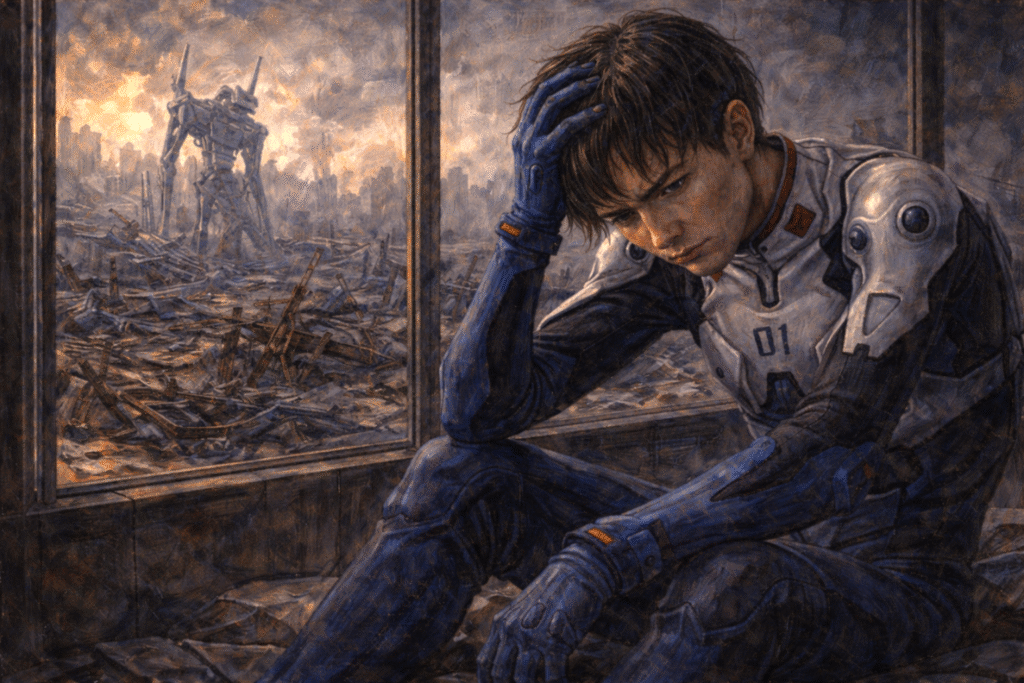

A Psychological Character Study of Saying No to the World
Neon Genesis Evangelion Shinji Ikari is a deeply traumatized, ambivalent protagonist torn between wanting connection and wanting to disappear. He repeatedly says he does not want to pilot Evangelion Unit-01, yet continues, driven by shame, fragile hope, and a desperate need to be needed, making him psychologically coherent rather than simply “whiny.”
- Shinji embodies a push-pull between craving intimacy and wanting to vanish completely.
- His refusal of the world is also a refusal of imposed roles, narratives, and Instrumentality.
- He keeps piloting from guilt, attachment wounds, and rare but real flashes of courage.
Spoiler note: This article discusses key events from Neon Genesis Evangelion and The End of Evangelion.
Introduction: Shinji’s Reputation and the Central Question
Among anime fans, Neon Genesis Evangelion Shinji Ikari is infamous. He is mocked as the boy who “whines,” refuses to get in the robot, and cries instead of acting like a traditional mecha hero.
The more interesting question is: why does someone who keeps saying “no” to the world still fight for it? Why does Shinji run away again and again, and still climb back into Evangelion Unit-01 when it matters most?
Seen through psychology rather than fandom stereotypes, Shinji becomes a rich case study in trauma, depression, ambivalent attachment, and what it means to choose life in a world that hurts.
Brief Context: Evangelion, Instrumentality, and the Hedgehog’s Dilemma
Neon Genesis Evangelion takes place in a post-apocalyptic world threatened by beings called Angels. Teenage pilots control biomechanical giants, Evangelions, to protect humanity. Shinji is summoned by his estranged father, Gendo, to pilot Unit-01.
Beneath the mecha trappings, the series is a psychological drama. The Human Instrumentality Project promises to dissolve all human boundaries into one collective consciousness. No more loneliness, no more misunderstanding—because there is no longer any separate “self.”
The show invokes the hedgehog’s dilemma: like hedgehogs on a cold night, humans want closeness but hurt each other with their “spines” when they get too near. Shinji lives this dilemma with Misato, Asuka, Rei, and especially Gendo.
Instrumentality is the extreme “solution”: remove all distance between people. Shinji’s decision at the end of The End of Evangelion—to reject Instrumentality and return to a painful, separate existence—is the culmination of his psychological arc.
Shinji’s Psychological Profile: Attachment Wounds, Shame, and Avoidant Coping
Shinji’s inner life makes sense when you look at three core elements: attachment wounds, shame, and avoidance.
Attachment wounds
Shinji’s mother, Yui, disappears when he is young. His father, Gendo, emotionally abandons him, sending him away rather than raising him. When Gendo finally calls Shinji back, it is not to reconnect—it is to pilot a living weapon.
This history maps onto insecure attachment. He expects abandonment: when Misato offers him a home, his first instinct is that it will not last. He is hyper-attuned to rejection: a stray criticism from Asuka or a cold glance from Gendo can crush him.
Shame and self-loathing
Shinji does not just believe people will leave; he believes they should leave. His inner monologue and the series’ abstract sequences reveal deep shame:
- In Episode 16, trapped inside an Angel, Shinji hears internal voices telling him he is worthless and unwanted.
- In The End of Evangelion, he loops through self-hating fantasies, convinced no one genuinely cares.
Shame is more than “I did something bad”; it is “I am bad.” Shinji’s repeated “I’m sorry” is not just politeness—it is a reflex of someone who assumes his existence is a burden.
Avoidant coping and learned helplessness
Shinji’s mantra “I mustn’t run away” matters because running away is his default coping strategy. When faced with conflict, he shuts down, freezes, or physically leaves.
Over time, he shows signs of learned helplessness: the belief that nothing he does will change the outcome. When told to pilot in Episode 1, he initially refuses—not as an empowered “no,” but as a collapse: “I can’t.” After the traumatic battle against Bardiel (Unit-03), he quits, convinced that his choices only create harm.
This is not laziness. It is the logic of a traumatized child: “If I do nothing, maybe I can’t make things worse.”
Saying “No” to the World: What Shinji Is Actually Refusing
By the time of The End of Evangelion, Shinji’s “no” to the world is not a simple refusal of responsibility. It is a layered refusal of several things.
No to Instrumentality as emotional anesthesia
Instrumentality promises a painless, unified existence. For someone like Shinji, drowning in shame and loneliness, this is tempting: no boundaries, no rejection, no need to risk being seen.
Yet, through the surreal interior sequences, Shinji realizes that in giving up pain, he would also give up the chance to be chosen, the possibility of authentic, if flawed, connection, and the ability to define himself, even imperfectly.
His “no” to Instrumentality is a “no” to being swallowed by a narrative where his individuality does not matter.
No to imposed roles and expectations
From Episode 1 onward, everyone tells Shinji what he is supposed to be:
- Gendo: the obedient pilot-son
- NERV: the expendable weapon
- Society: the savior of humanity
His refusals—“I don’t want to pilot,” “I want to run away”—are attempts to reject being used. He senses that his worth is conditional on performance.
No to painful, unpredictable connection
Shinji wants connection and fears it at the same time. Getting close to Misato, Asuka, and Rei repeatedly leads to disappointment, misunderstanding, or outright trauma.
So when he says “no” to the world, he is also saying: “I don’t want to be hurt anymore.” This is classic approach–avoidance conflict: the same relationships he longs for are the ones he cannot bear.
Still Piloting the Robot: The Web of Motives
Given all that, why does he keep getting in Evangelion Unit-01? The answer is not a single motive, but a web of conflicting drives that writers can learn from.
Guilt and internalized responsibility
After early battles, Shinji sees the collateral damage and the suffering around him. When Toji is injured and later becomes the pilot of Unit-03, Shinji’s choices have direct, horrific consequences.
This feeds into guilt: the sense not only that he has done something wrong, but that he is responsible for everyone’s safety. If he refuses to pilot, people will die; if he pilots, people still get hurt—but at least he is doing something.
The need to be needed (conditional love)
Gendo’s rare acknowledgment—like the silent approval after certain battles—is incredibly powerful for Shinji. To a starving child, crumbs feel like a feast.
Piloting becomes a way to earn conditional love: if he pilots well, maybe Father will look at him; if he saves people, maybe he deserves to exist. Even Misato’s encouragement can inadvertently reinforce this by tying his worth to his ability to fight.
Fear and hope, inseparably tangled
Shinji also pilots because he is afraid: afraid of rejection if he refuses, afraid of the apocalypse, afraid of losing the few bonds he has. But there is also fragile courage and hope. In moments like the rescue of Rei from the Angel Armisael, Shinji acts not from obligation but from genuine desire to protect someone he cares about.
The EVA as self, body, and parent
Evangelion Unit-01 is not just a robot. It contains Yui’s soul and often moves to protect Shinji without his conscious control. Psychologically, the EVA is a terrifying, uncontrollable body, a fused image of mother and weapon, and a place where Shinji sometimes feels truly “held.”
Piloting becomes a distorted way to reunite with his mother and experience a sense of power he lacks in ordinary life.
Table: Shinji’s Stated vs Underlying Motives
| Surface Statement or Behavior | Underlying Psychological Motive | Storytelling Function |
|---|---|---|
| “I don’t want to pilot.” | Fear of rejection, resistance to being used, avoidance of pain. | Sets up conflict between desire for escape and need for connection. |
| Returning to NERV after running away. | Guilt, need to be needed, hope for acceptance. | Shows ambivalent agency under pressure. |
| Repeated apologies (“I’m sorry”). | Deep shame and belief that his existence is burdensome. | Externalizes internalized self-loathing. |
| Risking himself to save Rei. | Genuine care breaking through avoidance and fear. | Reveals capacity for real courage and love. |
| Rejecting Instrumentality. | Refusal to erase self, willingness to face pain for authentic existence. | Thematic climax: choosing imperfect life over painless non-self. |
Key Moments That Reveal His Ambivalent Agency
Several scenes crystallize Shinji’s “I don’t want to—but I will” pattern.
Episode 1: The first refusal and first acceptance
Faced with a battered Rei and Gendo’s command, Shinji initially refuses. When Rei tries to stand despite her injuries, Shinji cannot bear it. His decision to pilot comes from empathy and shame more than heroism.
He is not saying “I want to be a hero.” He is saying, “I can’t watch someone else suffer in my place.”
Episode 4: Running away and being brought back
After early battles, Shinji flees the city. He drifts back, not with triumphant resolve, but with quiet resignation. This is ambivalent agency: he “chooses,” but within a world that has given him very few real options.
Episode 19: The berserk EVA and loss of control
In the battle with Zeruel, Unit-01 goes berserk. Shinji’s rage, terror, and survival instinct blur into the EVA’s animal aggression. The sequence visualizes how his agency is entangled with forces beyond him—parental, institutional, and biological.
Bardiel/Unit-03 and The End of Evangelion: Collapse and choice
The Bardiel incident, where he is forced to fight a friend’s possessed EVA, shatters Shinji’s remaining trust in NERV. In The End of Evangelion, he sinks into paralysis, embodying severe depression.
Yet, within Instrumentality, he is confronted with the possibility of a world without self, without risk. His decision to return to a broken, separate reality—even if he immediately hurts and is hurt—is his most important act of agency.
He says “no” to a false, painless world and “yes” to the possibility of authentic connection.
Conclusion: Why Shinji’s “No” and His Return Still Matter
Shinji Ikari is not a failure of heroism; he is a portrait of what it looks like to keep moving when you would rather disappear. His “no” to the world is a refusal of being used, of being numbed, of existing only as someone else’s instrument.
And yet he returns—to the EVA, to separate existence, to the possibility of connection. For viewers who have ever wanted to run away from everything, Shinji’s hesitant, painful, imperfect choice to keep living is not just relatable; it is quietly revolutionary.
Frequently Asked Questions
Why is Neon Genesis Evangelion Shinji Ikari often described as “saying no to the world”?
Neon Genesis Evangelion Shinji Ikari repeatedly tries to withdraw from relationships, responsibilities, and even existence itself. His “no” targets being used as a disposable tool, the emotional pain of connection, and the loss of individuality promised by Instrumentality, rather than a simple refusal to help others.
How does the hedgehog’s dilemma explain Neon Genesis Evangelion Shinji Ikari’s behavior?
The hedgehog’s dilemma describes how people hurt each other when they get too close, yet suffer when they stay apart. Shinji Ikari embodies this conflict, constantly oscillating between craving closeness and fleeing intimacy to avoid being abandoned, rejected, or emotionally overwhelmed by the pain of human connection.
What psychological issues shape Shinji Ikari’s decision to pilot Unit-01?
Shinji Ikari pilots Unit-01 from a mix of attachment wounds, deep shame, fear of abandonment, and a fragile desire to be needed. He is not motivated by heroism alone but by guilt, low self-worth, and a desperate hope that fighting might earn him his estranged father’s love or acceptance.
Why does Shinji Ikari reject Human Instrumentality in The End of Evangelion?
Shinji Ikari rejects Human Instrumentality because it erases individuality, personal boundaries, and the possibility of authentic choice. Despite his loneliness, he chooses a painful, uncertain world where separate people can hurt but also genuinely understand and accept one another, affirming the value of individual existence.
In what sense is Shinji Ikari’s refusal a rejection of imposed roles?
Shinji Ikari resists being defined solely as a pilot, a savior, or his father’s instrument. His repeated refusals express a rejection of roles forced on him without his consent and a struggle to assert his own needs, limits, and right to exist beyond others’ utilitarian expectations of him.
Further reading & authoritative sources
Authoritative sources
- avoidant attachment style — Learn more about the signs and causes of the insecure attachment pattern Shinji exhibits.
- learned helplessness — Understand the psychological definition of the state where individuals believe they are powerless to change their situation.