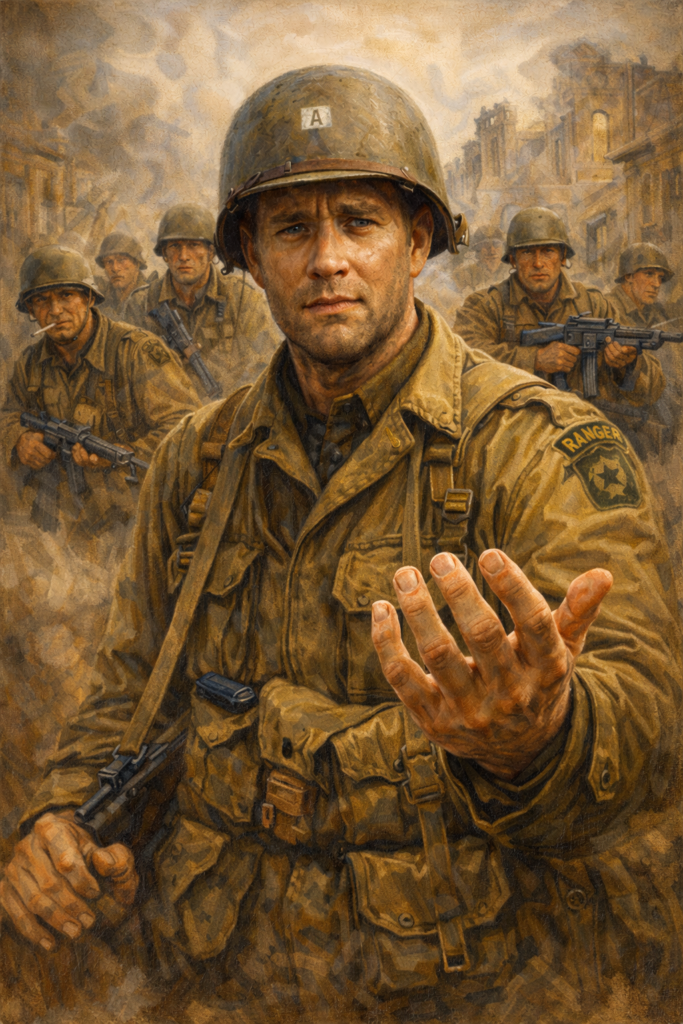

Saving Private Ryan leadership style is embodied in Captain Miller’s deliberate emotional withholding and carefully timed vulnerability. He leads through restraint, protecting his squad from his inner chaos while revealing just enough humanity to anchor their trust, courage, and cohesion amid relentless trauma and moral ambiguity. (Saving Private Ryan Review: Top 10 Leadership Lessons from the Movie)
- Captain Miller leads through emotional distance, not emotional absence, shaping how his men function.
- His guardedness is both trauma management and a strategic leadership choice under extreme stress.
- Spielberg and Hanks craft a model of masculine vulnerability that still resonates with streaming audiences.
Framing Leadership As Emotional Withholding In Saving Private Ryan
When we talk about leadership in war films, we often default to courage, sacrifice, and tactical genius. Captain John Miller complicates that picture. His authority is built less on inspirational speeches and more on what he refuses to show: panic, rage, despair, even hope.
Emotional withholding here is not a lack of feeling. It is the conscious containment of emotion in front of followers, combined with controlled, strategic disclosure at key moments. Miller becomes an emotional firewall for his squad, absorbing shock so they can keep moving.
This makes the Saving Private Ryan leadership style a powerful case study in how cinema fuses psychology, masculinity, and myth-making to shape our sense of what strength looks like under fire. (Leadership in the Crucible of War: Captain Miller’s Story in Saving Private Ryan)
War Cinema, Masculine Leadership, And Emotional Restraint
War cinema has long linked masculine heroism with silence. From classic World War II films to Vietnam dramas, the “good officer” is typically composed, measured, almost surgically in control of his emotions. Tears, doubts, and breakdowns are often shown in private, if at all.
In this tradition:
- Stoicism signals reliability.
- Emotional expression is rationed, often tied to sacrifice or death.
- Leadership is framed as the ability to endure without complaint.
Saving Private Ryan inherits this lineage but also revises it. Spielberg places us in a hyper-real, sensory-assaulting battlefield, yet gives us a commander who rarely externalizes that shock. The film’s realism in violence contrasts with its restraint in emotional exposition.
What shifts is how the film invites us to read that restraint. Instead of treating silence as simple toughness, it invites us to experience it as labor—a continual, exhausting effort to manage fear, grief, and moral injury.
Captain Miller’s Guarded Persona And Key Scenes Of Withholding
Tom Hanks builds Miller from micro-gestures and absences. We learn who Miller is as much from what he will not say as from what he does.
The Hand Tremor: Visible Panic, Hidden Explanation
One of the earliest clues to Miller’s inner life is the recurring hand tremor. The camera isolates it in close-up, often when his men are not watching. It is a betrayal of his body, but not of his composure.
He never explains it, never draws attention to it. This is emotional withholding as damage management: he allows his body to express what his leadership role cannot. The squad notices, but without context, it becomes a quiet mystery that deepens his aura.
“I Don’t Grumble To You”: Refusing Emotional Spillover
In moments of frustration, the men vent openly. Miller does not. When challenged, he tells them directly that he will not share his complaints downward. He withholds not because he is unfeeling, but because he believes that his emotional release would destabilize the fragile order he maintains.
Here, we see the difference between stoicism and deliberate withholding:
- Stoicism suggests a flat emotional experience.
- Withholding implies rich internal emotion, carefully barricaded.
Revealing His Home Life: Controlled Vulnerability
The scene where Miller finally discloses that he is a schoolteacher, with a wife and a life back home, is pivotal. Under pressure from his men’s doubts and near-mutiny, he makes a calculated choice: reveal just enough of himself to restore trust.
The power of the moment lies in its scarcity. Because Miller almost never speaks about himself, this brief confession lands with weight. It converts his authority from purely positional (rank, mission, orders) to relational—suddenly he is not just Captain Miller, but John, a man with stake and history.
The disclosure is still limited. We learn almost nothing specific about his wife, his students, his town. That gap is the essence of his style: vulnerability as precisely dosed information, not emotional overflow.
The German Prisoner Conflict: Withholding Judgment, Withholding Relief
The debate over killing or releasing the captured German soldier exposes fractures in the squad. Anger, grief, and the desire for revenge surge. Miller listens, absorbs, and delays clear emotional alignment with any one position.
He ultimately chooses to release the prisoner—a rational, regulation-driven act—but he does not narrate his own turmoil. He does not attempt an emotional debrief for the men. His choice preserves a certain moral framework, but at the cost of leaving their feelings largely unprocessed.
This is leadership through withholding in its most dangerous form: it keeps the unit moving, but plants seeds of resentment and second-guessing that later return with tragic force.
Trauma, Duty, And The Function Of Emotional Distance In Combat
From a psychological perspective, Miller’s emotional distance functions as compartmentalization—a mental strategy where experiences and emotions are segmented to prevent overload.
In a World War II combat context, this serves several survival functions:
- Protective Shield: By not verbalizing his own fear or grief, Miller attempts to box it off, delaying collapse until the mission is complete.
- Cognitive Clarity: Emotional flooding can impair decision-making. His restraint is a way of preserving a cool head under fire.
- Modeling Regulation: Soldiers often look to leaders for cues on how panicked or calm to be. Miller’s taut calm becomes an emotional thermostat for the squad.
At the same time, this distance has a cost. The ongoing suppression of emotion is a form of emotional labor—continuous internal work to present a composed exterior. In extended campaigns, that labor can contribute to burnout, numbness, or post-war breakdown.
The film does not pathologize Miller with a label; instead, it dramatizes the tension between duty and inner damage. His style is both effective and corrosive—necessary for survival in the moment, but unsustainable as a lifelong way of being.
How Withholding Shapes Trust, Morale, And Authority
Emotional withholding in leadership is ambiguous: it can amplify authority or erode it. Saving Private Ryan shows both sides.
Strengthening Authority Through Mystery
Initially, Miller’s reserve enhances his status. The men project onto him:
- Tactical competence
- Moral clarity
- Emotional strength
Because he reveals so little, they fill in the blanks with idealized attributes. This projection stabilizes the group; they want to believe in a leader who feels less afraid than they do.
Straining Morale When Distance Feels Like Indifference
As the mission drags on and casualties mount, Miller’s silence starts to feel, to some, like emotional abandonment. The German prisoner incident crystallizes this: some interpret his restraint as coldness toward their grief.
We see multiple responses in the squad:
- Obedient trust (those who still believe in his judgment)
- Bitter resentment (those who crave emotional validation)
- Anxious confusion (those unsure what his silence means)
His eventual personal disclosure partially repairs this fracture, proving that targeted vulnerability can reset group cohesion. He doesn’t suddenly become chatty; he simply opens one door, briefly, so they can see the man carrying all that weight.
Pros And Cons Of Miller’s Leadership Style
|
Aspect |
Positive Impact On The Squad |
Negative Impact On The Squad |
|---|---|---|
|
Emotional Withholding |
Maintains composure under fire; prevents panic from spreading. |
Creates emotional distance; some feel unseen or unheard. |
|
Controlled Vulnerability |
Deepens trust when shared; humanizes authority. |
Arrives late, only after tensions escalate. |
|
Moral Restraint (e.g., prisoner choice) |
Upholds rules of war; prevents descent into pure vengeance. |
Fuels resentment and later guilt when outcomes are tragic. |
|
Compartmentalization |
Keeps focus on mission; enables function despite trauma. |
Risks long-term psychological harm and unprocessed grief. |
This balance—authority gained through distance, intimacy gained through rare openness—makes Miller’s approach compelling for both viewers and leadership studies.
How Spielberg And Hanks Show What Miller Won’t Say
The film’s emotional power depends on cinematic craft. Spielberg and Hanks collaborate to externalize an internal life that the script rarely verbalizes.
Framing And Distance
Miller is often framed slightly apart from his men—on a small rise, at the edge of the group, or isolated in close-up while the squad blurs in the background. Visually, he is with them but also other, reinforcing his emotional separation.
In more intimate moments, the camera creeps closer, but still resists the full confessional close-up until crucial scenes, like his home-life reveal. The gradual shift in proximity mirrors the slow opening of his emotional guard.
Sound Design And Silence
Spielberg uses battlefield chaos contrasted with sudden pockets of quiet around Miller. When his hand trembles, the relative hush around the sound of his breath or gear makes his inner fragility more prominent. Silence becomes another form of withheld speech.
Performance Details
Hanks layers Miller with:
- Micro-pauses before answering questions
- Slight deflections with dry humor
- A soft voice that rarely escalates to shouting unless absolutely necessary
These choices build a leader who redirects emotion rather than unleashing it. When he finally lets genuine sorrow and frustration surface, it feels like a dam cracking—precisely because we’ve spent most of the film watching him maintain the wall.
Strength, Courage, And Emotionally Complex Leadership
Captain Miller’s example invites us to rethink what strength and courage can look like—on screen and beyond.
His Saving Private Ryan leadership style is not an instruction manual; it is a dramatization of a man trying to hold his world together by holding himself together. Emotional withholding, for him, is both shield and burden, strategy and scar.
For film enthusiasts, his arc is a reminder of cinema’s power to translate complex psychological realities into gesture, silence, and framed space. For anyone thinking about leadership—whether in creative teams, organizations, or communities—it offers a nuanced challenge:
- Strength is not the absence of feeling; it is the capacity to carry feeling responsibly.
- Courage is not endless composure; it is the willingness to reveal humanity when it matters most.
- Transformation begins when we move beyond simple archetypes—either the unbreakable hero or the endlessly confessing leader—and embrace models that contain both resilience and fragility.
In the end, Miller dies still holding much back. Yet the fragments he does share—his name, his past, his quiet hope that earning this sacrifice will mean something—continue to resonate across generations, rewatches, and platforms. His silence is not empty; it is loaded with all the things he chooses to protect others from. And it is in recognizing that weight that we, as viewers, find a deeper, more compassionate understanding of what emotionally complex leadership can be.
Frequently Asked Questions
What specific leadership tactics define the Saving Private Ryan leadership style used by Captain Miller?
Captain Miller’s Saving Private Ryan leadership style involves suppressing visible signs of trauma, such as his trembling hand, and maintaining a strict barrier regarding his civilian life. By acting as an emotional buffer, he prevents his squad from absorbing his internal panic, ensuring the unit remains focused on mission objectives rather than the commander’s distress.
How does the Saving Private Ryan leadership style differ from traditional stoicism in war cinema?
Traditional war films often portray stoicism as effortless, masculine toughness. In contrast, the Saving Private Ryan leadership style frames emotional distance as a deliberate, exhausting choice. This “burdened stoicism” treats withholding as a strategic tool for trauma management, highlighting the psychological labor required to lead a squad under extreme combat stress.
Which key scenes illustrate the transition from withholding to vulnerability in the Saving Private Ryan leadership style?
The transition is most evident when Captain Miller shifts from hiding his shaking hand and deflecting personal questions to revealing his civilian identity as a schoolteacher. Within the Saving Private Ryan leadership style, this calculated disclosure is used specifically to de-escalate a squad mutiny, humanize the chain of command, and restore unit focus.
What are the primary psychological benefits of the Saving Private Ryan leadership style for the squad?
The Saving Private Ryan leadership style prevents “emotional contagion,” ensuring soldiers are not overwhelmed by their leader’s personal fear. Miller’s restraint provides a stable, reliable anchor for the unit. When he eventually shares personal details, the scarcity of that vulnerability deepens loyalty and strengthens unit cohesion more effectively than constant emotional transparency.
Further Reading & Authoritative Sources
From screenpsyhce
Authoritative Sources
- Decoding Miller: The Character of Protagonist in “Saving Private Ryan” — In-depth character and leadership analysis of Captain John H. Miller in Saving Private Ryan, discussing his moral decision-making, command style, and relationships with his men.