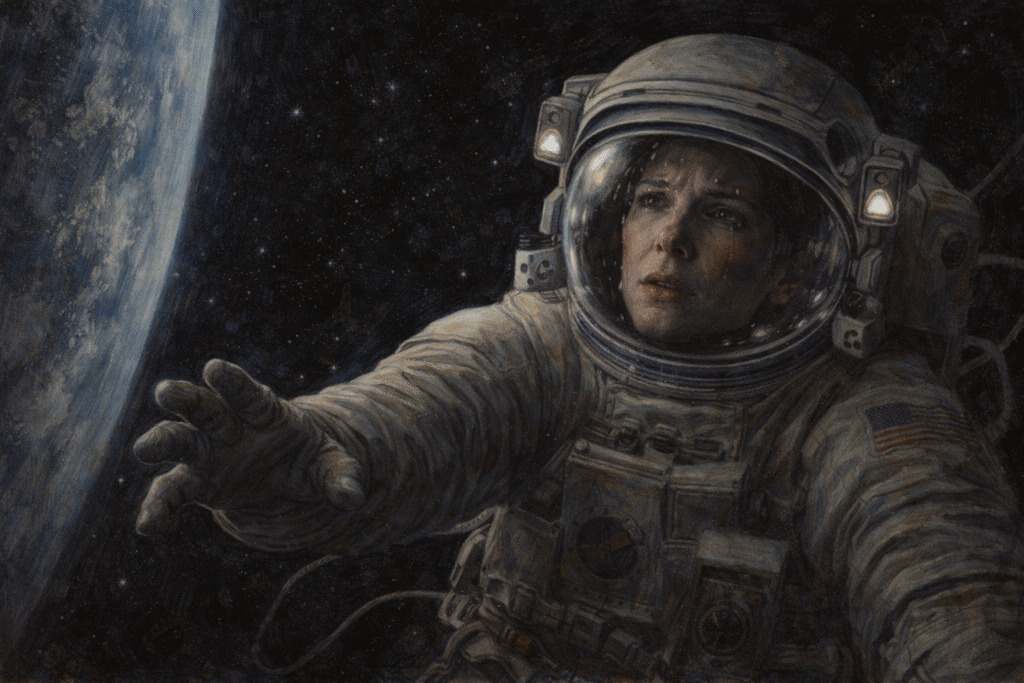

The fear of returning to Earth theme in Gravity centers on Dr. Ryan Stone’s terror of surviving only to crash back into a life emptied by grief. The film turns orbit, silence, and falling into metaphors for dissociation, depression, and the risky choice to re-enter ordinary life after trauma—a choice that gives Ryan Stone’s emotional arc its psychological weight.
- Gravity visualizes unresolved grief as literal drifting, spinning, and weightlessness in space.
- Ryan Stone’s fear of returning to Earth reflects survivor’s guilt, dissociation, and dread of re-entering ordinary pain.
- For writers, the film is a masterclass in externalizing inner conflict with minimal dialogue and psychologically grounded imagery.
Introduction: Surviving When You’re Not Sure You Want To
Gravity gives us one of contemporary cinema’s cleanest psychological journeys in Dr. Ryan Stone. On the surface, it is a survival thriller: debris, oxygen, orbits, re-entry. Underneath, it asks a tougher question: what does it mean to survive when the life waiting for you on Earth already feels like a void? That question drives the fear of returning to Earth theme and turns a space disaster into a study in grief.
From the opening shots, we watch Ryan literally adrift. She’s a mission specialist fixing hardware, not an explorer chasing glory. Matt Kowalski flirts and tells stories; Ryan keeps her responses clipped, functional. This isn’t just rookie anxiety. It’s the emotional baseline of a person living after, not truly living.
The film’s emotional engine is not just “will she make it back to Earth?” but “what is she returning to, and does she want it?” Earth stands for gravity, memory, responsibility, and the knowledge that her daughter is gone. That makes this a powerful case study in grief in storytelling and character psychology.
Ryan Stone’s Backstory: Grief Before the Disaster
We only get a handful of lines about Ryan’s past, but they are devastating. Her daughter died suddenly in a schoolyard accident. No escalating illness, no chance to prepare—just an abrupt shattering of her reality.
Psychologically, that kind of loss often produces:
- Shock and numbness – the mind goes “offline” to protect itself.
- Avoidance – pulling away from reminders, including relationships and places.
- Identity collapse – when your role (parent, caregiver) vanishes overnight.
We see traces of all three in the way Ryan talks about her life on Earth. She drives aimlessly after work because “it’s just driving.” She doesn’t mention friends, family, or a partner. Her “normal” is already dissociated.
So when she goes into space, it is not just a career move. It plays like an extension of that withdrawal. Orbit becomes the physical version of what she has already been doing emotionally: floating above her own life, detached, unreachable. The mission is dangerous, but also strangely safe, because it is far away from the playground and the empty bedroom.
In grief terms, Ryan starts the film somewhere between chronic grief and depressive withdrawal. She functions and works, but there’s no sense of meaning. The catastrophe doesn’t just threaten a happy life; it collides with someone unsure life is worth clinging to.
Space as Psychological Landscape: Orbit, Silence, and the Void
One of Gravity’s strengths is how it externalizes inner states through its setting. Space is not neutral here; it is Ryan’s inner world made visible, turning a survival narrative into a piece of psychological cinema.
Orbit as Dissociation
Dissociation is a trauma response: feeling unreal, detached from your body or surroundings, like you’re watching your life from the outside. The long opening shot—Ryan spinning, tumbling, losing orientation—is a literalization of that experience. (For a clinical orientation, see how Psychology Today describes dissociation as a mental escape from overwhelming events.)
- She can’t tell up from down.
- Her tether snaps and she spins away from the shuttle.
- The radio fills with static, then silence.
That shot of her spinning alone against the black mirrors what grief has already done inside her: she’s been untethered from her old identity, flung into emotional space.
Silence as Emotional Numbness
In space, sound doesn’t travel. The film leans into that: explosions bloom in eerie quiet; debris tears through metal without roar. We mostly hear Ryan’s breath and voice in the suit.
This evokes the emotional muting of traumatic loss. The world looks like it should be loud—catastrophes are happening—but inside, it’s muffled. Ryan’s early flatness matches that quiet; her interior life has gone silent.
The Void as Inner Emptiness
When the camera pulls back to show Ryan as a tiny figure against the infinite black, we get a visual metaphor for her internal state: a single, fragile self surrounded by nothingness. The void is not only the danger of space; it is the hollowed-out center of a life after a child dies.
The film rarely cuts to comforting Earth imagery. When it does—blue curve, sunlit horizon—it is remote. That distance mirrors how far away a grounded, connected life feels to Ryan.

Grief and Trauma in Ryan’s Choices
Instead of explaining Ryan’s psychology in speeches, Gravity lets her decisions reveal it. Several key scenes chart how grief and trauma shape her behavior and deepen the fear of returning to Earth theme.
Initial Panic: Trauma Response in Real Time
When debris first hits, Ryan’s reaction is immediate panic: hyperventilating, spinning, repeating “I can’t breathe.” This is a fight-flight-freeze surge.
Yet even here, we see a push-pull:
- She follows Kowalski’s instructions, counting her breaths, focusing.
- But there’s an undercurrent of despair—she’s not anchored to a strong will to live.
Her panic is about dying, but it’s also about confronting death again so soon, before she’s processed the last one.
The Near-Resignation: Suicidal Ideation in the Capsule
In one of the film’s most honest moments, Ryan turns down the oxygen in the Soyuz capsule, curls into a fetal position, and prepares to drift into unconsciousness.
She speaks over the radio to a stranger, listening to the sounds of a baby and dogs on Earth. There’s no melodrama. Just:
- Exhaustion.
- The belief that everyone she loves is gone.
- A sense that her death will not disrupt anyone’s life.
This is suicidal ideation framed as relief. She’s sliding toward the path that feels least painful: not having to return to a world defined by her daughter’s absence.
The Imagined Kowalski Visit: Attachment and Inner Dialogue
When Kowalski “returns” to the capsule, unlocking the hatch and floating in, we eventually realize it’s a hallucination—an internal conversation using his voice.
Psychologically:
- Kowalski has acted as a secure, steady presence—a temporary attachment figure in space.
- When Ryan is at her lowest, her mind borrows his voice to argue for life.
- He reframes the situation and points to a way out.
This imagined visit is Ryan’s survival-oriented self finally speaking up, using Kowalski’s tone because she trusts it more than she trusts herself.
Fear of Returning to Earth: Gravity as Pain and Responsibility
On a plot level, Ryan’s goal is simple: get back to Earth alive. Psychologically, it’s more complicated. The fear of returning to Earth is not only about burning up in the atmosphere; it’s about surviving the landing and then… what?
Earth as Memory and Mourning
Earth carries everything she has been orbiting to avoid:
- The playground where her daughter fell.
- The people who might remember and ask questions.
- The physical spaces that used to be filled with her child.
In grief terms, re-entry equals re-engagement with those painful memories. Ryan’s ambivalence about survival is tied to this: if she lives, she may have to feel again.
Survivor’s Guilt and the Question “Why Me?”
There’s an unspoken comparison: her child died in a random accident; Ryan repeatedly survives impossible situations. This feeds survivor’s guilt: Why did I live when she didn’t? What right do I have to crawl back onto that planet alone? Organizations such as the National Alliance on Mental Illness note that this kind of guilt is a common, if painful, part of grief after sudden loss.
Her earlier withdrawal is one response: live small, don’t want too much, don’t risk loving again. The disaster forces the question: will she continue to orbit pain forever, or risk coming back down into it?
The Weight of Gravity
The title’s metaphor lands most clearly in the final sequence. Gravity is not just a physical force; it’s:
- The pull of relationships.
- The weight of grief and responsibility.
- The heaviness of being fully embodied and present.
Returning to Earth means accepting that weight again after years of psychic weightlessness. The fear of returning to Earth theme is, at its core, the fear of choosing to feel and to risk new connection when you know how badly it can hurt.
Sandra Bullock’s Performance: Showing Ryan Stone’s Psychology Without Words
None of this psychological depth would land without Sandra Bullock’s performance as Ryan Stone in Gravity. With very little dialogue and long stretches of isolation, Bullock has to carry grief, terror, and the slow return of a will to live almost entirely through physicality and micro-expression.
Notice how her body tells the story:
- Early in the film, her movements are hesitant and slightly stiff, even before the disaster. She feels like someone going through motions, not savoring the experience of space.
- During the debris storms, Bullock lets Ryan’s panic show up in fragmented breathing, clipped phrases, and a wide-eyed stare that suggests old fear being ripped open rather than brand-new terror.
- In the Soyuz resignation scene, her face slackens, her voice softens, and her whole posture curves inward. It’s less a dramatic breakdown and more a slow folding in on herself, which aligns with depressive withdrawal.
- After the hallucinated Kowalski scene, there’s a subtle shift: her movements are still frightened and shaky, but more purposeful. Bullock lets resolve show up as tiny, repeated choices to keep going.
For searchers interested in Sandra Bullock’s Gravity character, this is where performance and psychology lock together. Her acting choices make Ryan’s internal conflict legible without ever overstating it. You feel the dissociation in her distant gaze, the survivor’s guilt in the way she hesitates before saving herself, the fragile courage in the way she hauls her body up after re-entry.
If you’re a writer or director, Bullock’s work is a masterclass in embodying internal conflict. If you’re crafting a character like Ryan, you can think in similar layers: what does grief do to their posture, their breath, their eye contact? How does a renewed will to live start to show up before they ever say it out loud? That’s how you turn an abstract fear of returning to Earth into specific, emotionally resonant behavior.
Broader Mental Health Reflection and Conclusion
For anyone who has lost someone or something central—whether a person, a relationship, or a version of yourself—Ryan’s journey can feel familiar. There is the phase of drifting, when days blur and you float through routines. There is the quiet fantasy of not having to come back down into the full weight of feeling.
Across the film, we watch a complete psychological arc unfold. Ryan begins in numb, dissociated grief, already emotionally “off planet” before the debris hits. Space then becomes a living metaphor for her inner world: orbit as dissociation, silence as emotional muting, the void as the hollow center of bereavement. Her choices—panic, resignation, the dreamlike conversation with Kowalski—reveal how trauma, survivor’s guilt, and the fear of returning to Earth pull her toward giving up.
What changes is not the physics of re-entry but the meaning she assigns to surviving. In the capsule, after deciding not to die, she reframes coming home: not as returning to the exact life she had with her daughter (which is impossible), but as choosing to be present in whatever life is left. That shift from “there’s nothing for me on Earth” to “I’m still here, so I’ll keep moving” is the essence of her emotional rebirth.
From a film-psychology perspective, Gravity becomes more than a space survival movie; it’s a story about returning to ordinary life after extraordinary pain. The fear of returning to Earth theme captures that moment when you eye the future and think: I know what gravity feels like. I know how hard it can pull me to my knees. Do I really want to step back into that?
Ryan’s answer, by the end, is not a speech; it is a posture. She staggers, falls, and then stands. She allows herself to be heavy again. She lets the planet hold her up and weigh her down. Healing, the film suggests, looks less like forgetting and more like daring to be grounded while carrying the memory of what we lost.
If you’re a storyteller, Ryan Stone’s arc in Gravity is a blueprint for psychologically rich survival narratives. Define what “Earth” symbolizes for your character, let their avoidance shape the plot, and make the return a conscious, fragile choice. If you’re a viewer navigating your own returns to Earth, that final image offers a quiet kind of hope: a human being, unsteady but upright, choosing, one breath at a time, to live under gravity instead of drifting in the dark.
Frequently Asked Questions
How does Gravity portray the fear of returning to Earth theme through Ryan Stone’s grief and survivor’s guilt?
Gravity portrays the fear of returning to Earth theme by linking Ryan Stone’s grief over her daughter’s death with survivor’s guilt. Her hesitation to fight for survival reflects a dread of resuming a life defined by loss, where landing on Earth means facing memory, responsibility, and ongoing emotional pain.
Why is space depicted as a psychological landscape for the fear of returning to Earth theme in Gravity?
Space is depicted as a psychological landscape by turning orbit, silence, and weightlessness into metaphors for dissociation and depression. Ryan’s drifting and spinning represent emotional numbness, making the fear of returning to Earth a conflict between staying in the void and re-entering a grounded, painful reality.
How does Ryan Stone’s backstory intensify the fear of returning to Earth theme in Gravity?
Ryan Stone’s backstory of losing her daughter in a sudden accident intensifies the fear of returning to Earth theme by establishing Earth as a place of shattered normalcy. Surviving the disaster means returning to a life that already feels empty, heightening her internal resistance to landing and moving on.
In what ways do Ryan Stone’s choices during the mission reveal the fear of returning to Earth theme?
Ryan’s choices, such as her initial passivity, near-surrender in the capsule, and later decision to fight, reveal the fear of returning to Earth theme. Each decision dramatizes an internal struggle between giving up in the void of space and accepting the burden of living with grief back on Earth.
How can writers use Gravity’s fear of returning to Earth theme as a model for externalizing inner conflict?
Writers can use Gravity’s fear of returning to Earth theme by turning psychological states into physical obstacles. Ryan’s limited dialogue, dangerous orbits, and oxygen shortages mirror her internal trauma, showing how external stakes can embody grief, avoidance, and ultimately, the difficult choice to live.
Further reading & authoritative sources
From screenpsyhce
- psychology of isolation — Understand how extreme detachment and self-imposed exile shape a character’s internal world in our analysis of Sherlock Holmes.
Authoritative sources
- describes dissociation as a mental escape — Understand the psychological mechanism of dissociation and how the mind detaches from reality during trauma.
- National Alliance on Mental Illness — Read personal stories and expert insights on navigating grief, survivor’s guilt, and the path to healing.