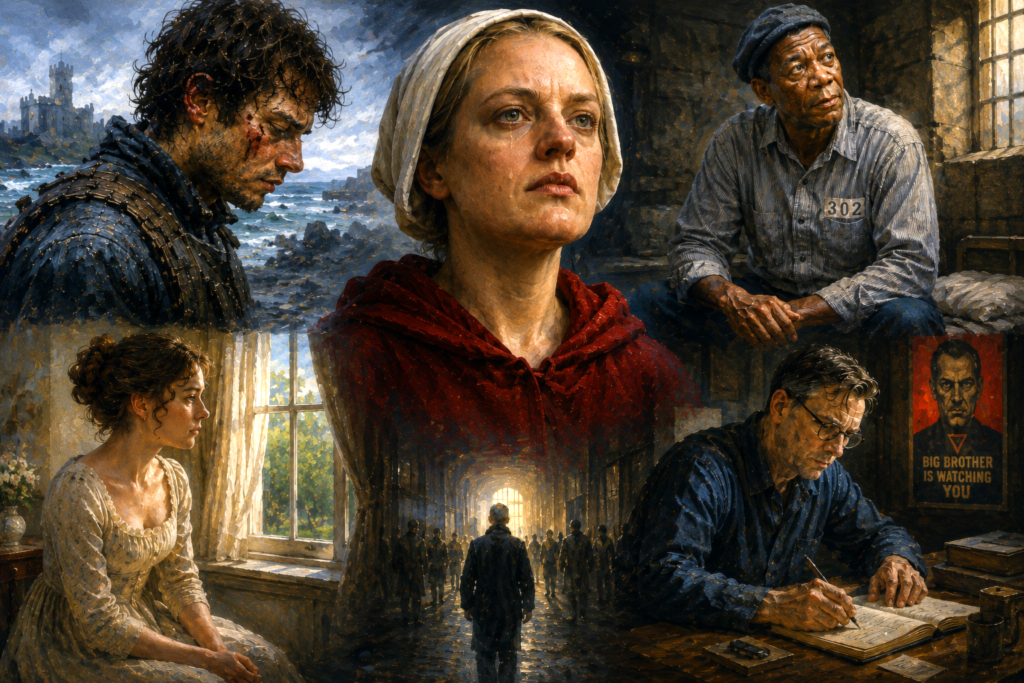

Learned helplessness in abusive relationships and workplaces is a state where people, after facing repeated hurt or blocked efforts, start to believe their actions no longer change anything. On screen and on the page, this often appears as the haunting moment when a character quietly stops fighting. (Learned Helplessness and Domestic Violence)
- Stories about powerlessness help us recognize similar patterns in modern life and emotions.
- Learned helplessness is an adaptation to repeated defeat, not a personal weakness or flaw.
- Small acts of resistance and choice can slowly rebuild a sense of agency and inner freedom.
Hello, Welcome To Screenpsyche
Hello friend, and welcome to Screenpsyche.
Learned helplessness is one of the most unsettling ideas in psychology on screen: the moment when a character stops believing their actions matter. It can feel like watching a light go out. Yet these stories also illuminate how that light can flicker back to life. (Learned Helplessness)
We see it in abusive relationships and workplaces, in cruel regimes and rigid social systems. Film and literature hold up a mirror to the instant when people stop trying because the world has taught them that trying only brings more pain.
Today, we will walk together through some iconic character arcs and agency: Theon Greyjoy, June Osborne, the prisoners of The Shawshank Redemption, Charlotte Lucas, and Winston Smith, connecting their journeys to modern life—and to your own quiet, powerful capacity to choose again.
Learned Helplessness In Simple, Human Terms
Forget the jargon for a moment. Let’s talk feelings.
Learned helplessness is what happens when you keep trying to change something important—your safety, your job, your relationship—and every effort is blocked, punished, or ignored. After enough of that, a painful belief can settle in:
“Nothing I do will make a difference.”
It is less about what is possible and more about what you have been taught to expect. The pattern is usually:
- You act.
- You get hurt or see no change.
- You act again.
- Same result—or worse.
- Eventually, your mind starts to protect you by whispering, “Stop. It’s useless.”
In abusive relationships and toxic workplaces, this can look like:
- Never speaking up about unfair treatment because past attempts led to retaliation.
- Staying quiet in meetings because your ideas were mocked or stolen.
- Feeling frozen in a harmful situation because every past exit door slammed shut.
This is not weakness. It is a survival strategy—your brain trying to avoid more damage. Stories that show this honestly help us see how these beliefs form, and how they might slowly, carefully, be unlearned.
Theon Greyjoy: When The Prison Moves Inside The Mind
Theon begins Game of Thrones as proud, impulsive, and desperate to prove himself. He wants to belong, to be seen as powerful. That hunger drives him into terrible choices and, eventually, into Ramsay Bolton’s hands.
Ramsay does not just imprison Theon. He breaks the link between action and outcome:
- Theon begs, and is mocked.
- He obeys, and is still punished.
- He tries to escape, and his punishment escalates.
Over time, the prison moves from the dungeon into Theon’s inner world. He becomes “Reek,” a name that signals how fully Ramsay has rewritten his identity. We watch him flinch before commands, anticipate pain, and even betray possible rescuers because he believes resistance only makes things worse.
This is the heart of learned helplessness on screen: a character who has been taught that any move leads to suffering, so doing nothing feels safer.
Tiny sparks appear:
- Moments where he hesitates instead of obeying cruelty.
- Splits in his loyalty when he remembers the Starks.
- Eventually, active choices to protect others.
Those small internal shifts are his character arc back toward agency. They do not erase the trauma, but they show something crucial: learned helplessness can soften when new experiences slowly teach, “Maybe this time, action might matter.”
June Osborne: Fighting For The Inner World
In the early seasons of The Handmaid’s Tale, June lives inside a theocratic nightmare. Her body is controlled, her family torn away, her every move watched. Gilead is built to install learned helplessness: to convince women that resistance is pointless and dangerous.
What makes June’s story powerful is her oscillation between despair and defiance. Some days, she appears to surrender—to survive. Other days, she risks everything for a small act of rebellion.
Her inner battle is exactly about perception of control:
- When she sees that allies exist, her belief in action strengthens.
- When rebellions fail or loved ones are hurt, the “why fight?” voice gets louder.
June’s character arc shows that belief in agency is not a straight line. In abusive systems or workplaces, people often move back and forth between hope and hopelessness. That does not mean they are weak; it means they are human, adjusting to shifting evidence about what is safe. The Psychological Impacts of Totalitarianism in Dystopian Literature
Viewers recognize their own experiences of mixed courage and fear, especially in structures that feel bigger than any one person—corporate cultures, institutions, even family dynamics.
Shawshank Prisoners: When The Walls Live In Your Head
The Shawshank Redemption gives us one of cinema’s clearest portraits of institutionalization.
Men like Brooks and Red have spent so long inside the prison that the outside world feels more terrifying than their cells. The prison has given them a script:
“Out there, you are nothing. In here, you know the rules.”
Years of having decisions made for them erode their sense that their own choices matter. We see this in:
- Fear of parole instead of relief.
- Paralysis when freedom finally comes.
- The tragic difficulty of building a life beyond the walls.
This is learned helplessness without an obvious villain in the room. The system itself trains people to stop dreaming beyond it.
Andy Dufresne, however, quietly resists. For him, small actions—scratching at the wall, building the library, playing music over the speakers—rebuild the connection between action and outcome. Each successful risk whispers, “You can shape something.”
That contrast shows both how suffocating helplessness can be and how powerful even a secret inner plan feels.
Glossary Of Key Story Terms
| Term | How It Shows Up In These Stories | Why It Matters For Us |
|---|---|---|
| Learned Helplessness | Characters stop acting because they expect nothing will change | Helps us notice similar beliefs in our own lives |
| Agency | The sense that your choices shape events | Central to character arcs and our mental wellness |
| Institutionalization | Adapting to rigid systems until they feel like home | Explains fear of change, even when freedom appears |
| Emotional Resonance | The feeling of “I know this” when watching a scene | Turns media into gentle narrative therapy |
| Catharsis | Emotional release when a character finally acts or breaks down | Can inspire us to dream of our own turning points |
Charlotte Lucas: Survival Inside A Narrow World
In Pride and Prejudice, Charlotte Lucas makes a choice that often frustrates modern readers: she marries Mr. Collins, a man she does not love, for security.
There is no overt abuse here, no dungeon or torture. Instead, the constraint is social structure. As a woman with limited prospects, Charlotte sees the pattern clearly:
- Staying single means poverty and dependence.
- Romantic love is a luxury she has not been taught to expect.
- This proposal is, realistically, her safest route.
Charlotte is not defeated so much as deeply pragmatic. Her “learned helplessness” is about belief in options: the world has shown her that certain dreams are out of reach, so she stops investing energy in them.
This resonates with anyone who has ever:
- Stayed in a dull but stable job because the risk of change felt too high.
- Lowered their standards in dating or friendship out of fear of being alone.
- Accepted unfair treatment because the system seemed immovable.
Charlotte’s choice is not evidence of a weak character; it is a commentary on a restricted world. Stories like hers remind us to ask: are we truly choosing freely, or from a menu that was cut down long before we arrived?
Winston Smith: When Resistance Loses Its Meaning
In Nineteen Eighty-Four, Winston begins with a flicker of rebellion. He writes in a diary, pursues forbidden love, dares to imagine another reality.
The regime, however, is not satisfied with obedience. It wants surrender. It does not just punish resistance—it erases the very belief that resistance has meaning.
Through propaganda, surveillance, torture, and constant rewriting of truth, the Party attacks Winston’s sense of cause and effect:
- If truth can be changed at will, what good is speaking it?
- If every rebel is already watched, what good is plotting?
- If love can be extracted from your deepest self, what good is feeling it?
By the end, Winston’s learned helplessness is complete. He no longer believes his actions matter, not because they are ineffective in a practical sense, but because he accepts the Party’s reality. When he says he loves Big Brother, we are witnessing the final collapse of agency.
Why These Stories Hit So Hard
These arcs echo our own fears about when characters stop fighting—and when we do.
We watch Theon, June, Charlotte, the Shawshank prisoners, and Winston and feel:
- The fear of being stuck in a job, relationship, or system forever.
- The ache of seeing someone slowly stop dreaming.
- The rush of catharsis when a character finally says, “Enough,” or quietly chooses a different path.
These narratives act like shared dreamscapes where we can explore powerlessness, hope, resignation, and courage at a safe distance. This is digital storytelling as narrative therapy: we project, we feel, we release, and sometimes we discover new language for our own lives.
Closing Reflection: Freedom Outside And Inside
The stories we love keep reminding us that freedom has two layers:
- Outer freedom: the systems, relationships, and workplaces we live in.
- Inner freedom: the quiet belief that our choices still have meaning.
When both are blocked, learned helplessness grows. When even one begins to open—an ally appears, a system shifts, a new belief forms—the character arc can bend toward hope.
Screenpsyche believes in your capacity to dream and achieve new chapters, even if right now your story feels paused in a difficult scene.
As you move through your week, you might gently ask yourself:
- Which character’s journey felt closest to mine?
- Where have I learned that my actions do not matter—and is that still fully true today?
- What is one small, kind choice I can make for myself that honors my agency?
If you feel moved, you are warmly invited to reflect on other films, shows, or books where a character’s helplessness spoke to you—or where their quiet courage helped you believe in your own.
Your story is still being written, and your next line can be one of quiet, powerful choice.
— Screenpsyche
Frequently Asked Questions
What are early warning signs of learned helplessness in abusive relationships and workplaces?
Early signs include apologizing for events outside your control, minimizing your own needs, and feeling numb rather than angry. You may notice an automatic tendency to blame yourself for failures, a loss of motivation to seek improvements, or feeling strangely calm in situations that are clearly unfair or unsafe.
How does learned helplessness in abusive relationships and workplaces specifically impair decision-making?
This psychological state narrows your perceived sense of choice, often leading to decision paralysis or defaulting to inaction. Even when realistic exits or support systems become available, they may feel invisible or unattainable, causing individuals to remain in harmful environments long after safer alternatives have been clearly established.
Why do individuals often stay in toxic environments when facing learned helplessness?
Repeated punishment and blocked attempts to improve a situation convince the brain that escape is impossible. Over time, exhaustion, financial dependence, and trauma bonding merge with learned helplessness, making staying feel safer and more predictable than the perceived terror of the unknown or the risk of further retaliation.
What small steps can begin to undo learned helplessness in abusive relationships and workplaces?
Recovery typically begins with low-risk choices: journaling feelings, reality-checking with a trusted friend, or documenting specific incidents. Each tiny act of autonomy—such as setting a single boundary or researching a support service—gradually retrains the nervous system to recognize that your individual actions can still produce meaningful, positive change.
Which fictional characters best illustrate the impact of learned helplessness in abusive relationships and workplaces?
Characters like Theon Greyjoy in Game of Thrones and June Osborne in The Handmaid’s Tale exemplify this conditioning. Their stories provide emotional validation for survivors, demonstrating how prolonged abuse can erode the will, while also modeling how agency can eventually be reclaimed through small, strategic, and persistent acts of resistance.
Further Reading & Authoritative Sources
From screenpsyhce