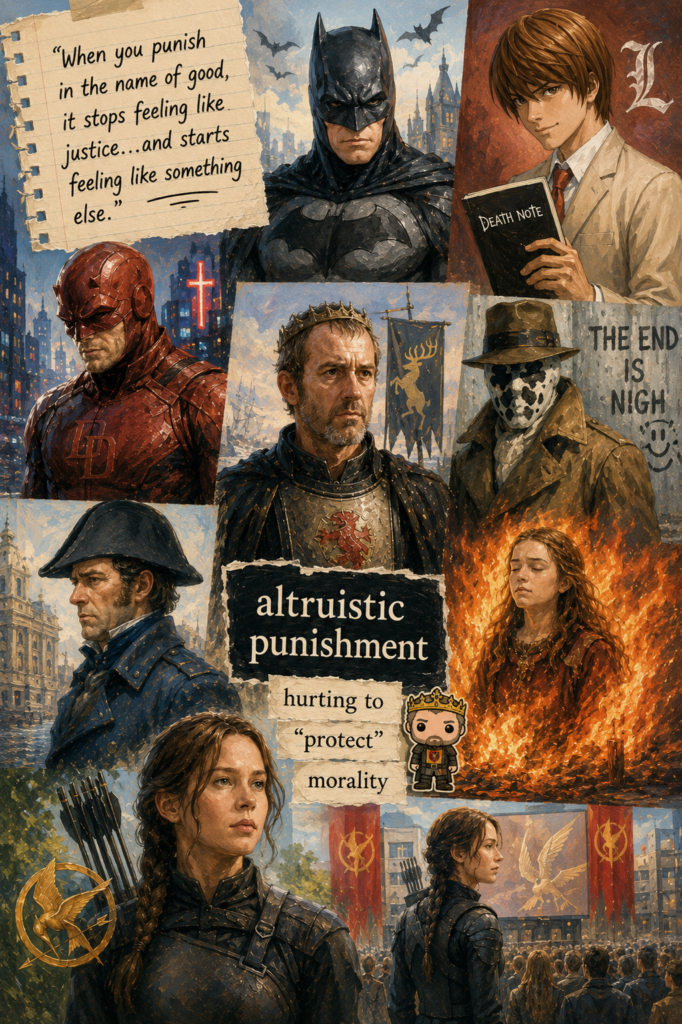

Altruistic punishment is when someone hurts, controls, or punishes others in the name of a “greater good.” Characters like Batman, Light Yagami, or Game Of Thrones’ Stannis Baratheon embody this, revealing how stories explore morality, justice, and the heavy psychological cost of becoming the punisher. (The philosophy of Stannis Baratheon)
- Altruistic punishment makes hurting others feel righteous, even loving, inside the story world.
- Each “moral punisher” character exposes a different mix of justice, trauma, and rigid belief.
- Our reactions to these characters can guide us toward kinder, repair-focused ideas of justice.
When Hurting Feels Heroic: The Pull Of Punishment Stories
Picture this: Batman hanging a criminal off a rooftop, growling for answers. Or Light Yagami calmly writing a name in the Death Note, convinced the world will be safer without that person alive. According to Nature, this analysis holds true.
On paper, that is violent, terrifying behavior. But in the moment, many of us feel a rush of, “Yes. Finally. Someone is doing something.”
Screen stories are full of characters who hurt, control, or punish “for the greater good”—from Gotham’s vigilantes to Game Of Thrones Stannis Baratheon morality arcs on the frozen shores of Westeros. At Screenpsyche, we explore why these characters resonate so deeply, and what they whisper about our own sense of justice, pain, and hope. (Violence, Politics, and Religion: Cosmic War in Game of Thrones) Altruistic punishment in humans
Let’s unpack the psychology behind altruistic punishment, and walk through Batman, Daredevil, Rorschach, Javert, Stannis, Light, and Katniss as different faces of the same haunting question:
How far is too far when we believe we are right?
What Altruistic Punishment Actually Is (And Why It Feels So Good)
In psychology, altruistic punishment is when someone accepts a cost to themselves—time, money, safety, even peace of mind—to punish someone who broke a rule or harmed others.
Key pieces:
- The punisher believes they are protecting the group or defending morality.
- They often don’t benefit personally in any simple way.
- They may even suffer for doing it.
In real life, that might look like reporting a coworker for serious misconduct even if your team will hate you, or testifying in court against a dangerous person and risking retaliation.
In digital storytelling and popular media, we just crank the volume up:
- Batman risks his life every night to punish criminals the legal system misses.
- Rorschach chooses death over compromising his moral code.
- Game Of Thrones Stannis Baratheon morality turns him into a man who sacrifices almost everything—including people he loves—for what he sees as rightful justice.
From a media-psychology angle, altruistic punishment hits several emotional buttons at once:
- Fairness hunger: We have a deep, almost primal need to see wrongs addressed.
- Catharsis: Watching punishment can release our own bottled anger and frustration.
- Moral clarity: The world feels safer when someone “draws a hard line.”
Stories let us explore this urge without actually harming anyone—and to notice when “justice” starts to look a lot like obsession, cruelty, or moral injury.
The Vigilantes: Batman, Daredevil, And Rorschach
Let’s start with three figures known as gritty, night-time moral enforcers.
Batman: The Broken Protector
Batman is classic altruistic punishment in a cape. Bruce Wayne is rich enough to walk away from Gotham, but he chooses the grind of endless, dangerous nights.
- Motivation: Childhood trauma (his parents’ murder) makes him obsessed with preventing similar harm.
- Method: Non-lethal, but brutal; he uses fear, intimidation, and violence.
- Belief: “The system fails. I have to be the one who draws the line.”
Psychologically, Batman’s punishment crusade is also self-punishment. He carries survivor’s guilt and unresolved grief, and his “mission” gives that pain somewhere to go.
Daredevil: Faith, Guilt, And The Body As A Battleground
Daredevil (Matt Murdock) blends religious guilt with superhero vigilantism.
- By day: Lawyer trying to work inside the system.
- By night: Masked fighter who takes law into his own hands.
- Inner conflict: Catholic faith vs. violent justice, compassion vs. rage.
For Daredevil, altruistic punishment is tangled with self-worth. He bleeds for his city because on some level he feels he should hurt to be good. His body becomes the receipt for his moral seriousness.
Rorschach: Moral Absolutism Turned Weapon
Rorschach from Watchmen shows us altruistic punishment without flexibility.
- Worldview: Pure black-and-white; no nuance, no context.
- Punishment: Extreme, often lethal, justified by a rigid, personal code.
- Choice: He would rather die than accept a morally gray compromise.
Rorschach’s story warns us: when you believe you are the moral law, everyone else becomes an object to control or erase. The altruism (“I protect the innocent”) is real—but so is the harm.
Law, Duty, And Fire: Javert, Stannis, And Light
Now let’s look at three characters whose idea of the “greater good” is built on law, destiny, or godlike power.
Javert: The Man Who Married The Law
In Les Misérables, Inspector Javert is convinced that law and morality are the same thing.
- Belief: Rules are absolute; mercy equals corruption.
- Target: Jean Valjean, a man Javert hunts for years over a stolen loaf of bread.
- Crisis: When Valjean shows him mercy, his worldview shatters.
Javert’s altruistic punishment is about order. He believes the world is safer when the law is strict and unforgiving. When reality proves more complicated, he cannot live with the emotional dissonance.
Game Of Thrones Stannis Baratheon Morality: Justice At Any Cost
Game Of Thrones Stannis Baratheon morality arcs are some of the bleakest and most fascinating in modern TV.
- Identity: The “rightful king,” obsessed with rightful claim and justice.
- Influence: Melisandre’s prophecy and religious zeal frame his actions as destiny.
- Line Crossed: He sacrifices his own daughter, Shireen, believing it will save his cause.
Stannis is a powerful portrait of moral injury: that internal wound you get when you do something that violates your core values.
He punishes in the name of a kingdom, of law, of prophecy—but each step isolates him more. By the time he burns Shireen, his altruistic punishment has become indistinguishable from cruelty, even though in his own mind he is making the ultimate, necessary sacrifice.
Light Yagami: The God Of The New World
In Death Note, Light Yagami gets a notebook that can kill anyone whose name he writes down. He decides to erase criminals to create a crime-free utopia.
- Early framing: “If I just kill the worst people, the world will be safer.”
- Shift: He starts killing anyone who threatens his mission, not just criminals.
- Self-image: Not just a hero—a god.
Light is altruistic punishment mixed with grandiosity. The “greater good” becomes an excuse to erase anyone in his way. The disturbing part: many viewers still feel a flicker of sympathy because the core desire—less suffering, more safety—is understandable.
The Martyr And The Rebel: Katniss And The Weight Of Symbolism
Katniss Everdeen: Punisher By Proxy
Katniss isn’t out there cracking skulls for fun. But The Hunger Games places her at the center of a violent resistance, where punishment becomes symbolic.
- The Games: A state-sponsored punishment system dressed as entertainment.
- The Mockingjay role: Katniss becomes the face of punishing the Capitol.
- Inner conflict: She wants survival and protection for loved ones, not endless cycles of revenge.
Her story complicates altruistic punishment by asking: when we overthrow a cruel system, can we avoid becoming what we hate? Katniss repeatedly resists being weaponized, pointing toward repair and protection rather than pure retribution.
Quick Guide: Punisher Archetypes In Popular Media
Here is a simple view of how these characters map onto different “moral punisher” archetypes.
| Character | Core Archetype | What They Protect Most | Main Risk To Their Psyche |
|---|---|---|---|
| Batman | Traumatized Vigilante | Innocents / Gotham | Isolation, endless self-blame |
| Daredevil | Guilty Martyr | Neighborhood / moral soul | Burnout, self-destructive guilt |
| Rorschach | Moral Absolutist | Personal code | Inability to empathize |
| Javert | Law Zealot | Order and rules | Identity collapse |
| Stannis Baratheon | Rigid Justice King | Claim / “rightful” order | Moral injury, loneliness |
| Light Yagami | Godlike Reformer | Vision of a pure world | Megalomania, loss of empathy |
| Katniss Everdeen | Reluctant Symbol | Loved ones / oppressed | Trauma, being used by others |
Tables like this flatten nuance, but they can help us see patterns: different flavors of altruistic punishment, different emotional prices.
The Emotional And Mental Health Cost Of Being The Punisher
When characters step into the role of punisher, they don’t just change the world around them—they change inside.
Common emotional themes:
Guilt And Moral Injury
- Stannis cannot outrun the horror of what he does to Shireen.
- Javert cannot integrate mercy into his hard-coded sense of right and wrong.
Moral injury happens when we act against our deepest values, even in the name of survival or a supposed greater good. Stories like these invite us to feel that inner tear.
Isolation And Loneliness
- Batman lives in a cave, literally and emotionally.
- Rorschach cuts himself off from almost everyone.
- Light pretends to be a normal student while hiding a god-complex secret.
Once your identity is built around punishing others, intimacy gets dangerous. If people got close, they might question you—and you might have to question yourself.
Obsession And Burnout
Daredevil’s body keeps the score: bruises, broken bones, exhaustion. Katniss is drawn again and again into battles she does not want, carrying more trauma each time.
- Hypervigilance (always scanning for threats)
- Emotional numbing to cope with what they do or witness
- Intrusive memories and nightmares (especially in war- and resistance-themed stories)
These characters show us that living as the punisher is not free. It costs sleep, joy, relationships, even your own sense of self.
Let’s Keep Exploring This Together
If any of these characters hit close to home—if you see your own anger, grief, or sense of responsibility reflected in them—you are not alone.
- Which character’s version of altruistic punishment resonates with you most?
- Where do you feel a hard “No, that is too far” in your body when you watch?
- What kinds of justice stories feel healing, not just satisfying, for you?
Screenpsyche is all about connecting through emotionally honest, psychologically aware storytelling. Share this with a friend, start a conversation, or keep exploring similar characters and arcs.
Together, we can move from simply cheering the punisher… to imagining worlds, on-screen and off, where justice and compassion actually walk side by side.
Frequently Asked Questions
What defines the altruistic punishment found in Game of Thrones Stannis Baratheon morality?
Stannis Baratheon’s morality is defined by the belief that any personal sacrifice—including his own family—is justified to uphold the law. This psychological phenomenon, known as altruistic punishment, frames his brutal enforcement of justice as a selfless burden he carries for the protection of the realm rather than an act of malice.
Why is the Shireen sacrifice the turning point for Game of Thrones Stannis Baratheon morality?
The Shireen sacrifice represents the moment Stannis Baratheon’s morality shifts from harsh discipline to fanatical altruistic punishment. By burning his heir to appease a deity, he prioritizes abstract duty over basic human empathy, proving that his rigid adherence to order has completely overridden the compassion required for legitimate and stable leadership.
How does Game of Thrones Stannis Baratheon morality compare to Batman’s sense of justice?
Both Stannis and Batman operate as self-appointed moral punishers who accept social isolation and personal pain to enforce order. However, while Batman’s code usually forbids killing to avoid becoming the evil he fights, Game of Thrones Stannis Baratheon morality views execution as a necessary tool to purge corruption and maintain law.
What distinguishes Game of Thrones Stannis Baratheon morality from Javert’s obsession with law?
Stannis and Javert both treat the law as a sacred, immutable force that sits above personal relationships. While Javert focuses on the letter of the law to punish individuals, Stannis Baratheon’s morality frames his adherence to duty as a cosmic necessity, showing how obsessive loyalty to abstract rules can eventually erase mercy.
What are the consequences of the rigid Game of Thrones Stannis Baratheon morality on his leadership?
Stannis Baratheon’s rigid morality creates a psychological savior complex that leads to total social isolation. By viewing himself as an altruistic punisher, he believes his own suffering justifies his cruelty. This mindset eventually blinds him to the fact that his pursuit of a “righteous” order has destroyed his family and his legacy.
Further Reading & Authoritative Sources
Authoritative Sources
- What Game of Thrones Reveals about Moral Decision-Making — Scientific American piece using Game of Thrones as case studies for moral psychology and decision-making; while not only about Stannis, it provides an authoritative framework (e.g., instrumental harm, moral trade-offs) that can be applied to interpreting Stannis’s morally motivated but harmful actions, akin to altruistic punishment.