
Last updated: September 25, 2026
Steam curls from a paper cup as a crowd freezes around a flickering news report, and one worn-out man quietly decides it hurts less to spike his drink than to care what happens next.
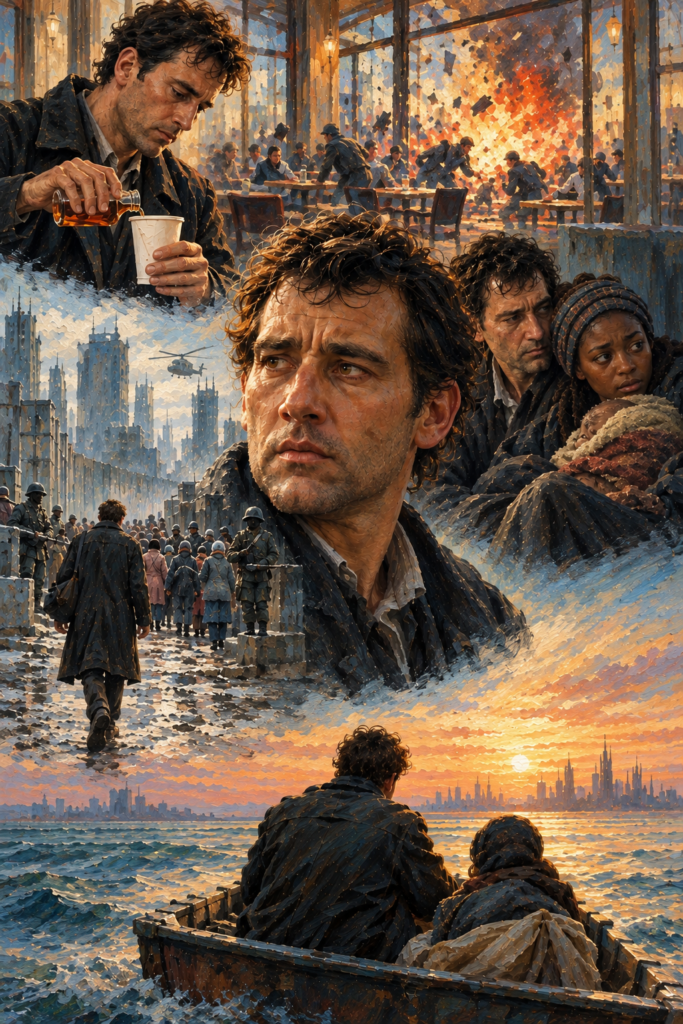
The coffee shop blows apart in a roar of glass and fire. Theo flinches, steps away from the wreckage, and calmly tips whiskey into his paper cup. In that single “whiskey sprinkle,” Children of Men frames a man who would rather numb out the end of the world than feel it. Across the film, Theo moves from that numbing cynicism and passive survival to active, relational courage—a psychological journey where hope becomes something practiced, not merely felt.
Theo’s Cynicism Feels Familiar Because Burnout Feels Current
When we look at Theo Faron’s world in Children of Men, we can see an extreme reality built around a form of burnout that feels uncomfortably current.
In 2027, after nearly two decades of human infertility, society is disintegrating under authoritarianism and violence. Mass displacement has become part of this world. Theo moves through it like a ghost: functioning and drinking, though not really living.
His cynicism lands hard because many of us recognise the pattern. Political fatigue and climate dread wear us down. A constant stream of bad news makes caring feel painful and pointless, while Children of Men quietly asks whether our numbness must be the end of the story.
Theo Survives by Keeping His Distance
When we first meet Theo Faron, we find a man living on emotional autopilot. The former activist now works as a low-level bureaucrat and self-medicates with alcohol. He keeps other people at arm’s length because numb detachment has become his survival strategy in a world that has repeatedly confirmed his worst fears.
We see this clearly in the opening coffee shop sequence, where the crowd remains transfixed by news that “Baby Diego”—the youngest person on Earth—has been killed, while Theo barely watches, pushes through, gets his coffee, and steps outside before the shop explodes behind him seconds later, causing him to flinch and then calmly sprinkle whiskey into his cup.
When we look at that tiny gesture, we understand who Theo is more clearly than exposition could ever tell us. His routine has been built out of several layers of withdrawal.
- He has lived with the global grief of human infertility for long enough to go numb.
- He has also lived with the death of his child and the loss of his marriage to Julian for long enough to stop expecting anything good.
- He has chosen a thin, self-protective routine rather than returning to serious engagement.
We read Theo as a weary and reluctant hero. That weariness reaches beyond his body because it has become existential. He is an ex-believer who looks apathetic on the surface. Psychologically, he is in survival mode.
Cynicism Protects Theo From the Risk of Hope
Theo’s cynicism functions as emotional armor because, after enough grief and disappointment, believing again would expose him to more pain. He chooses what appears to be the colder and safer position. Nothing will change. Caring only gets you hurt.
When we look beneath Theo’s dark humor, we can see how cynicism became a learned response. His experiences have shaped his helplessness and burnout.
- His child is dead, and his marriage has been destroyed. The activist community he once knew has scattered.
- For nearly two decades, the world has been told there will be no future generations.
- Whatever movements he once believed in have been unable to stop the slide into chaos.
From a media psychology lens, we can understand this cynicism as a coping strategy. When reality repeatedly violates our expectations of safety or justice, our brains search for a way to reduce the distance between what we hoped for and what we received. One option is to shrink hope itself.
Why does cynicism feel easier to us than hope?
- It promises control. If you declare in advance that everything is doomed, nothing can surprise or disappoint you.
- It looks smart. In a broken world, the person who still believes can be mocked as naïve, while the cynic feels like the only “realist” in the room.
- It protects attachment. If you do not get involved, you do not have to lose anyone again.
Theo’s heavy drinking and slumped posture show a body-level refusal to re-enter the arena of hope. Even his avoidance of deep eye contact keeps other people at a distance. Yet this protection carries its own cost because he remains alive without really living.
Children of Men Makes Theo’s Withdrawal Visible
Children of Men does not simply tell us Theo is numb. It stages his emotional state through the way the camera stays with him. Color and sound deepen that feeling, while his position within each scene lets us sense his inner shift before he says anything hopeful out loud.
- The narrative stays tightly aligned with Theo’s perspective. Long takes follow over his shoulder or move beside him, keeping us inside his limited and reactive point of view.
- Early scenes bathe Theo in greys and sickly greens, from the offices and city streets to Jasper’s cluttered cabin. As he becomes more engaged with Kee and the mission, warmer light begins to reach his face, even in dangerous spaces like the refugee camp.
- The opening bombardment of news reports and ambient panic creates an overwhelming soundscape that matches Theo’s internal noise. As his attention settles on Kee and the baby, the sound often narrows to cries or breathing. Sometimes we hear only footsteps.
- At first, Theo remains physically set apart. He lurks at the edge of frames, turns away from others, or disappears behind crowds and architecture. As he commits, he moves toward people and places himself between Kee and danger.
Without hearing a single speech about “finding hope,” we feel Theo’s shift because the film changes the way it holds him on screen.
Specific Moments Begin to Crack Theo’s Armor
Theo does not simply wake up hopeful in one scene. His armor begins to crack when grief meets conscience. Connection pushes the break wider, with each turning point moving him away from being a bystander and toward becoming a protector.
| Moment | What Happens To Theo | What Changes Inside Him |
|---|---|---|
| Opening bombing | Survives, shrugs it off with whiskey | Confirms his numb, fatalistic default |
| Julian’s death | Watches his former partner and co-parent die violently | Grief resurfaces; detachment fails to protect him |
| Discovering Kee is pregnant | Sees concrete proof of a future he had stopped expecting | Cynicism collides with undeniable miracle |
| Farmhouse betrayal | Realises the Fishes plan to use Kee politically | Moral clarity sharpens; neutrality is no longer an option |
| Bexhill refugee camp | Walks the gauntlet of human suffering to protect Kee | Expands his circle of concern beyond himself again |
| Final boat sequence | Bleeding, he keeps rowing and guiding Kee to the “Tomorrow” | Commits fully to hope he will not personally live to see |
Each beat asks more of Theo. He first helps for money, then continues from an obligation to Julian’s memory. Kee and the baby gradually become real human beings he cares about, until he is willing to help without any guarantee of survival or success.
Theo’s cynicism remains with him. Through action, we watch its hold on him grow weaker.
Theo Chooses Engagement While His Doubt Remains
Theo changes through his behavior while fear and doubt remain. He still believes the world is violent and unjust. What changes is his willingness to use that belief as an excuse for staying on the sidelines.
The change becomes clearest when we look at what he does.
- From transactional to relational. At first, Theo agrees to help Julian for money and access. By the time he is smuggling Kee through Bexhill, his choices are no longer calculated; they are relational. He jokes with her, comforts her, and treats her not as cargo but as a person whose future matters.
- From self-preserving to self-risking. The man who casually stands inches away from a bomb in the first scene ends the film crawling through gunfire, using his own body as a shield. The difference is that at the start, his risk is numb and passive; at the end, it is deliberate and other-focused.
- From passive witness to moral agent. Early on, he is carried by other people’s plans. By the final act, Theo is making the calls—choosing routes, bargaining, lying, even killing when there is no alternative to protect Kee.
Psychologically, this shows us hope as practiced courage. It is the willingness to act in alignment with our values even when the outcome remains uncertain.
Theo’s Care Gives Children of Men Its Point
Our reading of Children of Men is blunt: in a collapsing world, concrete care matters more than perfect ideology. The film places this meaning inside Theo’s reluctant heroism, as one burned-out man decides that another life is worth his own.
The film also supports readings about biopolitics and refugees. Authoritarianism shapes every part of its political backdrop. Those layers are there.
But when we follow the emotional point through Theo, we find that, in a world telling us there is no future, choosing to protect even one fragile possibility becomes a radical act.
Hope Begins With One Concrete Act of Care
Many of us recognise Theo’s exhaustion and intelligence. He is deeply wounded and has decided that caring is a luxury he can no longer afford. The cost of changing becomes clear when he ends up bleeding in a small boat after giving everything for a future he will never see.
His journey re-opens him one reluctant step at a time. Connection returns first, and responsibility follows.
The choice Theo leaves with us is demanding. We can allow heartbreak to harden into permanent detachment, or we can let it move us toward one concrete act of care.