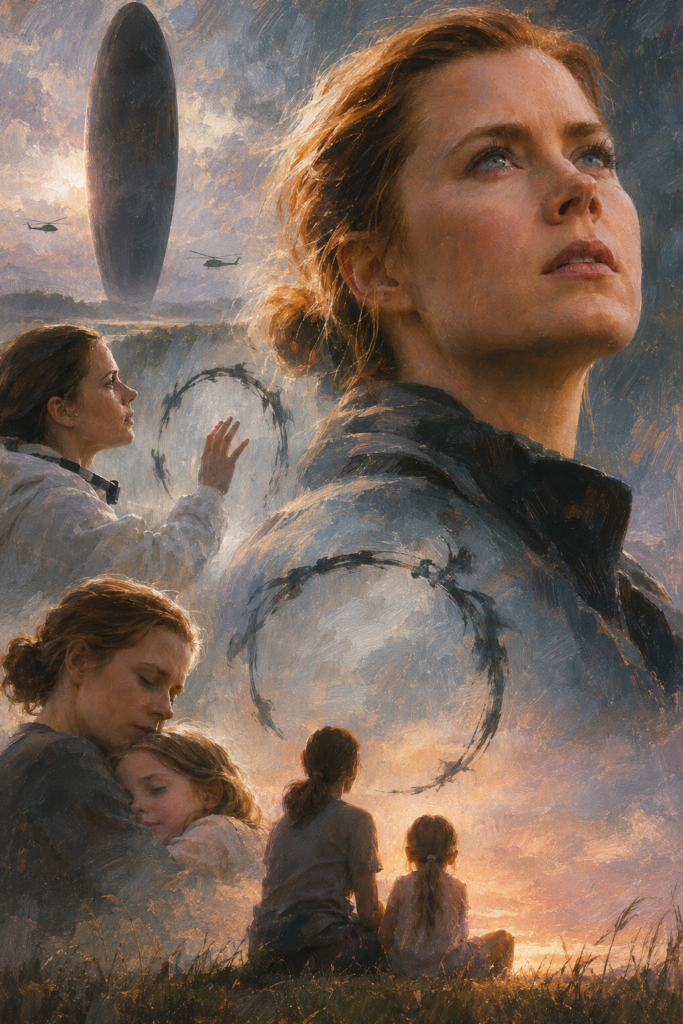

Spoiler Warning: This analysis contains major spoilers for Arrival (2016). It discusses the film’s ending, Louise Banks’ experience of time, and the choices that give the story its emotional weight.
Last updated: November 4, 2026
Arrival begins as a story about language, first contact and the possibility of understanding something radically unfamiliar. But beneath its science-fiction premise, the film is asking a much more intimate question: if you could know in advance exactly how much a future love would cost you, would you still choose it?
Louise Banks knows her daughter’s story ends in loss, yet chooses it anyway—a choice that brings Arrival themes of love and loss into focus. That choice is the heart of the film’s love and loss themes. Knowing the ending doesn’t cancel the worth of living it.
Seeing the future gives Louise clarity about her life
Most people spend years wishing they could see what’s coming. Louise Banks gets exactly that in Arrival: knowledge of the future. Wouldn’t that be a relief? You’d skip the guessing, sidestep the mistakes and stop worrying about outcomes.
The film quietly refuses that fantasy. What Louise learns about her future doesn’t protect her from pain. It hands her a harder question instead. Should she still walk toward a life she already knows will break her heart?
Here is why that matters for how you watch her. A person who can see the ending can’t plead surprise. Every step Louise takes toward her daughter, she takes with open eyes. The love on screen is the deliberate kind, and the grief carries no ambush. Foreknowledge doesn’t erase that grief, either. Louise still has to feel every bit of it.
Louise chooses her life, and fate doesn’t drag her into it
It’s tempting to call Louise a victim of a story already written. At ScreenPsyche, we see her differently. She is someone who consciously embraces love, motherhood and loss despite knowing how they turn out.
That shift changes everything about her. If fate trapped her, her tenderness toward her daughter would be something that simply happens to her. Because she chooses it, that tenderness becomes an act of courage. She agrees to the joy and the heartbreak as one package, and she doesn’t pretend she can keep the first while refusing the second.
You can see her agency in what she declines to do. She doesn’t run from the future to spare herself, nor does she hold back her love to soften the blow later. Holding back would protect her a little, and she judges that the price of that protection is too high.
This is where free will and fate in Arrival stop being opposites. Louise knows the shape of what’s coming, and she still decides how to meet it. Her freedom sits in how she says yes.
Is a life worth choosing when you know how much it will hurt?
This is the question underneath the whole film: is a life worth choosing when you know how deeply it will hurt? Louise never answers it with a speech. She answers it with her life.
Notice how differently the question lands once you know the ending. If you choose love partly in the hope that it will last, Louise’s decision may be hard to imagine. Louise can’t lean on that hope. Her answer has to rest on something else, on the value of the time itself and on who her daughter is during it.
It may feel uncomfortable to sit with that, and the discomfort is honest. Grief is real, and the film never asks you to wave it away with forced positivity. Even so, there is real possibility here. If Louise can find a life worth choosing with the ending in full view, you can begin asking what makes your own relationships worth choosing today, before any ending arrives.
Why temporary things still count
Everything Louise loves in her future is temporary. So is everything you love. The film makes that plain by letting her see the whole arc of a relationship at once.
Why does temporary feel like less? A common habit of mind measures value by duration, as if a thing were only real if it lasts. Louise’s choice pushes back on that habit. A moment of laughter with her child isn’t made smaller by the fact that it ends. It happened, it was hers, and she would not trade it for safety.
Grief, seen this way, grows out of how much she loved. Its size tells you how much the temporary thing mattered. You don’t have to like that to recognise it as true in your own life.
Would you still choose something beautiful that ends in heartbreak?
The question Louise answers is one you can carry out of the film: “If you knew from the beginning that something beautiful would end in heartbreak, would you still choose it?”
There’s no right answer handed to you, and that’s the point. Louise’s answer is yes. Yours might be yes too, or it might be a slower, more careful yes. A few ways to begin working with the question honestly:
- Name one relationship or chapter in your life that ended and still mattered.
- Ask whether you would choose it again, knowing what you know now.
- Notice what made it worth it: the moments, the person, who you became.
- Rewatch Arrival with Louise’s choice in mind, and watch how the early scenes change once you know she sees the ending.
You may find that, like Louise, you’re braver about love than you gave yourself credit for.
Frequently asked questions
What are the themes of the movie Arrival?
Through Louise Banks, Arrival explores love, motherhood, loss, fate, free will, grief and acceptance. It also asks you to weigh the value of temporary things. Her knowledge of the future ties all of these together.
What is the main message of Arrival?
In our reading, the main message is that a life can be worth choosing even when you know how deeply it will hurt. Louise embraces love and loss with full knowledge of their outcome. The film presents that choice as courage, and it never treats her as a prisoner of fate.
If Louise’s choice stayed with you, take the next step and explore more character studies in ScreenPsyche’s Film Character Analysis and Psychological Concepts via Characters categories, where we look at how screen characters help you understand your own life.
From screenpsyhce
- Gothic Themes in Film and TV: Analyzing Gothic Characters
- Disorganized Attachment: Characters Who Love and Push Away in Film and TV
- When Love Flips To Hate: Analysis Through The Lens Of Splitting