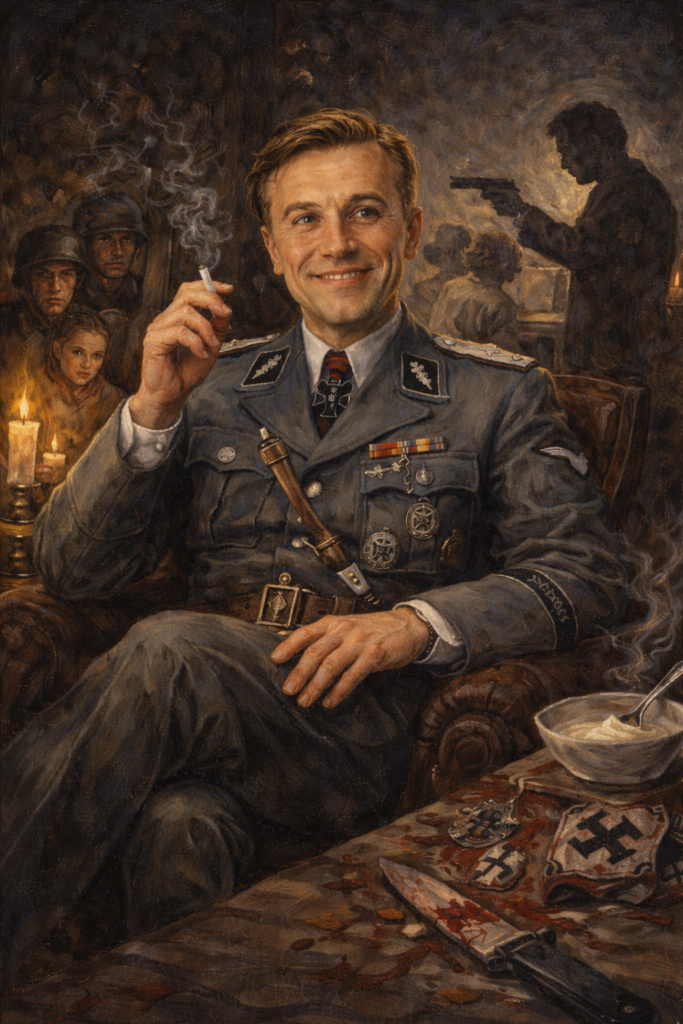

With this analysis of Hans Landa in Inglourious Basterds, we will explore how Quentin Tarantino crafts a charming, funny, and terrifying villain whose charisma exposes the psychology of power, moral flexibility, and our own media engagement. Understanding why we enjoy watching Landa can actually deepen self-awareness, boundaries, and emotionally healthy viewing. (Transforming Cultural Memory: Inglourious Basterds (2009))
Why We Are Fascinated By The Charm Of Evil
There is a specific kind of tension when Hans Landa walks into a scene: part dread, part delight. You might catch yourself smiling at his jokes, admiring his intelligence, and then suddenly remembering: he is a Nazi officer hunting people.
That inner conflict is exactly where this character is designed to live.
From a media psychology perspective, Landa embodies the “charm of evil” archetype: a figure who uses humor, warmth, and sophistication to pull us close, even as he commits or enables horrifying acts. Our brains are wired to pay attention to contradictions, and Landa is a walking contradiction.
screenpsyche leans into that tension—not to excuse him, but to use it. When we notice why a character like Landa feels so compelling, we can better understand power, manipulation, and even our own emotional reactions as viewers.
Brief Context: Hans Landa And His Role In Inglourious Basterds
In Inglourious Basterds, Hans Landa is an SS officer tasked with hunting Jewish people in occupied France. Nicknamed the “Jew Hunter,” he’s introduced in one of the film’s most unforgettable scenes: a slow, polite conversation over milk that ends with hidden terror and violence.
Landa’s role in the story is unique:
- He is not just a villain; he is the narrative’s engine of tension.
- He shifts allegiances when it benefits him, making him unpredictable.
- He brings a darkly playful energy that contrasts sharply with the horror around him.
Instead of portraying evil as loud and obviously monstrous, the film gives us a man who is:
- Polite and theatrical
- Linguistically skilled
- Often funny and disarming
This contrast between his behavior and his beliefs is central. It highlights how systemic violence can be carried out by people who appear “civilized,” and how danger can arrive with a smile.
The Performance Of Charm: How Landa Wins Attention And Power
Hans Landa is constantly performing. His charm is not random; it is a deliberate strategy.
Social Intelligence As A Weapon
Landa reads people with frightening precision. He observes micro-behaviors, pauses, eye movement, and social status cues. Then he tailors his persona:
- With Perrier LaPadite, he uses exaggerated politeness, humor, and storytelling.
- With the Basterds, he leans into arrogance and sly confidence.
- With Shosanna at the restaurant, he plays almost fatherly and teasing.
In psychology terms, this looks like high cognitive empathy coupled with low emotional empathy. He understands others’ feelings intellectually, but doesn’t genuinely share or respect them. That combination makes him feel both magnetic and terrifying.
Surface Warmth, Hidden Threat
Landa’s charm isn’t just about being likable; it is about controlling the emotional temperature of every room he enters.
He uses:
- Polite rituals (offering cigarettes, ordering milk, insisting on dessert)
- Playful language and jokes
- Sudden shifts in tone to remind everyone who holds the power
This creates what many viewers experience as emotional whiplash: we laugh, then we flinch. That rapid alternation keeps us glued to the screen and mirrors how manipulation often works in real life.
Psychological Profile: Archetypes, Motivations, And Moral Flexibility
Landa can be read through several archetypes and psychological lenses that deepen his complexity.
The Trickster And The Bureaucrat Of Evil
On one level, Landa is the Trickster archetype: clever, playful, always one step ahead, constantly shifting roles. But he is also close to the “banality of evil” idea: the bureaucrat who treats genocide like an opportunity for career advancement.
He is not driven by ideology in any deep, passionate way. Instead, he appears driven by:
- Self-interest – always negotiating for his best deal
- Narcissistic gratification – he enjoys being seen as the smartest person in the room
- Curiosity – he treats people like puzzles to solve
This combination makes him feel disturbingly modern. He is not an old-fashioned, mustache-twirling villain. He is a hyper-competent opportunist who adapts to whichever side benefits him.
Moral Flexibility As A Core Trait
Rather than a traditional conscience, Landa’s morality seems transactional:
- Loyalty is negotiable.
- Principles can be traded for comfort and safety.
- Other people are tools, not equals.
In psychological terms, this suggests moral disengagement—the capacity to separate one’s actions from ethical responsibility. The film never asks us to sympathize with him; instead, it shows how dangerous such detachment becomes when combined with power.
The Audience’s Experience: Why We Are Compelled, Amused, And Unsettled
The Tension Between Amusement And Horror
Tarantino and Christoph Waltz build Landa to be entertaining. His jokes land. His timing is perfect. His code-switching between languages feels impressive.
Media psychology offers some clues for why we respond so strongly:
- Arousal and suspense: Landa scenes are slow burns. Our nervous systems light up with anticipation.
- Cognitive dissonance: Our brains struggle to hold “I’m entertained” and “This is horrifying” at the same time, which makes the moment more sticky and memorable.
- Safe distance: We know we’re watching fiction, which gives us enough emotional distance to explore dark material.
Feeling Complicit And Conflicted
Many viewers feel a subtle guilt or discomfort: If I enjoy watching this villain, what does that say about me?
From a screenpsyche perspective, that self-questioning is actually a sign of ethical awareness. You are noticing that your emotional response (enjoyment) and your moral stance (condemning his actions) are not aligned—and you care about that.
Instead of shaming that reaction, we can treat it as an invitation: a moment to check in with our values and how we engage with media.
Media Psychology Lens: What Our Attraction To Landa Reveals About Us
When we’re drawn to a character like Hans Landa, we are often:
- Responding to competence and intelligence
- Fascinated by transgression (someone breaking every rule we wouldn’t)
- Curious about the psychology of evil in a safe, fictional container
Admiration Of Craft Vs Moral Endorsement
A key distinction for healthy media engagement is this:
- We can admire performance, writing, and character construction.
- We do not have to endorse the character’s beliefs or actions.
You might appreciate:
- Christoph Waltz’s acting
- The tension of the opening farmhouse scene
- The cleverness of Landa’s dialogue
That admiration is about craft, not consent to the character’s worldview.
What It Shows Us About Power
Landa also reveals our curiosity about how power works:
- How does someone gain control over a room without raising their voice?
- How does charm make people drop their guard?
- How can intelligence be used for harm instead of care?
Those questions are deeply relevant beyond the film. They point to real-world dynamics in workplaces, politics, and relationships.
Positive Media Engagement: Enjoying Complex Villains Without Glorifying Harm
You absolutely can enjoy complex villains and still prioritize psychological wellness and ethics. It just takes a little intention.
Here is a simple framework you can bring to characters like Landa.
Reflection, Not Imitation
Ask yourself after a powerful scene:
- What exactly did I enjoy here? (The tension? The dialogue? The performance?)
- Do I feel any discomfort? Where is that sitting in my body?
- What values of mine feel challenged or activated right now?
This turns passive watching into active reflection, which supports emotional awareness rather than numbing.
Separate The Layers
You can mentally separate your experience into three layers:
|
Layer |
What It Covers |
Healthy Way To Engage |
|---|---|---|
|
Craft |
Acting, writing, directing, pacing |
Appreciate skill, discuss technique, learn storytelling tools |
|
Character |
Motivations, archetype, psychology |
Analyze behavior, explore themes, notice emotional impact |
|
Ethics |
Real-world harm, historical trauma, values |
Affirm your stance, honor victims, set moral boundaries |
By moving between these layers consciously, you avoid collapsing “I admire this performance” into “I approve of this person.”
Gentle Emotional Check-Ins
Especially with a story set during World War II and rooted in real historical trauma, it helps to pause and notice:
- Do I feel numb right now? Overwhelmed? Energized?
- Do I need a break, a drink of water, a grounding activity?
- Would talking with a friend help me process any heavy feelings?
Positive media engagement means you get to enjoy intense storytelling without abandoning your own emotions.
Transforming Fascination Into Insight And Empowerment
Hans Landa’s enduring impact comes from the uneasy mix of pleasure and horror he creates. This Hans Landa Inglourious Basterds analysis doesn’t ask you to stop enjoying complex villains; it invites you to enjoy them more consciously.
When you:
- Notice the performance of charm
- Separate admiration of craft from moral endorsement
- Reflect on your own emotional reactions
- Carry those insights into your real-life boundaries and choices
…you turn a movie night into a chance for deeper self-knowledge.
At screenpsyche, we believe your media engagement can be both fun and transformative. You are allowed to be fascinated by dark characters like Hans Landa—and you are powerful enough to use that fascination as a mirror, a lesson, and a step toward a more aware, values-aligned life.
Frequently Asked Questions
Why is Hans Landa’s charm considered a weapon in Inglourious Basterds?
Hans Landa’s charm is a weapon because he uses politeness, humor, and social grace to disarm and manipulate his targets. By appearing friendly and reasonable, he lowers his victims’ defenses, making his sudden shifts into cruelty more effective. This calculated charisma allows him to dominate every social interaction through psychological intimidation and control.
How does the opening farmhouse scene establish Hans Landa’s predatory nature?
The farmhouse scene presents Landa as a calm and courteous guest who uses milk and small talk to hide his malicious intent. By maintaining a polite, conversational tone while methodically closing in on hidden victims, Landa demonstrates how he weaponizes social etiquette to exert psychological power and manipulate those who are vulnerable.
What psychological archetypes does Hans Landa embody?
Hans Landa fits the “trickster” and “charming predator” archetypes through his linguistic mastery and theatrical behavior. He prioritizes personal amusement and intellectual superiority over Nazi ideology. His lack of stable loyalty and his ability to switch sides based on convenience highlight a sociopathic detachment from human empathy and traditional moral convictions.
Why do viewers feel conflicted when watching Hans Landa’s performance?
Viewers experience conflict because Landa’s wit and intelligence are genuinely entertaining, yet they are tied to horrific actions. This emotional whiplash occurs when the audience recognizes they are enjoying the screen presence of a villain. The character exposes how easily charisma can distract from ethical judgment in both media and real-world scenarios.