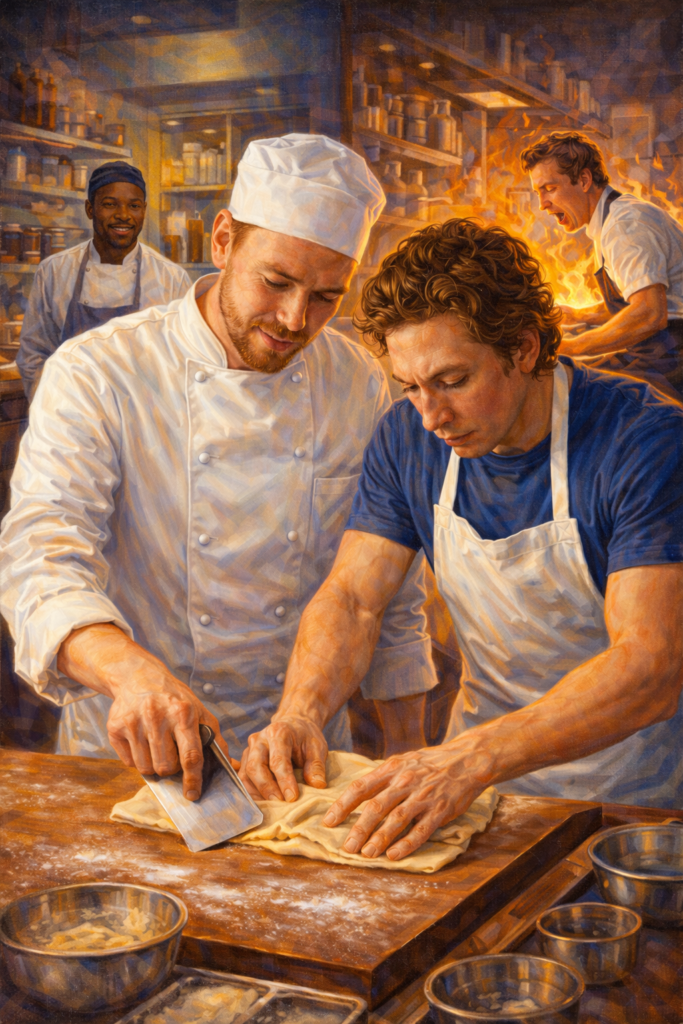

Ego and mastery in The Bear crystallize in the relationship between Luca and Carmy. Luca embodies calm, integrated mastery that quietly challenges Carmy’s shame-driven ego. Their so‑called rivalry becomes a psychologically rich portrait of how secure mentorship, not abuse, pushes real growth in high‑pressure creative work.
- Luca embodies mastery without ego, becoming Carmy’s mirror rather than his enemy.
- Their rivalry is mostly internal to Carmy and rooted in old shame and trauma.
- Luca models psychologically safe mentorship that real creatives can imitate at work.
Why Luca As Carmy’s ‘Rival’ Is Both Right And Misleading
The Bear is obsessed with what it costs to be great at something. Kitchens in the show are pressure cookers for ego, shame, and identity. So when we meet Luca in Copenhagen—the pastry “god” Carmy once worked with—it is tempting to slot him into a classic rival role.
On paper, he is everything Carmy fears he is not: master of his craft, beloved in a calm kitchen, respected rather than feared. Carmy sends Marcus to learn from him, but it is clear Luca still lives in Carmy’s head.
Yet the series quietly subverts the rivalry trope. Luca is not a jealous competitor keeping score. He is an ally, mentor, and in some ways a future‑self template. The tension sits mostly inside Carmy: a war between his bruised ego and the possibility that mastery could exist without cruelty.
This is where ego and mastery in The Bear get most interesting—because Luca shows us what growth can look like when competition becomes a mirror, not a weapon.
Luca’s First Impression: Calm Precision In Copenhagen
Luca’s introduction in the Copenhagen episode is soft, almost disarming. We do not get dramatic music or a villain entrance; we get a quiet kitchen, a snowy city, and a man moving with unhurried confidence.
- Body language: shoulders relaxed, movements economical, eye contact steady but kind.
- Tone of voice: low, amused, patient. Jokes with Marcus, but never at Marcus’s expense.
- Environment: the kitchen is bright, organized, almost meditative compared to the chaos of The Original Beef back in Chicago.
- Luca’s identity is not organized around proving himself every second.
- He has internalized competence; he no longer needs external drama to feel real.
- His authority comes from presence, not volume.
In trauma terms, this is a stark contrast to the abusive kitchens both he and Carmy come from. Where their old chef weaponized unpredictability and humiliation, Luca offers predictability and respect. The show is already asking: what if the same level of excellence did not require terror?
Mastery Without Spectacle
Luca’s mastery is obvious, but The Bear refuses to turn it into spectacle. Instead, we see:
- Long, repetitive practice with Marcus on laminating dough.
- Exact timing and sensory awareness—touching the dough, feeling for temperature and elasticity.
- Unemotional responses when something goes wrong; he simply adjusts and moves on.
- Process Over Performance
Luca is more interested in how Marcus moves than in the immediate result. He slows Marcus down, insisting on feel, not just following steps. That is the mindset of someone anchored in craft, not applause. - Emotion Regulation
When Marcus gets frustrated, Luca does not match his intensity. He regulates himself and, by extension, the room. This is a hallmark of true mastery: the ability to stay present under pressure without collapsing or exploding. - No Need To Dominate
Luca never uses his skill to belittle. He can say, “This isn’t there yet,” without tying it to Marcus’s worth. That separation of performance from identity is exactly what Carmy struggles to achieve.
Luca shows that excellence can be deeply serious and still emotionally safe. That is a radical statement in a genre that often romanticizes the tortured genius.
Ego And Identity: Luca Versus Carmy
To understand ego and mastery in The Bear, it helps to contrast how Luca and Carmy structure their sense of self.
Carmy: Shame, Perfectionism, And The Fragile Ego
Carmy’s ego is fragile because it is built on conditional worth. He learned in abusive kitchens that he mattered only when he was perfect. Failure equals humiliation; rest feels like weakness.
- Obsession with stars, rankings, and external validation.
- Self‑talk soaked in shame: he often assumes he is the problem.
- Perfectionism that burns him and everyone around him.
His identity is fused with performance. If a service goes badly, he is not just disappointed; he is annihilated.
Luca: Integrated Self And Quiet Confidence
Luca’s ego, by contrast, feels integrated. He clearly cares about quality, but we do not see him collapse when something is off. He can say “We’ll fix it tomorrow” without it sounding like denial or laziness.
- He can praise Marcus freely; someone else’s excellence does not shrink him.
- He does not need constant external approval.
- Failure is information, not indictment.
| Aspect | Carmy | Luca |
|---|---|---|
| Core Driver | Shame and fear of not being enough | Love of craft and curiosity |
| Response To Mistakes | Self‑attack, spiraling, overcontrol | Adjust, learn, move on |
| View Of Others’ Talent | Threatening, comparison‑prone | Inspiring, something to nurture |
| Relationship To Rest | Feels guilty or unsafe | Built into the rhythm of the work |
This contrast is crucial: Luca is not less ambitious than Carmy. He has simply metabolized his ambition into something sustainable.
The Psychology Of Their ‘Rivalry’
So where is the rivalry? Mostly, inside Carmy.
Luca represents the path Carmy did not take: leaving earlier, integrating, building a kitchen that heals instead of harms. When Carmy sends Marcus to Copenhagen, he is also sending a part of himself—his hope that greatness can exist without torment.
- Proof That Abuse Was Optional
If Luca reached this level without replicating the abuse they both endured, then maybe that cruelty was never necessary. That undercuts Carmy’s painful belief that his suffering was the price of greatness. - Secure Attachment In The Kitchen
Luca offers Marcus something like secure attachment at work: predictable feedback, kindness, clear limits. For someone with Carmy’s history, that level of emotional safety around a mentor is almost unimaginable—and therefore both inspiring and threatening. - Future Self Mirror
Luca functions as a “future self” mirror: he is what Carmy could become if he integrates his trauma, loosens perfectionism, and allows intimacy without control.
The rivalry, then, is not over who can make the better dish. It is over which story about mastery Carmy will choose to believe: the old narrative of pain and punishment, or Luca’s quieter belief in growth through respect.
Mentorship Style And Psychological Safety
One of the most powerful aspects of ego and mastery in The Bear is how Luca mentors Marcus.
- Clear standards, soft delivery: “This isn’t right yet” lands differently when the tone is gentle and specific.
- Modeling first: he shows, then lets Marcus imitate, then gives space for error.
- Curiosity over judgment: when Marcus struggles, Luca asks questions rather than issuing verdicts.
This is psychological safety in practice. Marcus is safe to:
- Admit he doesn’t know something.
- Ask for clarification.
- Make mistakes without fear of character assassination.
Luca proves you can maintain uncompromising standards and protect people’s dignity. That is exactly the middle ground Carmy has trouble holding.
Shared Trauma And A Different Outcome
Both Luca and Carmy passed through the same abusive kitchen culture. Yet they carry it differently.
The show does not overexplain their shared past, but we feel its weight in small details: references to their old chef, snippets of respect tinged with pain, the unspoken understanding of what they survived.
Luca’s kitchen in Copenhagen becomes a kind of corrective emotional experience for that history. Here, the hierarchy remains—Luca is clearly in charge—but the rules have changed:
- No public shaming.
- Mistakes are corrected, not weaponized.
- The workday has a rhythm that includes laughter and human conversation.
For Marcus, this is life‑changing. For Carmy, watching from afar, it is destabilizing and hopeful. The same lineage of technique that once hurt him is now being passed on in a way that might heal someone else.
This does not mean Luca is perfect or unscarred. It simply means he has chosen not to let his trauma dictate the emotional terms of his kitchen. That choice is precisely what Carmy still struggles to make.
Lessons You Can Steal From Luca’s Way Of Working
Luca’s approach offers concrete guidance for anyone navigating ambition, ego, and mentorship.
If You Are In A Mentor Or Leader Role
- Separate standards from shame. Hold the bar high, but make feedback about the work, not the person.
- Regulate yourself first. Your nervous system sets the emotional climate.
- Model curiosity. Ask, “What are you noticing?” instead of, “Why did you mess this up?”
- Normalize not knowing. Say out loud when you are still learning.
If You Are The Learner Or Younger Creative
- Treat secure mentors as allies, not threats. If someone like Luca appears in your life, notice any impulse to compete with them instead of learning from them.
- Let feedback be data, not a verdict. Ask, “What can this teach me?” rather than “What does this say about my worth?”
- Watch how they live, not just how they work. Luca’s mastery is in his rhythm, boundaries, and relationships as much as in his pastries.
In short: become a Luca where you can, and when you meet one, let them expand your idea of what a high‑level creative life can feel like.
How Ego And Mastery In The Bear Reflect Bigger Themes
Luca matters to Carmy’s arc because he embodies the show’s larger questions: Can found family heal what brutal systems broke? Can craft be both serious and humane? Can you chase excellence without sacrificing yourself?
By making Luca a non‑toxic “rival,” The Bear suggests that the answer can be yes. Rivalry does not have to be war; it can be a mirror that shows you a kinder way to be great.
For us as viewers, Luca offers a grounded, hopeful message: the masters we admire do not have to crush us to make us better. The healthiest ones will invite us into rooms where our talent can grow alongside our humanity.
Understanding that dynamic—how ego and mastery in The Bear collide and then recalibrate through characters like Luca—is not just good TV analysis. It is a way of understanding our own workplaces, mentors, and ambitions with more clarity and compassion.
Frequently Asked Questions
How does Luca’s approach to ego and mastery in The Bear challenge Carmy?
Luca’s precise, relaxed cooking style directly contrasts with Carmy’s shame-fueled urgency. By proving a chef can be world-class without relying on chaos or self-punishment, Luca exposes Carmy’s internal belief that pain is mandatory for greatness. This shift forces Carmy to question if his ego is actually hindering his professional growth.
Why is Luca considered Carmy’s “healthiest rival” regarding ego and mastery in The Bear?
Luca represents the version of a chef Carmy fears he cannot become: highly skilled yet emotionally grounded. Because Luca prioritizes mentorship over competition, he serves as a mirror for Carmy’s insecurities rather than an antagonist. This dynamic transforms a traditional rivalry into a psychological catalyst for Carmy’s internal development.
What does the Copenhagen kitchen symbolize regarding ego and mastery in The Bear?
Luca’s kitchen in Copenhagen operates on trust and quiet precision, starkly contrasting with the trauma-informed environments Carmy usually inhabits. This setting demonstrates that mastery thrives in psychological safety. It undermines the toxic narrative that high performance requires a massive ego, proving that a calm environment produces superior culinary results.
How do Luca and Carmy differ regarding ego and mastery in The Bear?
Carmy fuses his identity with his culinary output, making every mistake feel like a personal failure. Conversely, Luca demonstrates mastery by decoupling his self-worth from his performance. This lack of ego allows Luca to mentor others with patience and precision, unlike the defensive, shame-driven leadership Carmy displays at The Bear.
What psychological dynamics define the internal rivalry involving ego and mastery in The Bear?
The rivalry is driven by Carmy’s internal struggle with perfectionism and past trauma from abusive mentors. Luca acts as a psychological yardstick, highlighting what Carmy believes he lacks. Rather than an external fight, the conflict is Carmy battling his own self-loathing, using Luca as a benchmark for healthy, ego-free mastery.
Further Reading & Authoritative Sources
Authoritative Sources
- Will Poulter’s Luca is The Bear’s Most Important C — In-depth character analysis of Luca that explicitly contrasts his calm mastery and ego with Carmy’s unhealthy, ego-driven pursuit of perfection, directly addressing themes of ego, craft, and alternative models of mastery in The Bear.
- The Bear Season 2’s Best Food Moments — TIME’s feature on The Bear’s second season uses specific sequences, including Carmy’s Copenhagen backstory and Marcus’s training under Luca, to explore how the show frames culinary excellence, mentorship, and the pressures of high-end mastery.
- The Bear’s Lionel Boyce Breaks Down Marcus’ Season — Interview with Lionel Boyce (Marcus) that unpacks the Copenhagen arc with Luca, focusing on passion, creative growth, and the process of getting ‘better and better’ at one’s craft—key to understanding how The Bear stages ego, apprenticeship, and mastery.