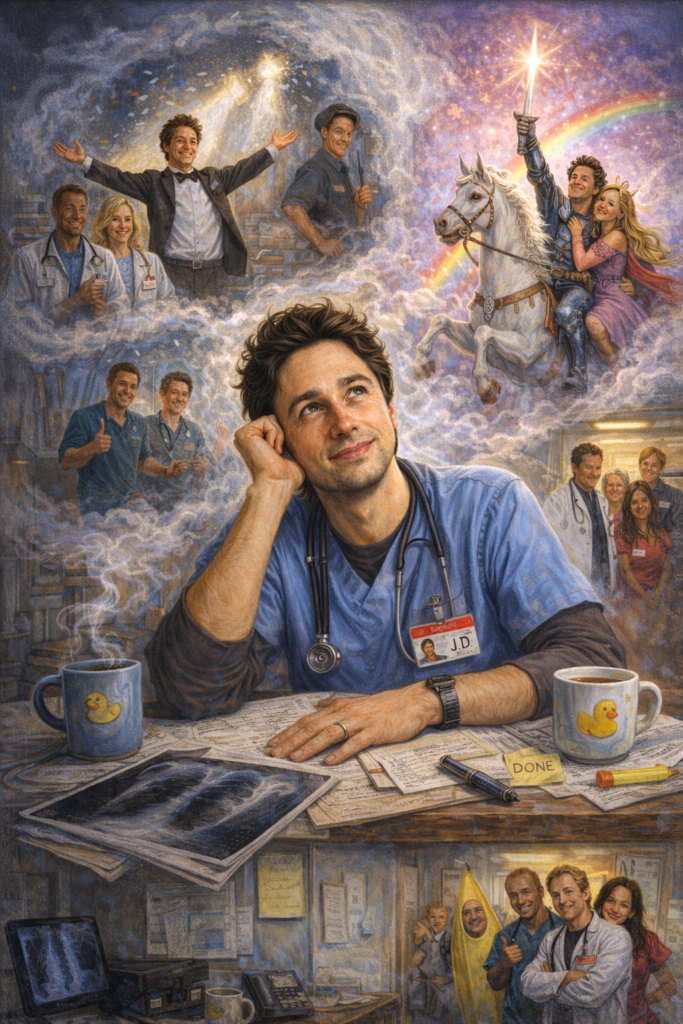

In Scrubs, identity and fantasy themes center on J.D.’s vivid imagination, which works as a coping mechanism for anxiety, uncertainty, and a fluid sense of self. His fantasies soften harsh realities, create emotional safety, and quietly model self-compassion, offering viewers comfort, reflection, and pathways toward healthier identity exploration.
⚡ Key Takeaways
- J.D.’s fantasies are not immaturity; they are emotional tools for surviving pressure.
- Scrubs blends surreal humor with psychological realism to mirror real adult identity anxiety.
- Viewers can use J.D.’s inner world as a gentle guide for self-reflection and self-kindness.
Why J.D. In Scrubs Still Feels So Comforting
J.D. walks through the hospital, gets overwhelmed, and suddenly we are in his head: musical numbers, slow-motion hero shots, absurd cutaways. On paper, it is comedy. Emotionally, though, many of us recognize something deeper.
We know what it feels like to stand in a serious adult role and secretly think, I still feel like a kid pretending.
That is why Scrubs identity and fantasy themes still land so deeply. J.D. is not just a goofy doctor. He is a case study in how imagination helps us survive uncertainty, pressure, and the slow, messy work of becoming ourselves.
At screenpsyche, we see his fantasy life as a gentle mirror for anyone navigating self-understanding. His inner world does not just entertain; it comforts, validates, and quietly empowers you to believe that you can grow without having everything figured out.
J.D.’s Fantasy Life: Humor, Escape, And Emotional Safety
J.D.’s trademark daydreams are more than running gags. Psychologically, they look a lot like coping mechanisms and emotional regulation tools.
When a moment is too intense, confusing, or painful, his mind flips to fantasy. A harsh remark turns into a physical gag. A professional failure becomes a movie trailer. A vulnerability transforms into a musical scene. These shifts offer him:
- Emotional distance from stress
- Humor as a release valve
- Symbolic storytelling that makes big feelings more manageable
In media psychology, we might say J.D. is using internal visualizations to create emotional safety. Instead of shutting down, he stays engaged with the situation—but on a level that feels less threatening.
For many viewers, that looks familiar. Maybe you replay tough conversations in your head as if they were scenes. Maybe you imagine witty comebacks, heroic rescues, or dramatic speeches. This is not failure. It is your brain trying to regulate feelings and make sense of your story.
J.D.’s fantasies show that escape and insight can coexist. Sometimes he is avoiding discomfort; other times, his daydream reveals exactly what he is afraid of or longing for.
Uncertain Identity: J.D. As A Dreamer In An Adult World
Under the lab coat, J.D. is unsure who he is. Is he a competent doctor? A scared intern? A best friend? A romantic? A disappointment?
That wobbliness is what psychologists might call identity diffusion—not a diagnosis, just a way of saying his sense of self is still forming and shifting. He tries on versions of himself like outfits: the confident hero, the sensitive romantic, the jokester, the professional.
In US culture, adulthood is often packaged as a clear milestone: college, job, independence, maybe a mortgage. Scrubs quietly pushes back on that myth. J.D. is living the “adult” life on paper, but inside he still feels like he is catching up.
His fantasy world becomes a testing ground for identity:
- He imagines himself as the flawless doctor to see what confidence might feel like.
- He imagines dramatic confrontations to explore anger he rarely expresses.
- He imagines exaggerated rejections to process his fear of not being enough.
Instead of treating this as immaturity, we can see it as experimental identity play. Many of us do the same thing when we picture alternate futures, rehearse conversations, or imagine different versions of ourselves.
J.D. reminds us that the gap between who you are and who you want to be does not mean you are failing. It means you are in process.
Identity Struggles And Fantasy: Myth Vs Reality
Here is a quick look at some common beliefs about fantasy and identity, compared with what Scrubs subtly models through J.D.
| Belief About Fantasy & Identity | Reality Reflected In J.D.’s Story |
|---|---|
| Fantasy means you are avoiding real life. | Fantasy can give you space to feel and think safely about real life. |
| Adults should not need imagination to cope. | Adults often rely on inner stories to manage pressure and uncertainty. |
| Not knowing who you are is a sign of weakness. | Identity evolves; uncertainty is a normal part of growth and change. |
| Daydreaming makes you less serious or competent. | J.D. still shows up, learns, and cares deeply, even with constant fantasies. |
Scrubs identity and fantasy themes help reframe imagination from “immature” to human and adaptive, especially during intense life transitions. (TV Education: Ally McBeal and Scrubs)
Archetypes And Psychological Realism In J.D.’s Character Arc
Underneath the jokes, J.D. fits a powerful archetype: the Dreamer, or the Reluctant Adult.
As a Dreamer, he:
- Lives partly in his inner world
- Leads with emotion and imagination
- Struggles to fully accept adult responsibilities without losing his softness
As a Reluctant Adult, he represents that very modern feeling: “I am doing the grown-up things, but I am still not sure I fit this role.”
This is where Scrubs really shines in psychological realism. The show exaggerates visuals, but its emotional beats stay grounded in recognizable experiences:
- Wanting approval from mentors
- Feeling like an imposter at work
- Craving love and friendship while fearing rejection
- Wondering if you are a good person, not just a good professional
His character arc is not a clean leap from insecure to confident. It is looping, messy, and deeply human. He grows, backslides, tries again. He keeps his imagination, but slowly learns to:
- Take more responsibility for his actions
- See others’ inner worlds, not just his own
- Integrate his softness with his professional strength
The goal is not to “kill the Dreamer” so a “serious adult” can take over. It is to let the Dreamer mature—bringing empathy, humor, and creativity into adult life in a healthier way.
Why J.D.’s Fantasy Comforts Us As Viewers
From a media engagement perspective, J.D.’s inner world does at least three powerful things:
- It normalizes inner chaos. You see someone whose thoughts are wild, dramatic, and sometimes embarrassing—and he is still worthy of love, friendship, and growth.
- It gives shape to unnamed feelings. When his panic becomes a visual gag or his longing becomes a musical number, it turns fuzzy emotions into clear images. You can point to the screen and think, Yes, that’s exactly what it feels like.
- It allows safe emotional rehearsal. Watching him navigate identity, failure, and vulnerability lets you quietly try on those emotions from your couch.
Scrubs identity and fantasy themes are comforting because they say: You are not the only one whose inner world looks like a full-blown sitcom. And you are not broken for needing humor and fantasy to make it through hard days.
For many US adults living with high expectations around success, independence, and emotional control, J.D. is a rare permission slip to be both:
- Deeply responsible and caring
- Deeply uncertain, imaginative, and sensitive
That combination is not a contradiction. It is a form of wholeness.
Closing Reflection: Welcoming Your Own Inner ‘J.D.’
If you see yourself in J.D.—the uncertainty, the vivid imagination, the longing to be both kind and competent—you are in good company.
Scrubs identity and fantasy themes invite you to welcome that part of you, not erase it. Your inner Dreamer is not the enemy of your adulthood. It is a source of creativity, empathy, and honesty about how hard this whole “being a person” thing can be.
You do not need to stop daydreaming to become real. You can learn, like J.D., to:
- Let your imagination name your feelings
- Let humor soften your hardest days
- Let fantasy open doors to self-reflection and gentle change
At screenpsyche, we see you as a friend walking this path alongside J.D., not as someone watching from the outside. You are allowed to be in progress. You are allowed to use the shows you love as tools for healing and growth.
So the next time an episode ends and you find yourself still living in that slightly surreal hospital world, try this simple, empowering thought:
If J.D. can grow while staying soft, imaginative, and scared sometimes—maybe I can, too.
Your story is still unfolding. And your inner fantasy life might just be one of your greatest allies in writing it.
Frequently Asked Questions
How do Scrubs identity and fantasy themes relate to the concept of imposter syndrome?
J.D.’s fantasies often visualize his fear of being exposed as incompetent, directly reflecting the “imposter syndrome” common in high-pressure roles. By dramatizing internal doubts through absurd humor, the show validates the emotional reality of professionals who feel they are merely “playing a part” while navigating the complexities of adult responsibility.
What specific psychological archetypes define J.D.’s inner world in the series?
J.D. primarily embodies the “Puer Aeternus” (eternal youth) and the “Wounded Healer” archetypes. His fantasies allow him to maintain a youthful, imaginative spirit while processing the trauma of hospital life. These surreal segments serve as a psychological bridge between his sensitive, creative self and the clinical demands of medicine.
How do Scrubs identity and fantasy themes differ from standard sitcom cutaway gags?
Unlike standard cutaway gags used strictly for laughs, J.D.’s fantasies serve as narrative windows into his emotional subconscious. These sequences provide subtextual clues about his anxiety, desire for approval, or grief, grounding the surrealism in psychological realism rather than using it as a disjointed or meaningless punchline.
In what ways can J.D.’s fantasy-based coping mechanisms be used to manage real-life anxiety?
J.D.’s inner world models “cognitive reframing,” where overwhelming situations are visualized as manageable, humorous narratives. By using imagination to create emotional distance from stress, individuals can lower their immediate physiological response to anxiety. This practice allows for more objective problem-solving and fosters self-compassion during difficult professional or personal interactions.
How does J.D.’s musical fantasy impact his professional identity development?
Musical sequences, such as those featured in “My Musical,” represent a heightened state of emotional integration. These fantasies allow J.D. to harmonize conflicting aspects of his identity—such as clinical excellence and emotional vulnerability. By turning internal chaos into structured performance, he processes complex feelings that are too difficult to express through traditional dialogue.
Further Reading & Authoritative Sources
From screenpsyhce
Authoritative Sources
- Scrubs – the television pilot — Critical breakdown of the Scrubs pilot that highlights the use of J.D.’s fantasy sequences and voice-over to frame the story from his subjective point of view, tying these devices to character identity and tone.