
Barton Fink’s creative paralysis captures what happens when a sensitive, idealistic writer is swallowed by a system that only cares about output. Through his writer’s block, mounting anxiety, and surreal surroundings, the film mirrors how perfectionism, ego, and external pressure can quietly shut down our creative voice. (Barton Fink: Atmospheric Sounds of the Creative Mind – Offscreen)
- Barton’s writer’s block reveals how fear, ego, and pressure fuse into creative paralysis.
- The hotel and Hollywood landscape mirror a decaying inner world under constant demand.
- The film speaks directly to today’s hustle culture and offers a chance to redefine worth.
Welcome To The Wallpaper Peeling Off The Walls
Welcome to Screenpsyche, where we use stories on screen to understand the stories inside us.
If you’ve ever stared at a blank page, cursor, canvas, or content calendar and felt your whole body lock up, you already know the world of Barton Fink.
We live in a culture that praises “grind,” “output,” and “content strategy” more than internal rest or play. Barton walks into that world in 1940s Hollywood, but emotionally, he could be any writer on a deadline, any YouTuber chasing the algorithm, any creative checking engagement stats at 2 a.m.
Screenpsyche invites you to sit with this film not just as a dark, surreal comedy, but as a mirror: how does Barton’s breakdown reflect the way you relate to your work and your worth?
Barton Fink In A Glance: The Writer Trapped In His Own Script
Spoiler-aware overview:
Barton Fink is a New York playwright celebrated for his “serious” work about the so‑called common man. On the wave of that success, a Hollywood studio lures him west to write a wrestling picture.
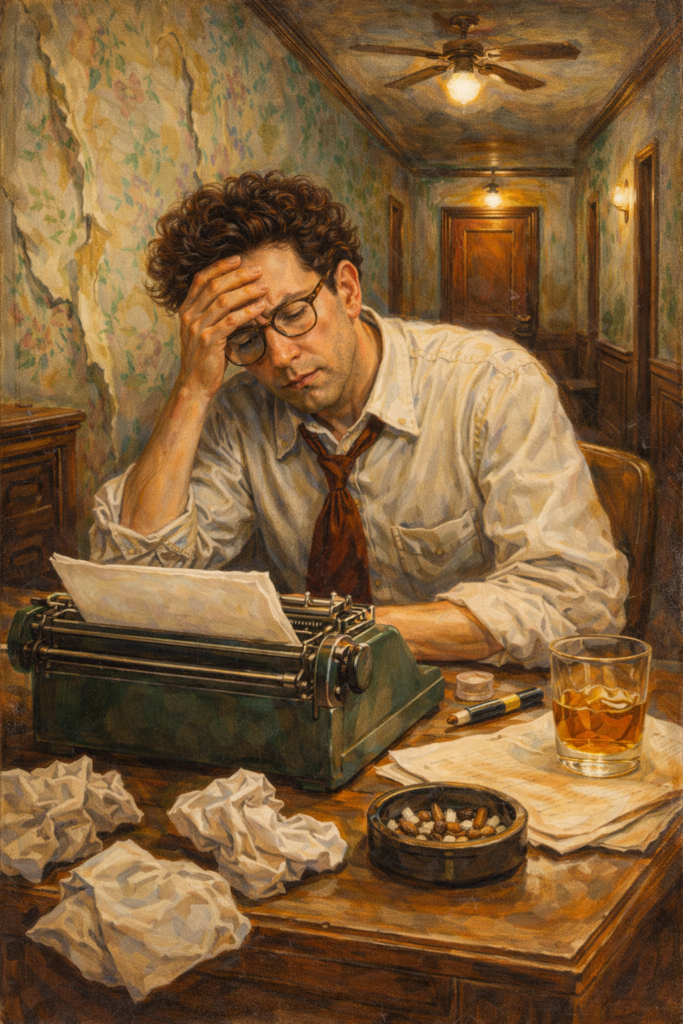
He checks into a decaying, near-empty hotel, is told to crank out a simple genre script, and completely freezes. Days pass. The page stays blank. The wallpaper peels, the heat rises, and the hallway becomes a kind of limbo.
Around him orbit a genial but unsettling insurance salesman named Charlie, a blocked novelist turned Hollywood helper, and a studio boss who only cares that Barton delivers something—anything.
The plot gets stranger and darker, but at its core, Barton Fink is about a man who cannot write while the world demands that he do nothing else.
Inside Barton Fink’s Creative Block
Barton’s writer’s block is not laziness. It is a psychological storm. The film lets us feel four powerful forces at once:
Anxiety And Fear Of Failure
From his first meeting with the studio, Barton is praised and pressured in the same breath: “We like your stuff. Don’t screw this up.”
This is performance anxiety in cinematic form. His mind races with consequences—losing artistic credibility, disappointing the studio, betraying his ideals. Anxiety narrows his attention to imagined failure, not the actual task.
Many creatives know this feeling: the project stops being “something I’m curious to explore” and becomes “a test of who I am.” When work becomes a verdict on your identity, every sentence feels like a trap.
Perfectionism Disguised As Integrity
Barton insists he must create serious art about real people. Asked to write a simple wrestling B‑movie, he feels the assignment is beneath him—but he also wants to prove he can elevate it.
That tension births a perfectionist loop:
- The script must be truthful and profound.
- The genre feels too “low” to support that depth.
- So nothing he imagines feels good enough.
His high standards, initially grounded in genuine values, tip into rigidity. Perfectionism here is not aiming high; it is refusing to begin because the final product in his head can never exist in reality.
Imposter Feelings In Someone “Already Successful”
Barton is supposed to be a rising star. Yet the more Hollywood treats him as a genius, the more fraudulent he feels.
He talks in confident monologues about “the life of the mind,” but in private he is terrified he cannot deliver on that brand. Many creatives who seem accomplished from the outside silently wonder, “What if I just got lucky once?”
Avoidance As A Coping Strategy
In the hotel, we see classic avoidance behaviors:
- Staring at the typewriter without typing
- Walking the hallways
- Getting lost in conversations with Charlie
- Seeking help from others to “unlock” the story
Avoidance temporarily reduces anxiety, but it reinforces the belief that writing is dangerous or too painful. So the block hardens. The more he delays, the heavier the expectations feel.
Art Vs. Industry: When Your Soul Has A Deadline
Barton arrives as the archetype of the serious artist: he wants to write for “the common man,” to capture authentic struggle, to resist cheap entertainment.
Hollywood, by contrast, represents a content pipeline. The studio boss doesn’t care about emotional resonance or character arc; he cares that Barton sticks to the formula and hits his marks.
This clash does three things to Barton’s sense of self:
- Threatens His Identity
If he writes a generic script, is he still the authentic artist he believes himself to be? Barton has fused his identity with a specific image of purity. Compromise feels like self-erasure. - Turns Creativity Into A Transaction
The studio’s notes and deadlines frame writing as a product. Barton’s internal creative process is suddenly negotiated, priced, and timed. - Inflates His Defensiveness
Instead of adapting creatively, Barton doubles down on his ideals, growing more rigid. This defensiveness protects his ego but isolates him from collaborators who might actually help.
In this way, Barton Fink mirrors what many modern creatives feel when their work becomes content: something to be optimized and monetized, rather than a living exploration.
The Hotel As A Portrait Of A Mind Unraveling
The hotel in Barton Fink is not just a backdrop. It is a psychological X‑ray.
- Peeling wallpaper echoes the feeling of a self coming apart. The sticky glue that clings to his fingers resembles thoughts that won’t let go.
- Oppressive heat stands in for mounting stress—he is constantly sweating, as if his own mind is an overheated engine.
- Endless, almost empty hallways evoke isolation. Barton is surrounded by doors, but no one truly reachable.
The more stuck he becomes, the more the environment feels warped—sounds are exaggerated, the light is sickly, the sense of time dissolves. This is how severe creative block and mental strain can feel from the inside: unreal, dreamlike, disconnected from the outside world.
The film never labels Barton with a diagnosis. Instead, it lets us feel how isolation, pressure, and unspoken shame can distort perception. You’re not “broken” for finding your mind strange under stress; the circumstances around you matter.
Symbolic Spaces: Hotel Vs. Hollywood
The contrast between the grim hotel and the shiny studio lots gives us a symbolic map of Barton’s psychology:
| Space | What It Represents Psychologically | How It Feels In The Film |
|---|---|---|
| The Hotel | Inner world, isolation, rumination | Hot, decaying, echoing, surreal |
| The Studio | External demands, productivity | Brisk, transactional, full of forced enthusiasm |
| New York Stage | Idealized artistic self | Distant, almost mythic in Barton’s memory |
Together, these spaces show how a person can feel split: the private self spiraling, the external world demanding performance, and the ideal self hovering just out of reach.
The “Common Man” And Barton’s Ego
Barton believes he speaks for the common man, but he rarely listens to one.
Charlie, the chatty insurance salesman in the next room, is exactly the kind of person Barton claims to write about. Yet when Charlie shares pieces of his life, Barton often cuts him off, launching into speeches about his own artistic philosophy.
This exposes a painful but relatable truth:
- Barton’s savior complex—“I will give voice to the voiceless”—
- coexists with a lack of real empathy and curiosity.
His creative identity depends on seeing himself as morally superior to “sellouts” and more insightful than the people he depicts. That ego traps him:
- He cannot admit confusion or ask genuine questions; that would puncture his expert persona.
- He cannot relax into conversation, which might actually nourish his work.
The film doesn’t shame him; it simply shows the cost of romanticizing oneself as a heroic artist. When your creativity rests on being the savior, not the learner, you lose the flexibility and humility that real art—and real connection—require.
For modern viewers, especially those with platforms, this is an invitation: Is my work about being seen as insightful, or about truly seeing?
Why Barton Fink Feels So Modern In The Age Of Hustle
Even though Barton Fink is set in the 1940s, its emotional core could easily live on today’s internet.
Hustle Culture As A Studio Boss
Today’s equivalent of the studio is the algorithm, the brand, the audience expectation:
- Post consistently.
- Grow your following.
- Make it “on trend” but still “authentic.”
Creatives, streamers, writers, and influencers often live with the same dissonance: “I want to make something true, but I’m told to be fast, clickable, and constant.”
Content Strategy And The Life Of The Mind
Barton talks about “the life of the mind” while the studio talks about wrestling pictures. Today, we might talk about emotional resonance and character while a dashboard talks about impressions and watch time.
Neither side is evil, but the gap between them can be deeply stressful. When engagement metrics become the only mirror we look into, our inner world starts to feel less real than our analytics.
Creative Burnout As A Shared Experience
Many people have felt:
- Chronic exhaustion from “always being on” creatively
- Anxiety when away from work, as though rest threatens relevance
- Shame when output slows, as though you have become less valuable
Barton embodies this in an exaggerated, surreal way, but the emotional resonance is unmistakable. His creative paralysis is our burnout, magnified.
Closing Reflections: Stepping Out Of The Hallway
Barton Fink creative paralysis is intense and surreal, but it is also deeply human. Behind the strange imagery is a familiar ache: the fear that if we don’t keep producing, we will disappear. (Barton Fink (1991) | The Definitives | Deep Focus Review)
Screenpsyche sees you in that tension: the part of you that wants to honor your inner world, and the part that is trying to survive in a metrics‑driven system. Both are real. Both deserve compassion.
As you leave Barton’s peeling hotel corridors, you might ask yourself:
- Where am I confusing my worth with my output?
- Where has perfectionism silenced my curiosity?
- What small act of connection, rest, or play could loosen my own creative block today?
Stories like Barton Fink are not blueprints; they are warnings and invitations. You do not have to follow Barton all the way into paralysis. You can pause, breathe, and begin a kinder chapter in your own character arc.
Frequently Asked Questions
How does Barton Fink’s creative paralysis reflect real-world pressure on writers and creators?
Barton Fink’s creative paralysis mirrors how modern creators freeze under rigid deadlines and the constant demand for algorithmic output. His anxiety and self-importance echo the burnout prevalent in today’s hustle culture, where professional worth is measured by volume rather than depth, forcing a conflict between authentic expression and industrial expectations.
Which scenes in Barton Fink best illustrate the physical experience of writer’s block?
Barton’s struggle is physically captured through scenes of him staring at a blank page in a sweltering room, obsessively revising a single sentence. The visual of peeling wallpaper and his strained, repetitive interactions with the studio head emphasize the mounting tension and the claustrophobic nature of a mind unable to produce required content.
What does the Hotel Earle represent in the context of Barton Fink’s creative paralysis?
The decaying Hotel Earle serves as a direct metaphor for Barton’s collapsing psyche. Its oppressive heat, oozing wallpaper, and infinite, empty hallways represent the isolation and internal decay caused by extreme pressure. As Barton’s paralysis deepens, the hotel transforms from a simple setting into a nightmarish reflection of his own creative stagnation.
How does the conflict between art and industry contribute to Barton Fink’s creative block?
The conflict arises when Barton, a serious playwright, is forced to write a formulaic wrestling movie for a studio that values speed over substance. This clash between his high-minded idealism and the industry’s demand for marketable clichés creates a psychological impasse, where the pressure to conform silences his genuine creative intuition.
What strategies can creators use to overcome the creative paralysis seen in Barton Fink?
Creators can overcome Barton Fink-style paralysis by externalizing their internal critic and lowering the stakes of their initial output. By replacing Barton’s rigid perfectionism with playful experimentation and acknowledging that worth is independent of productivity, artists can bypass the ego-driven fear that often fuels severe writer’s block and creative stagnation.