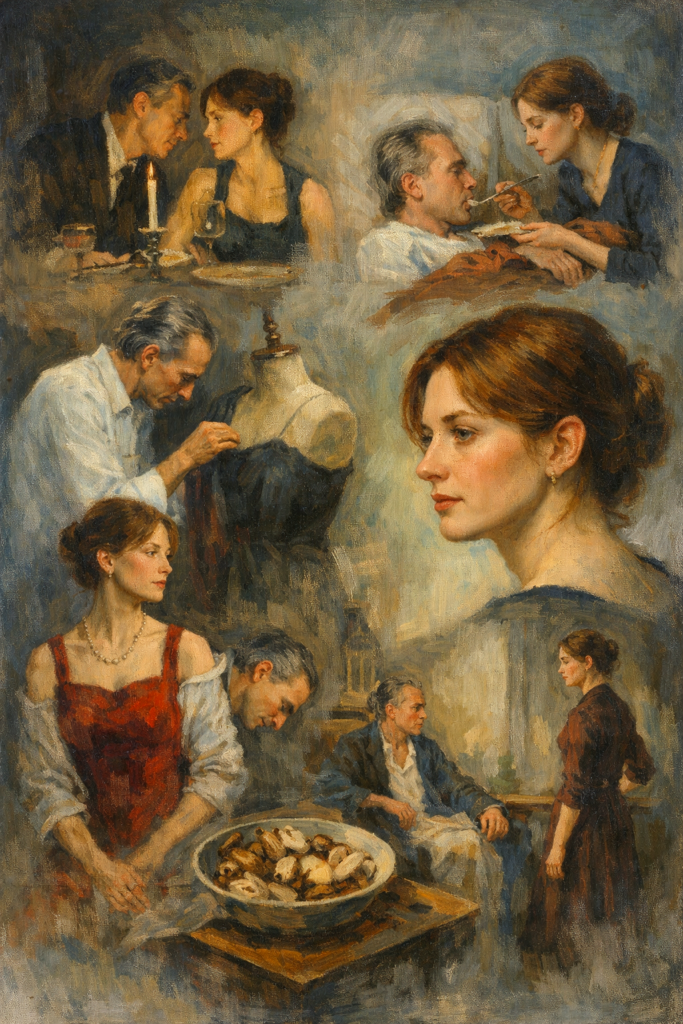

Alma Elson in Phantom Thread embodies a quietly radical kind of power. Through patient observation, emotional attunement, and morally complicated care, she reshapes a controlling world from the inside, challenging assumptions about passivity, agency, love, and the subtle strength of those who are usually underestimated. (A Lover’s Discourse: On Phantom Thread (2017))
⚡ Key Takeaways
- Alma’s power grows from quiet observation, not loud confrontation or control.
- Her relationship with Reynolds blurs boundaries between care, dependence, and agency.
- Alma redefines the “muse” as an active, ethically complex partner in creation.
Setting The Stage For Alma’s Quiet Power
If you have ever felt like the one who notices everything but is rarely noticed yourself, Alma Elson’s presence in Phantom Thread can feel uncannily familiar. (Recap: A Psychoanalyst Goes to the Movies – Unpacking Unconscious Content in Phantom Thread)
This film surrounds a famously exacting artist, Reynolds Woodcock, yet its emotional spine is Alma. Our Alma Elson Phantom Thread analysis starts from a simple but powerful idea: her true strength lives not in volume, but in attention.
Not every transformation comes from a speech or a showdown. Sometimes it comes from the person who watches the room, learns its rhythms, and then very gently changes the tempo.
Who Is Alma Elson? Context Within Phantom Thread
Alma enters the film as a waitress in a seaside town, seemingly ordinary, almost invisible to the world around her. Reynolds notices her first for her physical presence, but the film quickly reveals that she is not just a muse in a beautiful dress. She is a listener, a learner, and ultimately, a co-author of this intense relationship.
Within Reynolds’ highly structured fashion house, Alma appears at first to be another in a long line of women who orbit his genius: models, clients, lovers, and the ever-present sister, Cyril. Yet, unlike those who simply adapt to his rules, Alma quietly studies them.
She notices:
- how he eats
- how he reacts to sounds
- how he leans into routine when anxious
- how other women have learned to tiptoe around him
Instead of accepting that this is “just how he is,” Alma treats his habits as data. She is not passive; she is collecting information.
This is crucial for understanding Alma’s character arc. She moves from being an outsider to someone who understands the emotional architecture of Reynolds’ life better than almost anyone else. That understanding becomes her power.
Quiet Observation As Emotional Intelligence And Power
Alma’s main tool is observation. But observation, in her hands, is not detached or clinical. It is deeply emotional. She notices to care, and she notices to survive.
Her quiet observation operates on multiple layers:
- Emotional attunement: Alma senses when Reynolds is slipping into overwhelm long before he admits it. She perceives his fragility beneath his controlling exterior.
- Pattern recognition: She sees how the fashion house enables Reynolds’ rigidity, how Cyril shields him, and how other women are discarded once they disrupt his routine.
- Boundary testing: Alma gently pushes against established rules—speaking at breakfast, changing the energy of the room—to see where the cracks are.
Observation becomes a coping strategy in a space where she has little formal power. She is younger, less wealthy, and entering an already established hierarchy. But by becoming the person who understands the emotional system, she gains leverage that is intimate, not institutional.
Alma And Reynolds: Evolving Power Dynamics In Their Relationship
The relationship between Alma and Reynolds is one of the most psychologically complex aspects of Phantom Thread. It shifts constantly between tenderness, control, resistance, and dependency.
At first, Reynolds seems to hold all the power. He chooses Alma, dresses her, and places her into his world. The dynamic echoes a familiar pattern: the older, genius male artist and the young, inspiring muse.
But as their relationship deepens, the balance begins to tilt.
- Phase 1 – Idealization: Alma is positioned as the perfect canvas. Reynolds is in control, and Alma appears to accept his terms.
- Phase 2 – Friction: Alma starts disrupting his rituals—cooking a loud dinner, insisting on being seen not just as a mannequin but as a partner. Conflict emerges.
- Phase 3 – Reversal: Through her controversial choice to make him physically vulnerable (the poisoning sequences), Alma inverts the power dynamic. Reynolds must rely on her for care.
She is not simply trying to dominate him. Instead, she creates a space where he can be weak, needy, and softened.
Their power dynamic becomes a loop:
- He controls her environment.
- She learns the system.
- She carefully destabilizes it just enough to allow intimacy.
Their bond exposes how, in some intense relationships, love and control can become entangled in ways that are hard to categorize as purely healthy or unhealthy.
Subtle Resistance: Redefining The Muse And Feminine Agency
On the surface, Alma fits the visual trope of the muse: young, beautiful, and chosen by the artist. But her narrative function resists that trope at every turn.
Traditional muses in film often:
- inspire without demanding much in return
- remain emotionally secondary to the artist’s journey
- exist as symbols rather than complex individuals
Alma quietly refuses this.
She insists on being a full participant, not merely a source of inspiration. Her “subtle resistance” shows up in moments that might seem small but are emotionally enormous—choosing when to speak, when to stay, when to challenge Reynolds, and when to nurture him.
By using observation, not spectacle, she shifts the idea of feminine power from performative to strategic. She does not overthrow the system from the outside; she rewires it from within.
Glossary Of Key Psychological And Narrative Terms
|
Term |
Meaning In The Context Of Alma Elson |
|---|---|
|
Emotional Attunement |
Alma’s ability to sense Reynolds’ inner states and needs. |
|
Power Dynamics |
How control and influence shift between Alma and Reynolds over time. |
|
Narrative Catharsis |
The emotional release viewers feel as Alma claims her agency. |
|
Subtle Resistance |
Alma’s quiet, strategic challenges to the roles imposed on her. |
|
Relational Dependency |
The mutual reliance that forms between Alma and Reynolds, especially in his vulnerable states. |
Psychological Insights: Care, Control, And Emotional Boundaries
One of the most challenging aspects of Alma’s character is her choice to make Reynolds physically ill to create a context where he needs her. It is ethically ambiguous and emotionally intense.
From a psychological perspective, we can see several intertwined themes:
- Care as power: By becoming the one who nurses Reynolds through weakness, Alma gains a kind of emotional authority no one else has.
- Control through vulnerability: Instead of controlling him when he is at his strongest, she shapes the relationship around his moments of fragility.
- Blurry boundaries: The line between care and control becomes porous. Is she nurturing him, or orchestrating his dependence—or both at once?
The film does not present Alma as a villain, nor as a flawless savior. Instead, it invites us to sit in the discomfort of relationships where love, need, fear of abandonment, and a longing for deep connection collide.
For some viewers, this dynamic echoes experiences where feeling needed became the only secure way to feel loved. Alma’s choices, while extreme in narrative form, mirror a very human desire: to be indispensable to the person we love.
Emotional Resonance And Narrative Catharsis For The Audience
Why does Alma’s story linger so powerfully with audiences, especially those who feel overlooked or underestimated?
- She shows that quiet people are not empty—they are often full of rich interior life and strategy.
- She offers a form of narrative catharsis to anyone who has ever felt sidelined but deeply observant.
- She validates the emotional labor of noticing, caring, and holding space.
Watching Alma evolve from an “extra” in Reynolds’ life to a central architect of their shared world can feel deeply validating. Her arc says: your sensitivity is not a weakness, and your ability to read a room is a form of intelligence.
Have you ever watched a scene in this film and thought, “I would never do what she did… but I understand why she might”? That tension—that mix of recognition and resistance—is part of the emotional power of her storyline.
Representation And Media Critique: What Alma Adds To On-Screen Women
From a representation perspective, Alma contributes to a growing tradition of women characters who resist easy categorization.
She is not:
- the purely self-sacrificing caregiver
- the one-dimensional muse
- the simple “strong female character” who wins by being louder or more aggressive
Instead, she embodies quiet feminine power in film—strategic, emotionally literate, and ethically complicated.
Alma is an important counterpoint to narratives that equate power only with domination or independence. Her version of power exists within a relationship, not outside of it. She negotiates, adapts, and sometimes manipulates, but with an underlying desire for a deeper, more mutual connection.
This makes her an important figure for discussions about representation:
- She shows that agency can coexist with need and vulnerability.
- She invites us to question whose emotional labor is usually invisible on screen.
- She expands what it means for a character to be both loving and resistant.
Takeaways: What Alma’s Story Teaches About Power, Vulnerability, And Connection
Alma’s journey offers several key insights that resonate beyond the film itself.
1. Observation Is A Form Of Power
Noticing patterns, reading emotions, and understanding unspoken rules are all powerful skills. For many viewers, especially those who move through the world quietly, Alma’s story can feel like a recognition of that hidden strength.
2. Relationships Can Hold Both Care And Control
Alma and Reynolds’ bond is not easily labeled. It contains tenderness, manipulation, devotion, and dependency. Acknowledging these layers can help us reflect on our own relationships without harsh self-judgment.
3. Boundaries Are Complicated, But Essential
Alma’s choices highlight what happens when boundaries are tested in extreme ways. They invite us to ask: where do I feel responsible for someone else’s well-being, and where do I need to protect my own?
4. Quiet Characters Deserve Center Stage
By giving narrative weight to a woman who is, on the surface, unassuming, Phantom Thread offers a powerful reminder: the people watching from the edges often hold the deepest insights.
Why Alma’s Quiet Observation Still Speaks Loudly
Alma Elson is the kind of character who stays with you long after the credits. Our Alma Elson Phantom Thread analysis reveals someone who turns observation into agency, care into complex power, and vulnerability into a kind of emotional authorship.
Her story is not a manual for how relationships “should” work. Instead, it is a mirror for the messy, intricate ways love, need, and power can weave together.
If you have ever felt like the quiet one in a loud world—always watching, always interpreting—Alma’s arc can feel like an invitation. Your way of moving through relationships matters. Your perception, your sensitivity, and your subtle resistance are all forms of strength.
Frequently Asked Questions
How does Alma Elson’s quiet observation give her power over Reynolds in Phantom Thread?
Alma’s power originates from her meticulous observation of Reynolds’ rigid rituals and emotional triggers. By mastering his routines more thoroughly than he does, she identifies the exact moments to challenge his authority or offer comfort, effectively steering their complex relationship without the need for loud or open confrontation.
Why is Alma Elson’s relationship with Reynolds considered morally complicated?
Their relationship is morally complex because Alma deliberately intertwines care with harm to secure her place in Reynolds’ life. By making him physically vulnerable, she forces a state of dependence that blurs the boundaries between selfless devotion, psychological control, and her own strategic need for emotional survival.
How does Alma Elson redefine the traditional concept of a muse?
Alma rejects the role of a passive, decorative inspiration by actively intervening in Reynolds’ creative process and personal life. She asserts her own agency, making critical decisions that shape his environment and work. This transforms the muse from a silent object into a strategic co-creator with her own distinct agenda.
What are specific examples of Alma’s subtle resistance to Reynolds’ control?
Alma resists Reynolds’ dominance through calculated disruptions, such as intentionally breaking his strict breakfast silence or orchestrating his physical illness. These acts are not mere rebellions; they are strategic maneuvers designed to slowly dismantle his absolute authority and reclaim her own psychological space within their tightly controlled household.
How does Alma Elson eventually gain the upper hand in the film’s power dynamics?
Alma gains the upper hand by recognizing that Reynolds’ strength is a fragile performance sustained by routine. By compromising his health and becoming his primary caretaker, she flips the dynamic of the household. Reynolds ultimately becomes dependent on her presence, making Alma the true, hidden architect of their shared world.