Skip to content
screenpsyche.com
  • Home
  • Categories
    • Film Character Analysis
    • TV Character Analysis
    • Psychological Concepts via Characters
  • About Us
Subscribe

Posts by Screen Psyche

  • Home
  • Screen Psyche
  • Page 6
About Screen Psyche
A cinematic oil painting inspired by Léon: The Professional, showing a stoic hitman cleaning his gun beside a young girl gazing out a window, bathed in soft light — symbolizing the balance between innocence and violence.
Posted inFilm Character Analysis

Innocence and Violence in Léon: A Deep-Dive Analysis of The Professional

Luc Besson's 1994 masterpiece, Léon: The Professional, is far more than a stylish action film; it is a profound and unsettling exploration of the fragile line between good and evil. At…
Posted by Screen Psyche October 23, 2025
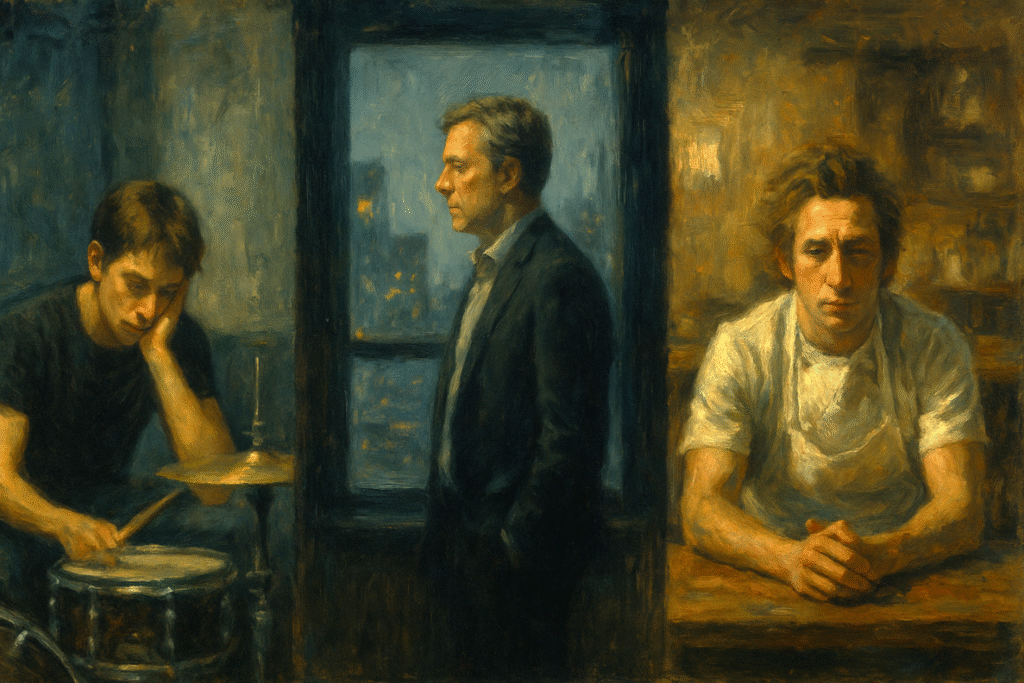
A cinematic oil painting depicting three symbolic figures — a jazz drummer under harsh light, a businessman frozen before a city skyline, and a chef in a tense kitchen — representing the fear of stagnation and emotional pressure in modern storytelling.
Posted inPsychological Concepts via Characters

The Fear of Stagnation: Analyzing Its Cultural and Psychological Significance in Modern Storytelling

Stagnation and Its Thematic Relevance Stagnation, often characterized by a lack of progress, development, or change, holds a significant place in modern storytelling. As the pace of contemporary life accelerates,…
Posted by Screen Psyche October 22, 2025
An oil painting inspired by The Blacklist, depicting a calm and authoritative man symbolizing Harold Cooper standing in a shadowy FBI office surrounded by monitors and files, radiating stoicism and leadership.
Posted inTV Character Analysis

Harold Cooper Blacklist: The Stoic Leader

Introduction to Harold Cooper and The Blacklist The Blacklist, a gripping crime thriller series on NBC that premiered in 2013, has captured the attention and hearts of audiences worldwide. The…
Posted by Screen Psyche October 21, 2025
An oil painting depicting HAL 9000’s glowing red eye inside a futuristic spacecraft, symbolizing artificial intelligence consciousness and emotional complexity from 2001: A Space Odyssey, painted in metallic blues and warm red tones.
Posted inFilm Character Analysis

Inside the Mind of HAL 9000: When Machines Learn to Feel

Stanley Kubrick's 1968 film, 2001: A Space Odyssey, is often heralded as one of the most significant works in science fiction cinema. The film explores humanity's relationship with technology and the…
Posted by Screen Psyche October 20, 2025
An oil painting depicting three emotionally detached figures — a quiet driver in a dim city, a pale girl with braids staring blankly, and a stylish woman with a cold smile — rendered in muted colors and soft light to symbolize isolation and introspection.
Posted inPsychological Concepts via Characters

The Psychology of Detachment: Why Some Characters Feel Too Little, Not Too Much

Introduction to Emotional Detachment in Characters In the worlds of film and television, numerous characters embody emotional detachment, provoking various responses from audiences. Emotional detachment is characterized by a lack…
Posted by Screen Psyche October 19, 2025
An oil painting inspired by Only Murders in the Building, showing a young woman symbolizing Mabel Mora standing in a vintage New York apartment hallway illuminated by warm light, surrounded by mystery and subtle crime-related details.
Posted inTV Character Analysis

Mabel Mora: Solitude, Curiosity, and the True-Crime Psyche

Introduction to Mabel Mora and Her Role in 'Only Murders in the Building'Mabel Mora, played by the charismatic Selena Gomez, stands at the heart of Hulu's hit series 'Only Murders…
Posted by Screen Psyche October 18, 2025
An oil painting inspired by The Grand Budapest Hotel showing Gustave H. in his purple concierge uniform standing in front of the pastel-pink hotel surrounded by colorful mountains, symbolizing elegance, nostalgia, and decay in Wes Anderson’s cinematic world.
Posted inFilm Character Analysis

The Grand Budapest Hotel’s Gustave H.: Perfectionism, Decay, and the Art of Elegance

Wes Anderson’s 2014 film, _The Grand Budapest Hotel_, offers a stunning tapestry woven with a rich array of themes, aesthetics, and character intricacies. Set in the fictional Republic of Zubrowka,…
Posted by Screen Psyche October 17, 2025
An oil painting symbolizing the paradox of control and freedom, featuring a ballerina between light and shadow, a woman in a red cloak walking toward an open door, and a figure choosing between mechanical and organic paths, inspired by The Matrix, Black Swan, and The Handmaid’s Tale.
Posted inPsychological Concepts via Characters

The Paradox of Control and Freedom

In the spectrum of human experience, the dichotomy of freedom and control presents a fascinating psychological landscape, especially when explored through media narratives. Characters offered the opportunity to break free…
Posted by Screen Psyche October 16, 2025
An oil painting of Daenerys Targaryen standing before a burning city with a dragon flying overhead, symbolizing her power, descent into madness, and destiny in Game of Thrones, illuminated by fiery tones and dramatic shadows.
Posted inTV Character Analysis

Daenerys Targaryen: Power, Madness in Game of Thrones

Daenerys Targaryen, the last surviving member of the once-mighty Targaryen dynasty, is one of the most pivotal characters in HBO's adaptation of George R.R. Martin's "A Song of Ice and…
Posted by Screen Psyche October 15, 2025
A realistic oil painting of a man and a woman walking together along the Seine River at sunset in Paris, with golden light reflecting on the water, symbolizing nostalgia, emotional connection, and unspoken romantic tension inspired by Before Sunset.
Posted inFilm Character Analysis

Céline in ‘Before Sunset’: Navigating Nostalgia and the Fear of Settling in Relationships

Introduction to Céline and 'Before Sunset' Richard Linklater's 'Before Sunset' (2004) stands as a pivotal exploration of relationships through the lens of time, memory, and shifting emotional landscapes. Serving as…
Posted by Screen Psyche October 14, 2025

Posts pagination

Previous page 1 … 4 5 6 7 8 … 21 Next page

Recent Posts

  • When Love Flips To Hate: Analysis Through The Lens Of Splitting
  • George Bailey’s Emotional Burden Of Being Everyone’s Safety Net
  • Self-Objectification: Becoming the Brand You Perform
  • Ego and Mastery in The Bear: How Luca Becomes Carmy’s Healthiest ‘Rival’
  • The Girl With The Dragon Tattoo: Lisbeth Salander And Trust As A System

Recent Comments

  1. Wearing The Mask: Study Of The False Self - screenpsyche.com on Identity and Reality in ‘The Truman Show’
  2. Killing Eve Themes: From Civilian To Dangerous - screenpsyche.com on The Trauma Bond: Why Characters Stay in Toxic Relationships
  3. Killing Eve Themes: From Civilian To Dangerous - screenpsyche.com on Charm and Chaos in Killing Eve: A Deep Dive into Villanelle
  4. Parasocial Attachment: Loving a Person Who Doesn’t Know You on The Double Life of Severus Snape: Love, Bitterness, and Redemption in Harry Potter
  5. Kendall on Peggy Olson in Mad Men: A Symbol of Feminism and Ambition

Archives

  • February 2026
  • January 2026
  • December 2025
  • November 2025
  • October 2025
  • September 2025
  • August 2025
  • July 2025

Categories

  • Film Character Analysis
  • Psychological Concepts via Characters
  • TV Character Analysis
Search
Categories
  • Film Character Analysis
  • Psychological Concepts via Characters
  • TV Character Analysis
Archives
  • February 2026
  • January 2026
  • December 2025
  • November 2025
  • October 2025
  • September 2025
  • August 2025
  • July 2025
Copyright 2026 — screenpsyche.com. All rights reserved. Bloghash WordPress Theme
Scroll to Top