Skip to content
screenpsyche.com
  • Home
  • Categories
    • Film Character Analysis
    • TV Character Analysis
    • Psychological Concepts via Characters
  • About Us
Subscribe

Posts by Screen Psyche

  • Home
  • Screen Psyche
  • Page 7
About Screen Psyche
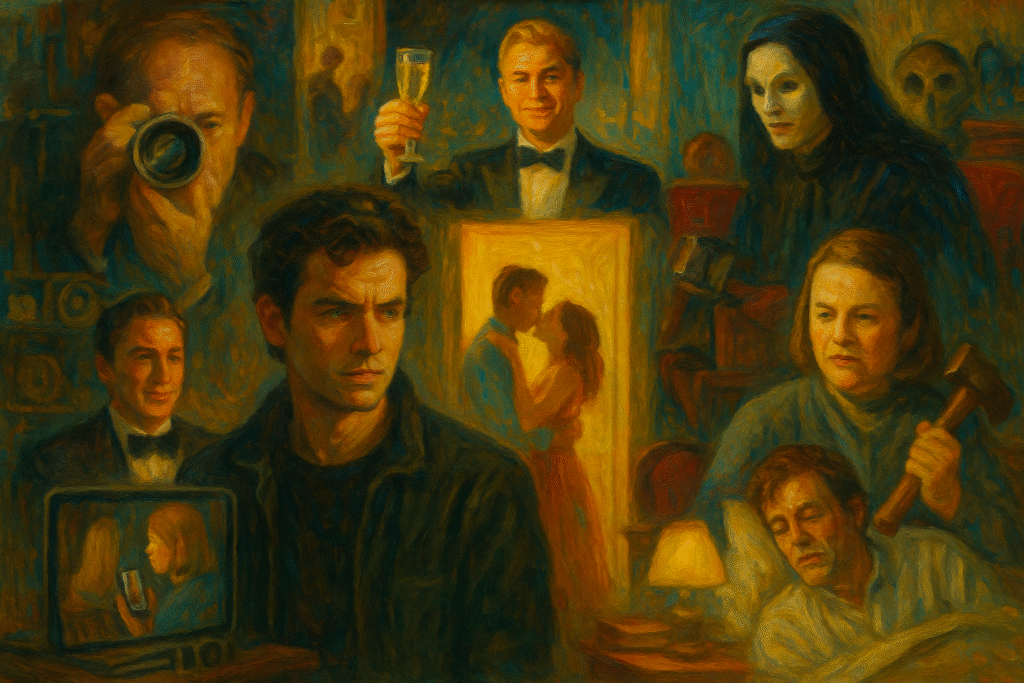
Tom Ripley in 1950s suit on a Venetian pier, stealing a glance at Dickie and Marge on a gondola—envy, mimicry, and assumed identity
Posted inFilm Character Analysis

Tom Ripley and the seduction of envy

Watching Tom Ripley is like watching someone practice breathing — until he takes your breath away. In Anthony Minghella’s The Talented Mr. Ripley (1999), the phrase "Tom Ripley and the…
Posted by Screen Psyche November 7, 2025
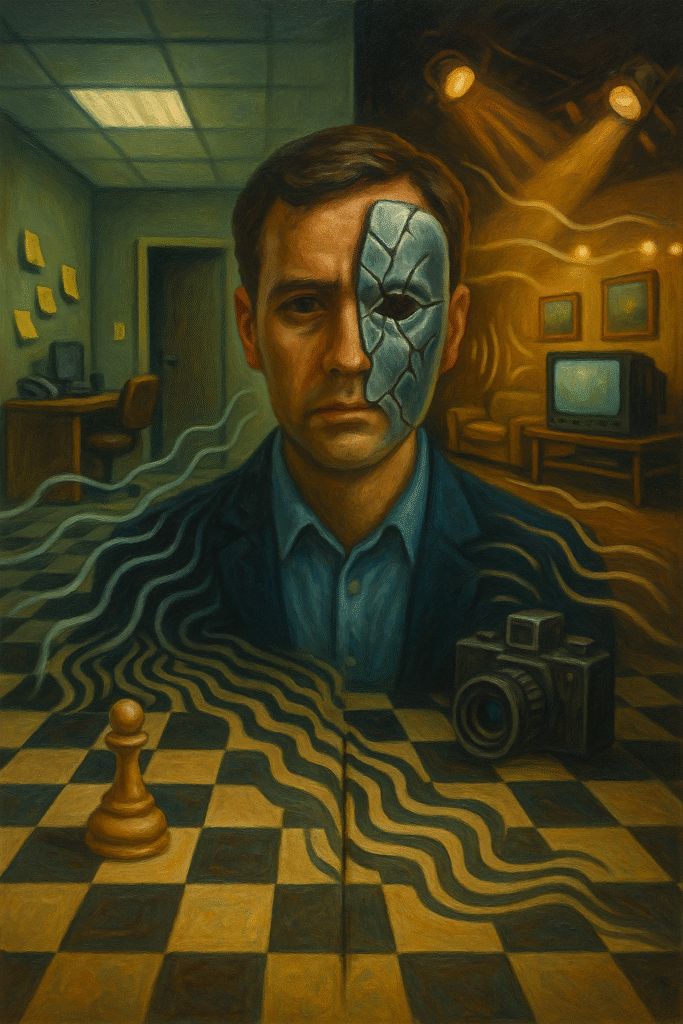
Man with cracked mask over half his face on warped checkerboard; office vs. living-room split, vintage camera—sanity unraveling.
Posted inPsychological Concepts via Characters

Fragility of Sanity: How Rational Minds Unravel

We often assume sanity is stable, but the fragility of sanity on screen shows something else: small cracks in routine, role, or reputation can widen into radical interior change. This…
Posted by Screen Psyche November 6, 2025
Barry with a half-theatre mask between an acting class and a shadowed gun silhouette—double life of vulnerability and violence.
Posted inTV Character Analysis

Barry Berkman: The Double Life of Violence and Vulnerability

"Barry Berkman is both monster and mourner — and the show makes you hold both truths at once." Spoiler warning: This piece contains scene-level analysis from HBO's Barry. If you haven't…
Posted by Screen Psyche November 5, 2025
Two schoolgirls with paper crowns walk a garden path toward giant monarch statues; journal pages become birds—Borovnia fantasy vs. reality.
Posted inFilm Character Analysis

Fantasy and Control in Heavenly Creatures: Pauline Parker Psychological Profile

Trigger warning: This article discusses adolescent violence, murder, and mental health. It examines the 1954 Christchurch case involving Pauline Parker and Juliet Hulme and Peter Jackson's film Heavenly Creatures (1994). If you are…
Posted by Screen Psyche November 4, 2025
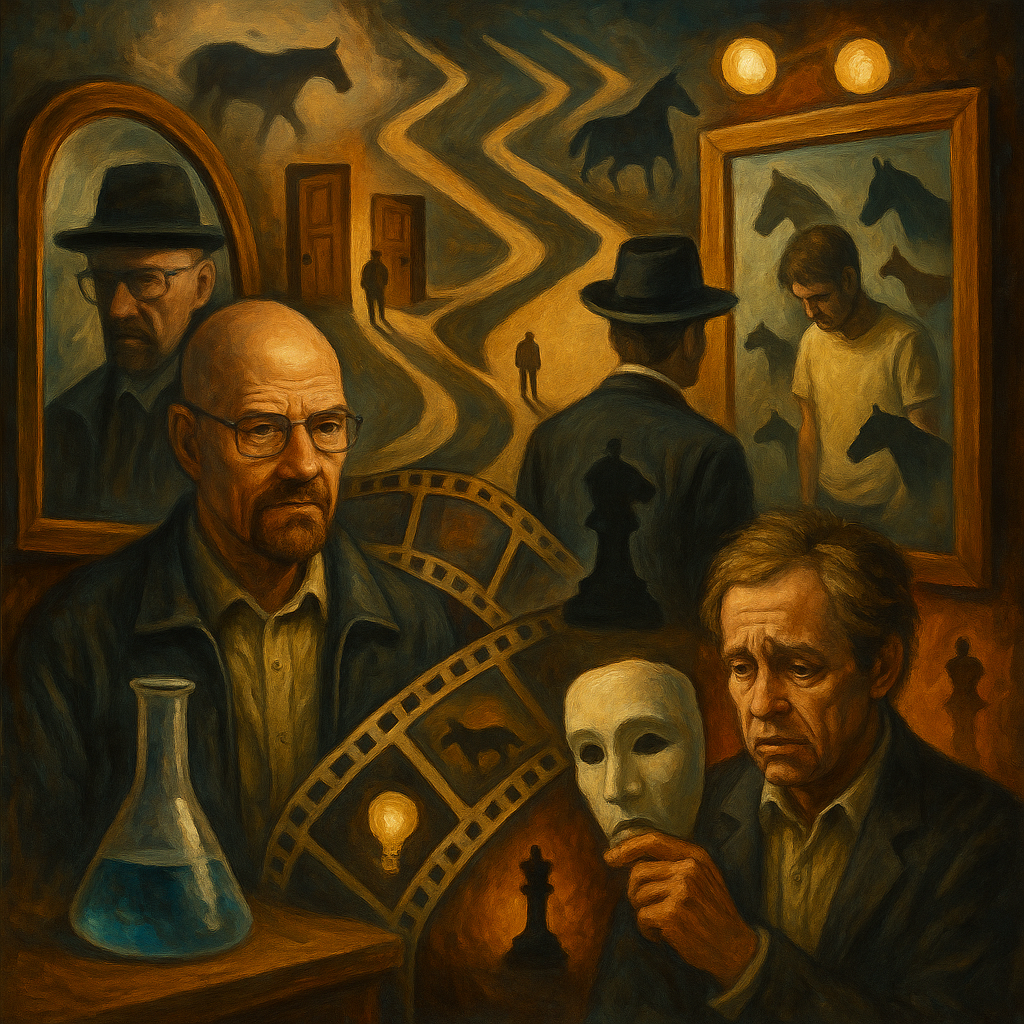
Surreal oil collage: man before mirrors, split paths and doors, film reel, chess pieces and mask—haunted by the self he could have been.
Posted inPsychological Concepts via Characters

Haunted by Potential: The Characters Who Fear Who They Could’ve Been

Spoiler note: this analysis discusses major beats from Breaking Bad, BoJack Horseman, The Godfather, and others. If you're spoiler-averse, skim the psychological framework and filmmaking sections first. Film Characters Haunted…
Posted by Screen Psyche November 3, 2025
Eleanor Shellstrop holds a ‘Try Again’ clipboard beside a trolley-problem chalkboard in a sunny Good Place village—ethics and growth.
Posted inTV Character Analysis

Eleanor Shellstrop (The Good Place): Morality, Growth, and the Comedy of Redemption

The Scene That Defines Eleanor Shellstrop Imagine a woman, played by Kristen Bell, arriving in a sunlit afterlife and arguing with the receptionist about where she parked her SUV —…
Posted by Screen Psyche November 2, 2025
Triptych of Tony Montana: Miami arrival under ‘The World Is Yours,’ power at the desk, and tragic fall—desire, ambition, moral decay.
Posted inFilm Character Analysis

Scarface Tony Montana analysis: Desire, Ambition, and Moral Decay

Thesis: In this Scarface Tony Montana analysis we argue that Tony's hunger is not only for money or power but a corrosive appetite that steadily erodes his moral compass. By tracing…
Posted by Screen Psyche November 1, 2025
Triptych mirror with Joker’s shadow, Amy-like woman writing, and Don Draper–type ad man; shattered shards reflect our flaws and identities.
Posted inPsychological Concepts via Characters

The Mirror Effect: Why We Fall for Characters Who Reflect Our Flaws

Understanding the Powerful Connection to Flawed Characters In film and literature, the most memorable characters are rarely the perfect ones. Instead, they are often reflections of ourselves, embodying the messy,…
Posted by Screen Psyche October 31, 2025
Tommy Shelby in flat cap and dark suit, cigarette in mouth, holding a pocket watch; horse and smokestacks behind—post-WWI Birmingham.
Posted inTV Character Analysis

Tommy Shelby: The Trauma and Ambition That Forged a Peaky Blinders Empire

In the soot-stained streets of post-WWI Birmingham, one name echoes with both fear and respect: Thomas "Tommy" Shelby. As the magnetic anti-hero of the hit series Peaky Blinders, Tommy, portrayed with…
Posted by Screen Psyche October 30, 2025
Margot Tenenbaum in a bathtub with green tiles, fur coat and cigarette—stoic gaze capturing emotional distance.
Posted inFilm Character Analysis

Margot Tenenbaum’s Guarded Heart: A Psychological Reading

Introduction to Margot Tenenbaum's Character Margot Tenenbaum, portrayed by Gwyneth Paltrow, is one of the standout figures in Wes Anderson's critically acclaimed film The Royal Tenenbaums. Margot is introduced as a…
Posted by Screen Psyche October 29, 2025

Posts pagination

Previous page 1 … 5 6 7 8 9 … 24 Next page

Recent Posts

  • Mildred Hayes And Anger As Loyalty To The Dead
  • Choice Overload On Screen: When Too Many Options Hurt
  • When Curiosity Quietly Becomes Obsession in Mindhunter
  • Ava: The Psychology of Performing Vulnerability
  • When People Stop Believing Their Actions Matter

Recent Comments

  1. Love, Safety, and the Illusion of Rescue: Alex in Maid on The Trauma Bond: Why Characters Stay in Toxic Relationships
  2. Don’t Worry Darling; Love, Control, and the Fear of Being Ordinary on The Trauma Bond: Why Characters Stay in Toxic Relationships
  3. Ruth Langmore Loyalty And Rage In Ozark on The Trauma Bond: Why Characters Stay in Toxic Relationships
  4. Wearing The Mask: Study Of The False Self - screenpsyche.com on Identity and Reality in ‘The Truman Show’
  5. Killing Eve Themes: From Civilian To Dangerous - screenpsyche.com on The Trauma Bond: Why Characters Stay in Toxic Relationships

Archives

  • August 2026
  • July 2026
  • June 2026
  • May 2026
  • April 2026
  • March 2026
  • February 2026
  • January 2026
  • December 2025
  • November 2025
  • October 2025
  • September 2025
  • August 2025
  • July 2025

Categories

  • Film Character Analysis
  • Psychological Concepts via Characters
  • TV Character Analysis
Search
Categories
  • Film Character Analysis
  • Psychological Concepts via Characters
  • TV Character Analysis
Archives
  • August 2026
  • July 2026
  • June 2026
  • May 2026
  • April 2026
  • March 2026
  • February 2026
  • January 2026
  • December 2025
  • November 2025
  • October 2025
  • September 2025
  • August 2025
  • July 2025
Copyright 2026 — screenpsyche.com. All rights reserved. Bloghash WordPress Theme
Scroll to Top