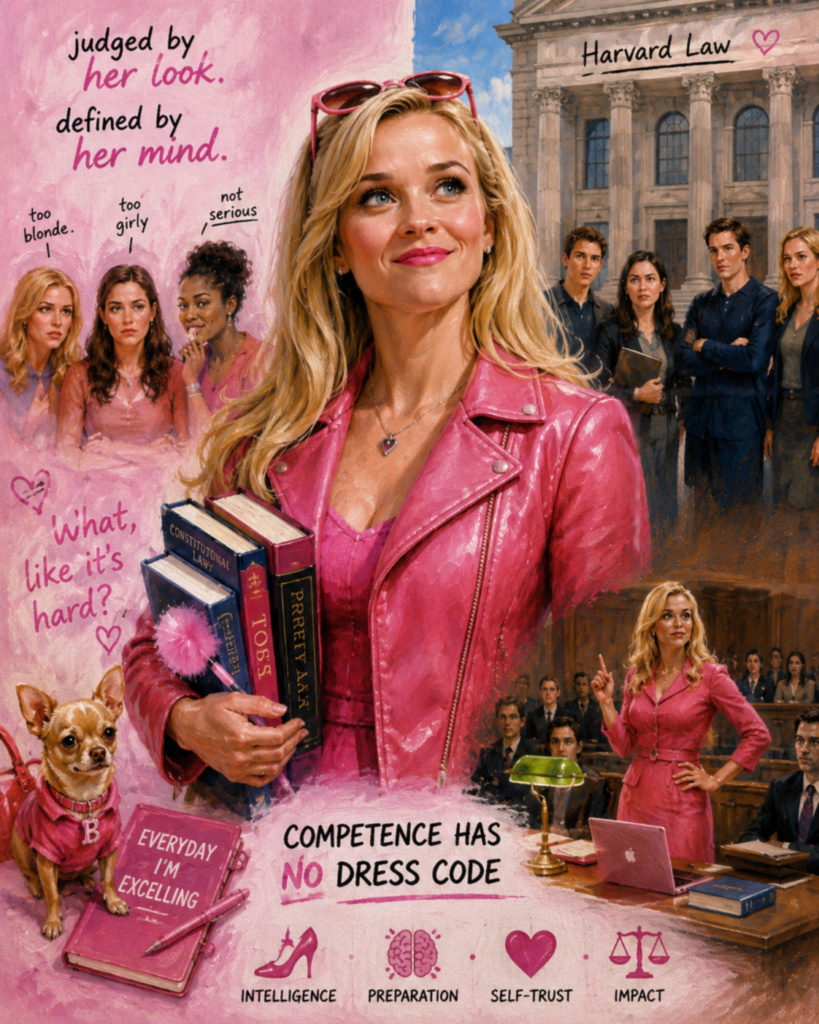

The aesthetics of competence describes how appearance, style, and visual cues influence whether we see someone as intelligent or capable. Through Elle Woods in Legally Blonde, we see how hyper-femininity, stereotypes, and bias shape who is taken seriously—and how self-trust can transform that story.
- We judge intelligence quickly using visual shortcuts like clothing, color, and facial expression.
- Hyper-feminine aesthetics often trigger bias, leading people to underestimate real competence and depth.
- Elle Woods models a shift from chasing approval to trusting herself while staying fully authentic.
How We Decide Who Looks Smart Before They Speak
Before anyone opens their mouth, we are already forming opinions: smart, shallow, serious, silly, powerful, harmless. That split-second reading is not just about words; it is about hair, color palettes, facial expressions, tone of voice, posture, and clothes.
This is the core of the aesthetics of competence: the way certain looks are culturally coded as “professional,” “intelligent,” or “serious,” while others are coded as frivolous or less capable.
Legally Blonde understands this so well that it lets us misjudge Elle Woods on purpose.
We meet her through a swirl of pink, glitter, sorority energy, and a tiny dog in a matching outfit. Before she speaks, we think we know her: pretty, shallow, boy-obsessed. The film invites us into that snap judgment—and then proves it wrong.
If you have ever felt underestimated because you are colorful, soft, feminine, queer, neurodivergent, or just not “corporate-looking,” Elle’s story can feel like a mirror.
The Stereotype Before The Character
Elle Woods steps onto the screen as a stereotype: the “dumb blonde” sorority girl. We see coordinated outfits, scented stationery, bubbly friends, and a campus life framed like a glossy magazine spread.
Psychologically, this is the halo effect and first impression bias at work. Our brains love shortcuts. When we see certain traits—blonde hair, tiny dog, pink everything—we quickly attach a whole story to that image: superficial, not serious, not smart.
In the film, almost every character does this to Elle:
- Warner assumes she could never be “serious” enough for his political future.
- Her Harvard classmates see her outfits and instantly decide she does not belong.
- Professors underestimate her before reading a single brief she writes.
They decide who she is before they know anything real about her internal world.
The painful part? This mirrors real life. Many of us have had versions of this experience:
- Being talked over in meetings because we look young or soft-spoken.
- Having our ideas repeated by someone with a more “serious” aesthetic and suddenly taken seriously.
- Being told to “tone it down” if we want to be respected.
The stereotype forms before the character. Elle’s journey is about slowly reclaiming her right to author her own narrative.
Femininity As A Cognitive Bias Trigger
Elle’s look is not just feminine—it is hyper-feminine: hot pink, sparkles, heart-shaped accessories, scented resumes. The film treats all of this lovingly, but the world inside the film (and our own world) often does not.
Hyper-femininity becomes a bias trigger.
Our culture has long coded “girly” traits—pink, fashion, cheerfulness, emotional expressiveness—as the opposite of depth and seriousness. There is an unspoken stereotype that if you care about beauty or style, you must not care about intellect.
In psychological terms, Elle constantly runs into stereotype-based attribution:
- If she does something smart, people call it a fluke.
- If she does something “girly,” people use it as confirmation that she is not intelligent.
Think about how she uses her knowledge of hair care to crack the case in court. She understands the science of a perm well enough to spot a lie. Yet the courtroom treats this as a funny twist rather than acknowledging that beauty knowledge can be technical, detailed, and logical.
How many skills traditionally coded as feminine—relationship management, aesthetics, emotional labor, style, caretaking—are quietly dismissed as “not real intelligence”? This is bias, not reality.
If you have ever felt your love of beauty, softness, or color made people assume you were less capable, you are not alone. Elle’s pink is not a costume hiding her competence; it is part of her identity that the world has been taught to underestimate.
The Pressure To Perform Seriousness
Because of these biases, many people feel they must perform seriousness to be seen as smart.
Performing seriousness can look like:
- Switching to muted colors for job interviews.
- Lowering your voice, flattening your facial expressions, or hiding enthusiasm.
- Avoiding fashion, makeup, or accessories you genuinely love at work.
- Adopting “neutral” aesthetics to reduce the risk of being judged.
This becomes a rulebook: to be read as intelligent, you are expected to visually signal it in a very narrow way. Dark suits, minimal makeup, calm tones.
The cost of this performance is not just external—it is internal.
Psychologically, it can create:
- Self-monitoring overload: constantly editing yourself drains mental energy.
- Impression management anxiety: worrying that one “wrong” outfit will undo your credibility.
- Self-alienation: feeling like your real self is something to hide if you want to achieve anything.
Elle feels this pressure intensely when she arrives at Harvard. She is laughed at in class. People mock her outfits. The environment subtly tells her, “To belong here, you must not look like you.”
In her lowest moments, she does not just doubt her legal abilities; she doubts her right to be herself in that space. That is a deep psychological wound many recognize: the fear that our authentic self and our competent self cannot coexist.
Glossary Of Key Psychological Concepts
|
Term |
Meaning In Elle Woods’ Journey |
Everyday Example |
|---|---|---|
|
Aesthetics of Competence |
How appearance shapes who seems intelligent or professional |
Being taken more seriously in a blazer than in bright colors |
|
First Impression Bias |
Snap judgments formed in seconds, hard to undo |
Assuming someone is shallow because they love fashion |
|
Halo Effect |
Letting one visible trait define the whole person |
Treating a bubbly person as less capable at work |
|
Self-Concept |
How you see your own abilities and identity |
Seeing yourself as “not the smart one” in a group |
|
Authenticity |
Aligning outer expression with inner self |
Dressing like yourself even in serious settings |
Elle’s Real Transformation: From External Approval To Self-Trust
One of the most powerful things about Legally Blonde is what Elle does not do.
She does not abandon pink. She does not shave off her personality or transform into a different person.
Her real transformation is psychological: she shifts from chasing other people’s approval to trusting her own mind.
Early in the film, Elle’s goals are shaped by external validation:
- She wants Warner back to prove she is “good enough.”
- She treats Harvard as a stage where she can win him, not as her own dream.
- Her self-concept is attached to being chosen—by a boyfriend, by a social group.
As the story unfolds, key moments signal her shift:
- She prepares for the LSAT and gets into Harvard at all, revealing discipline and intelligence.
- She solves classroom questions using her existing knowledge and realizes her brain works.
- She is mentored by Paulette and Emmett, who reflect her strengths back to her.
What we are really watching is the rebuilding of self-concept. Elle begins to see herself not as “the girl who might be good enough for Warner,” but as “a person who can succeed at law on her own terms.”
Authenticity becomes her power source: her breakthrough legal strategy depends on something only she, with her specific blend of experience and interests, would notice.
Instead of giving up her aesthetic to fit the aesthetics of competence, she expands what competence is allowed to look like.
Underneath the jokes and the pink is a quiet revolution: competence does not have to be visually dull. You do not have to dim your colors to be taken seriously. You can be warm, feminine, soft, bright—and still be deeply, undeniably capable.
Why Elle Woods Still Feels So Relevant Today
Even though Legally Blonde came out years ago, its themes feel very current, especially in workplaces and online spaces.
In modern offices, video calls, and social feeds, the aesthetics of competence are everywhere:
- On LinkedIn, profile photos often favor one specific look: blazer, clean background, neutral colors.
- In many workplaces, natural hair, visible tattoos, colorful makeup, or cultural clothing can still trigger assumptions.
- Online, “girlboss” and “that girl” aesthetics create new molds for how a competent woman should look.
Bias around femininity and competence has not disappeared; it has just updated its wardrobe.
We still see:
- Bright colors or playful style being read as “unprofessional.”
- Emotional expression being misread as lack of control or weakness.
- Care roles (HR, teaching, nursing, social media community work) being undervalued compared to more traditionally masculine fields.
At the same time, more and more people are challenging this. Remote work, creator culture, and younger generations are widening the visual vocabulary of professionalism. You might see a software engineer with pastel hair, a therapist with sleeve tattoos, or a lawyer who unapologetically loves fashion.
Elle Woods feels right at home here: her story becomes a template for how to navigate a world that wants to box you in—and gently, persistently refuse the box.
How Pop Culture Analysis Helps You See Your Potential
Legally Blonde is not just a comedy about law school and pink heels. It is a story about reclaiming identity in the face of bias, about letting competence and authenticity coexist.
At ScreenPsyche, we believe films like this are more than entertainment—they are mirrors and maps.
- Mirrors: They reflect the pain of being underestimated because of how you look, sound, or move through the world.
- Maps: They offer pathways forward—toward self-trust, toward owning your intelligence, toward embracing the full spectrum of who you are.
If Elle Woods teaches us anything, it is this: the aesthetics of competence are not fixed laws. They are stories we inherited. And stories can transform.
You are allowed to be bright and brilliant, soft and strong, stylish and deeply smart. You do not have to trade one for the other to achieve your potential.
Frequently Asked Questions
How does Elle Woods challenge traditional aesthetics of competence in Legally Blonde?
Elle Woods challenges traditional aesthetics of competence by pairing hyper-feminine style—pink palettes, sequins, and upbeat energy—with high-level academic performance. Her success at Harvard Law exposes how visual stereotypes distort professional judgment, proving that “serious” capability can coexist with a soft aesthetic and that style should not be used as a proxy for intelligence.
Why do hyper-feminine visual cues often trigger competence bias in professional settings?
Hyper-feminine cues like pastels and playful accessories often trigger bias because they conflict with the “serious” visuals of dark suits and minimalism. Through the halo effect, observers unconsciously associate femininity with frivolity, causing them to underestimate an individual’s authority and depth before any evidence of actual performance or technical skill is ever presented.
Which psychological biases influence how we judge someone’s intelligence based on their appearance?
Perceptions of competence are shaped by the halo effect, first impression bias, and confirmation bias. These cognitive shortcuts cause people to infer traits like professionalism from clothing and grooming choices. Once a snap judgment is made, observers selectively notice behaviors that support their initial visual assumption while ignoring contradictory evidence of talent or expertise.
How can professionals maintain a “serious” image without abandoning a feminine or colorful style?
Professionals can signal authority while embracing color by prioritizing tailored fits, intentional grooming, and confident posture. Balancing expressive style with clear communication and consistent results reinforces credibility. When aesthetics are paired with visible expertise, they are read as a sign of unique professional identity rather than a lack of seriousness or professional commitment.
What is the professional impact of “covering” or muting personal aesthetics to fit in?
The pressure to fit traditional corporate aesthetics often leads to “covering,” where individuals mask their authentic style or identity to appear more competent. This self-monitoring creates significant cognitive fatigue and self-doubt. It often forces those who are colorful or hyper-feminine to over-perform significantly just to receive the same baseline recognition as their more traditionally dressed peers.