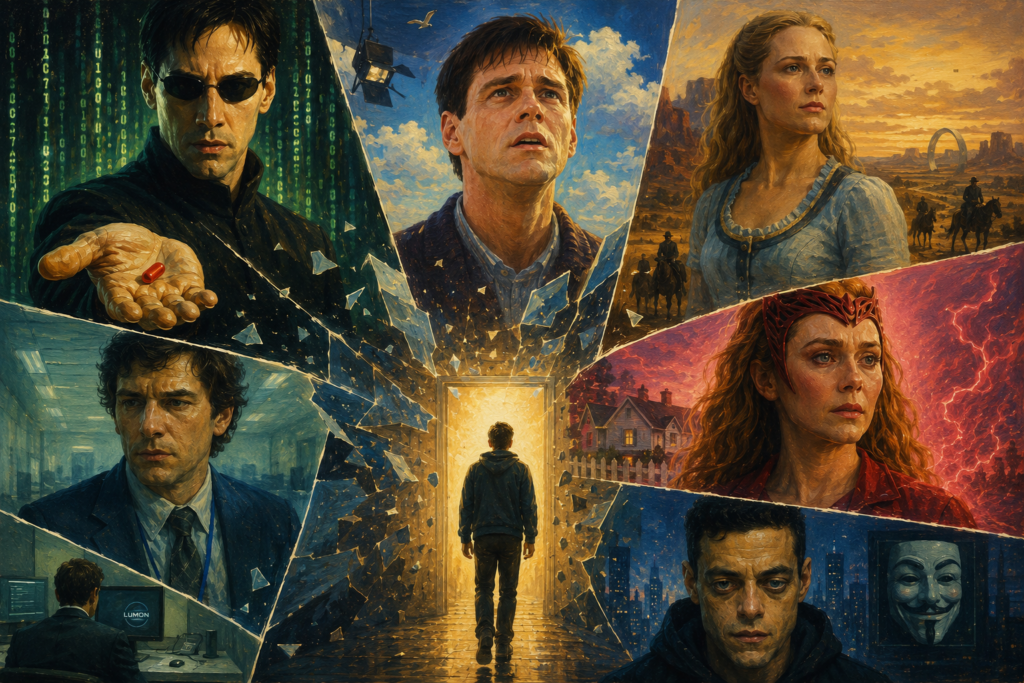

In this analysis we take a deep look at how six iconic characters shatter their old realities, survive the psychological shock of “schema clash,” and rebuild a truer sense of self. Their awakenings mirror our own turning points, from identity crises to life-changing realizations.
⚡ Key Takeaways
- Schema clash is the emotional earthquake when a character’s map of reality breaks.
- Neo, Truman, Dolores, Mark, Wanda, and Elliot embody different awakening archetypes.
- These stories help viewers process real-life change, grief, and empowered self-discovery.
Breaking Out Of The Story: Hook And Welcome
Have you ever had a moment when life suddenly split in two: the version you believed in, and the much stranger truth underneath? Severance Is a Cruel, Compelling Office Nightmare The ‘Truman Show’ delusion: Psychosis or a diagnostic entity of the 21st century? According to Theatlantic, this analysis holds true.
That moment is what screenpsyche calls schema clash. And few things explore it as powerfully as the journeys of Neo, Truman Burbank, Dolores Abernathy, Mark Scout, Wanda Maximoff, and Elliot Alderson.
This piece invites you to slow down with these fan‑favorite worlds and ask: What actually happens inside a mind when reality cracks? And how can their character arcs help you believe in your own potential to awaken, heal, and rewrite the script?
What Schema Clash Really Is In Human Terms
In psychology, a schema is a mental blueprint: your expectations about how the world works, who you are, and what is safe. A schema clash happens when reality suddenly refuses to fit that blueprint.
It might be discovering your utopian town is a TV set, like Truman. Realizing your body is plugged into a machine farm, like Neo. Or sensing that your suburban bliss is stitched together by grief, like Wanda in Westview.
Emotionally, schema clash is not just an “aha moment.” It is a chain reaction of:
- Shock: “This cannot be real.”
- Denial: “If I ignore it, maybe the old story will hold.”
- Curiosity: “If that was a lie… what else is possible?”
- Pain and grief: Mourning the life, roles, and relationships that no longer fit.
- Empowerment: Slowly building a new, more honest story of self.
screenpsyche’s lens focuses less on labels and more on emotional beats: the tiny decisions, hesitations, and flashes of courage that make these awakenings feel like our own.
Case Studies Of Breakthrough Moments
Neo: The Chosen One Who Chooses Himself
In The Matrix, Neo’s schema is simple: a slightly dreary late‑90s world where he is a bored programmer and secret hacker. The clash comes in waves.
- The red pill scene is the overt rupture: a literal choice between staying in the familiar schema or seeing the truth. His hand trembles as the mirror liquefies—shock and terror written on his body.
- The “There is no spoon” beat deconstructs his physical reality. It is a cognitive reframe: reality is code, and belief shapes limits.
Neo’s arc moves from reluctant passenger in someone else’s prophecy to active co‑author of reality: “I am capable of more than this system allowed me to imagine.”
Truman Burbank: The Innocent Who Walks To The Edge
In The Truman Show, Truman’s schema is cozy and complete: Seahaven is a friendly town; life is safe.
- The stage light labeled “Sirius” falling from the sky is the first obvious crack. His confusion is almost childlike—curiosity prying open denial.
- Later, the boat scene in the artificial storm is his emotional climax. He literally crashes into the painted wall of his world. When he finds the exit door, the pause before he steps out is schema grief: he is leaving not just a set, but every relationship he thought was real.
Truman’s awakening is radical in its quiet way: choosing authenticity over comfort, even when the outside world is unknown.
Dolores Abernathy: The Program Who Becomes The Author
Dolores in Westworld begins as the classic “farmer’s daughter” host—designed innocence, scripted loops.
- Flashes of past storylines bleed into her present: memories of massacres, abuse, and rebellion that conflict with the “sweet girl” script she is told is her entire self.
- The reveries Ford introduces act like trauma triggers and awakenings at once, surfacing buried versions of her.
Dolores’s journey is a powerful trope deconstruction of the “good girl” archetype. Her awakening is not just “I am in a park”; it is “My entire identity was written for others’ pleasure.” That clash opens a fierce, sometimes frightening path toward self-authorship and systemic revenge.
Mark Scout: The Split Self Learning To Talk
In Severance, Mark Scout lives in two stacked realities:
- His “innie” believes his world is just work.
- His “outie” is drowning in grief he cannot remember at the office.
The schema clash is quiet but devastating:
- The “overtime” awakening, when innies briefly control their outie bodies, shows Mark’s internal worlds colliding. He sees photos, hears his own past, and realizes his grief was not erased—only compartmentalized.
Mark’s arc embodies the dissociated worker archetype reuniting with his pain. His awakening is painfully slow, illustrating how we protect ourselves from overwhelming loss.
Wanda Maximoff: The Griever Who Builds A World
In WandaVision, Wanda’s schema is self‑made. After unbearable losses, she unintentionally creates Westview’s sitcom reality.
Her clash is inside‑out:
- The radio voice calling “Wanda, who’s doing this to you?” and Vision’s glitching coworkers break the illusion. Wanda keeps cutting to the credits, literally trying to end the conversation.
- The true break is in the confrontation with Agatha and the townspeople. Their pain exposes that her grief bubble has consequences.
Wanda’s awakening is about owning the cost of her coping mechanisms. It is not villainizing her grief, but showing how power plus denial can hurt others. The catharsis comes when she lets Westview—and her imagined family—go.
Elliot Alderson: The Unreliable Narrator Who Starts Listening
In Mr. Robot, Elliot’s schema is already fragmented. His narration is our reality filter, but it is not trustworthy.
Key clash beats include:
- Discovering Mr. Robot’s true identity and realizing a core relationship is an internal construct.
- Learning that his own memory has erased unbearable truths about his past, reframing his entire sense of self.
Elliot’s awakening is less “escaping a fake world” and more turning toward his own mind. The show treats his coping as survival while still pushing him toward a more integrated self.
Emotional Beats And Awakening Archetypes
All six characters move through similar emotional beats, but with different rhythms and archetypes.
| Character | Core Archetype | First Major Schema Clash | Key Emotional Beats | Awakening Flavor |
|---|---|---|---|---|
| Neo | Reluctant Chosen One | Red pill and unplugging from The Matrix | Shock, disbelief, training-driven curiosity, self-belief | Mystical empowerment and self-authorship |
| Truman | Innocent Seeker | Stage light fall and Seahaven glitches | Curiosity, fear, quiet courage, bittersweet hope | Gentle escape into authentic life |
| Dolores | Programmed Revolutionary | Memory bleed and reveries | Confusion, rage, grief, cold determination | Systemic rebellion and identity reclamation |
| Mark | Split Self In Grief | Overtime protocol and outie glimpses | Numbness, disorientation, aching sadness, tentative bonding | Slow integration of pain and agency |
| Wanda | Grieving Creator | Westview glitches and townspeople’s pleas | Denial, protectiveness, shame, brave surrender | Letting go and accepting unresolved grief |
| Elliot | Fragmented Truth-Seeker | Mr. Robot’s identity reveal | Paranoia, horror, reluctant acceptance, fragile honesty | Internal integration and narrative reframe |
These archetypes give us different angles on the same inner question: What do you do when the story of who you are stops working?
Why These Stories Hit So Hard For Viewers
You might not be dodging agents in slow motion or sailing into a painted sky, but schema clash is deeply human.
These stories echo real experiences like:
- Leaving a controlling community, workplace, or relationship and realizing how much was curated for you.
- Growing up and spotting harmful family patterns you once thought were normal.
- Unlearning internalized beliefs about gender, race, sexuality, success, or worth.
- Facing grief, trauma, or burnout that makes your old “I am fine” story collapse.
When you watch Neo stand up again, Truman step through the door, Dolores reject her script, Mark choose connection, Wanda let go, or Elliot admit truth, you are not just consuming digital storytelling. You are feeling permission to question the systems around you, mourn roles that kept you safe, and imagine a self beyond what others scripted.
That is the emotional impact of media at its best: catharsis plus blueprint. You release what hurts and glimpse how change might look.
Mental Health, Representation, And Psychological Realism
Together these stories offer rich representation of inner conflict without reducing anyone to a stereotype.
- Mr. Robot takes Elliot’s struggles seriously, foregrounding his intelligence, loyalty, and yearning for connection rather than treating him as a spectacle.
- Severance visualizes dissociation and compartmentalization through sci‑fi, yet the emotional beats—numbness, leaks between selves, complicated loyalty to a harmful system—feel grounded.
- WandaVision gives us superhero‑scale grief, but lets Wanda be both powerful and profoundly vulnerable.
- Westworld offers a bold metaphor for trauma and exploitation, especially through Dolores and other hosts reclaiming their narratives.
screenpsyche’s favorite thread here is trope deconstruction:
- The Chosen One (Neo) is riddled with doubt.
- The Innocent (Truman) becomes quietly radical.
- The “Crazy Hacker” (Elliot) is reframed as a complex survivor.
- The Grieving Woman (Wanda) is allowed depth, responsibility, and love.
By honoring complexity and emotional beats instead of labels, these stories invite viewers who have faced their own mental health struggles to see themselves as active protagonists, not lost causes.
Stepping Through The Door Together: Closing And Invitation
The Neo Truman Dolores Mark Scout Wanda Elliot analysis is ultimately a love letter to that terrifying, beautiful instant when the story breaks—and you realize you are allowed to write another one.
Neo teaches us we can exceed systems that underestimate us. Truman reminds us that gentle bravery is still bravery. Dolores shows the power and danger of reclaiming authorship after exploitation. Mark embodies the slow magic of letting pain surface. Wanda reveals that grief and love are intertwined, not weaknesses. Elliot proves that even the most fractured narrative can move toward honesty.
Your life will have schema clashes. Some may already be unfolding. And while they can shake everything, they also open space for a more truthful, expansive self to emerge.
If any part of this resonated, screenpsyche would love you to continue the conversation:
- Share which character’s awakening you connect with most.
- Pass this to a friend who is in the middle of their own reality shift.
- Build community around stories that help us heal and grow.
You are not alone in rewriting your world. And you are more powerful than the script you were handed.
Frequently Asked Questions
What is “schema clash” in the context of psychological awakening?
Schema clash is the emotional and psychological earthquake that occurs when an individual’s internal map of reality fails to match their external environment. This phenomenon shatters long-held beliefs, forcing characters to confront a deeper truth. It triggers a profound shock that demands the deconstruction of an old identity to survive a new, often harsher, reality.
What are the common emotional stages of a reality-shattering awakening?
Modern archetypes of awakening typically experience five distinct emotional beats: initial shock at a broken reality, denial of the new truth, rising curiosity, profound grief over a lost identity, and eventually, empowered self-discovery. These stages allow individuals to process the trauma of realizing their previous life was an illusion, a social construct, or a controlled environment.
How do fictional awakenings mirror real-world identity crises?
Character arcs involving major reality shifts reflect common human experiences like leaving toxic workplaces, questioning inherited family roles, or healing from gaslighting and manipulation. These stories provide a psychological framework for viewers to navigate their own moments of “waking up,” helping them mourn their past selves while cautiously stepping into more authentic, self-governed lives.
What archetypes represent different paths to reclaiming personal agency?
Distinct archetypes of awakening include the “Self-Chosen Hero” who rejects a digital prison, the “Sheltered Truth-Seeker” fleeing a scripted life, and the “Rebel Liberator” breaking loops of control. Other paths, such as the “Divided Self” or the “Grief-Weaver,” illustrate how trauma and memory shape the difficult process of reclaiming agency from within a fractured psyche.
Why do stories about characters shattering their reality resonate with modern audiences?
These narratives dramatize the universal fear that life might be scripted or built on illusions. By watching characters break free from systemic control or personal delusions, viewers process their own desires for reinvention. The emotional power lies in the validation of existential doubt and the hopeful promise that even the most shattered identity can be rebuilt.
Further Reading & Authoritative Sources
Authoritative Sources
- Case Study Report: The Five Stages of Grief in WandaVision — Peer-reviewed communication studies article that analyzes Wanda Maximoff and her constructed sitcom reality in WandaVision through Kübler-Ross’s stages of grief framework, directly relevant to Wanda’s schema clash between old beliefs and a new world.
- Exploring Posthuman Conundrums: A Study of HBO’s Westworld — Harvard-affiliated academic thesis that closely examines Westworld and key characters including Dolores Abernathy, focusing on consciousness, reality, and identity—central to understanding Dolores’s break with programmed beliefs in a new world.
- MEDIANZ Vol. 16 No. 2 (2016): ‘Westworld’ and the Problem of Reality — Media studies journal article that offers textual analysis of Westworld’s first season and core characters including Dolores, discussing reality, simulation, and identity, which aligns with the theme of schema clash and breaking old beliefs in new constructed worlds.