Skip to content
screenpsyche.com
  • Home
  • Categories
    • Film Character Analysis
    • TV Character Analysis
    • Psychological Concepts via Characters
  • About Us
Subscribe

Psychological Concepts via Characters

  • Home
  • Psychological Concepts via Characters
  • Page 2
Oil painting of a man moving between four rooms, each symbolizing separate lives and roles, visualizing psychological compartmentalization.
Posted inPsychological Concepts via Characters

A Practical Guide to Compartmentalization

He walks into a conference room, pitches a campaign with an easy smile, then later sits alone in a dim apartment, peeling an orange and thinking of the boy he…
Posted by Screen Psyche November 18, 2025
Oil portraits of Sherlock, Spock, Lisbeth, and Don Draper, each tense and inward—icons of characters who can’t name what they feel.
Posted inPsychological Concepts via Characters

Alexithymia on Screen: Characters Who Can’t Name What They Feel

From Sherlock's clinical logic to Don Draper's ritualized distraction, alexithymia appears again and again in film and TV. This practical guide explains alexithymia, surveys on-screen portrayals, and gives craft-forward, ethical…
Posted by Screen Psyche November 12, 2025
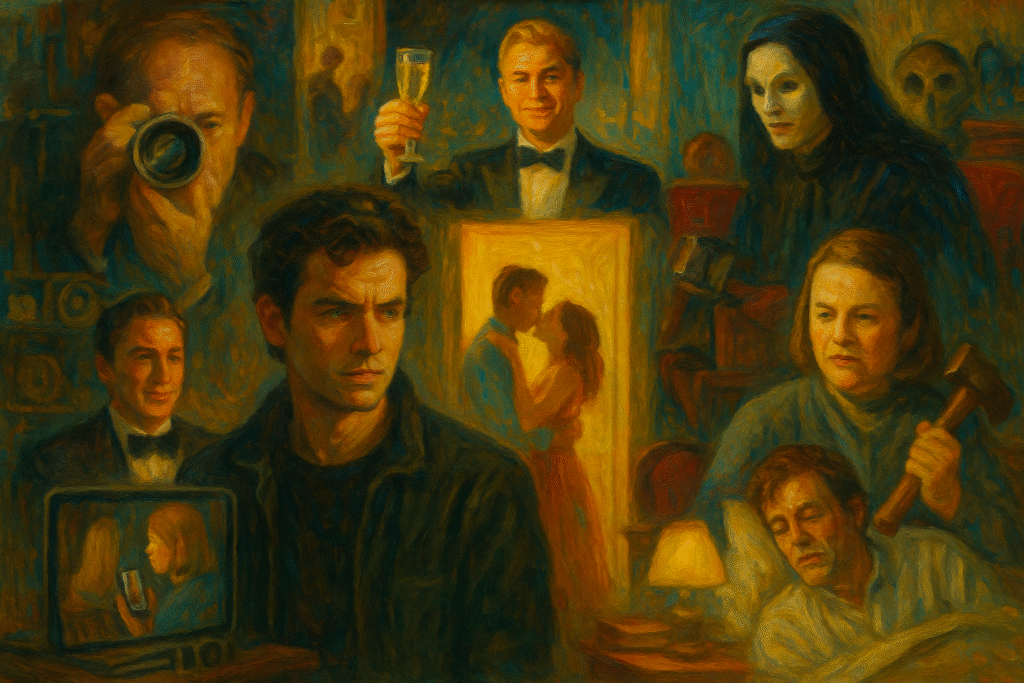
Oil collage of romantic couple framed by watchers, masks, screens, and captive writer—obsessive limerence vs love in film and TV.
Posted inPsychological Concepts via Characters

Limerence on Screen: When Obsession Looks Like Love

Trigger warning: this article discusses stalking, boundary violations, captivity, and violence. If these topics are distressing, please pause. Examples of Limerence in Film and TV — Introduction It’s a familiar cinematic…
Posted by Screen Psyche November 9, 2025
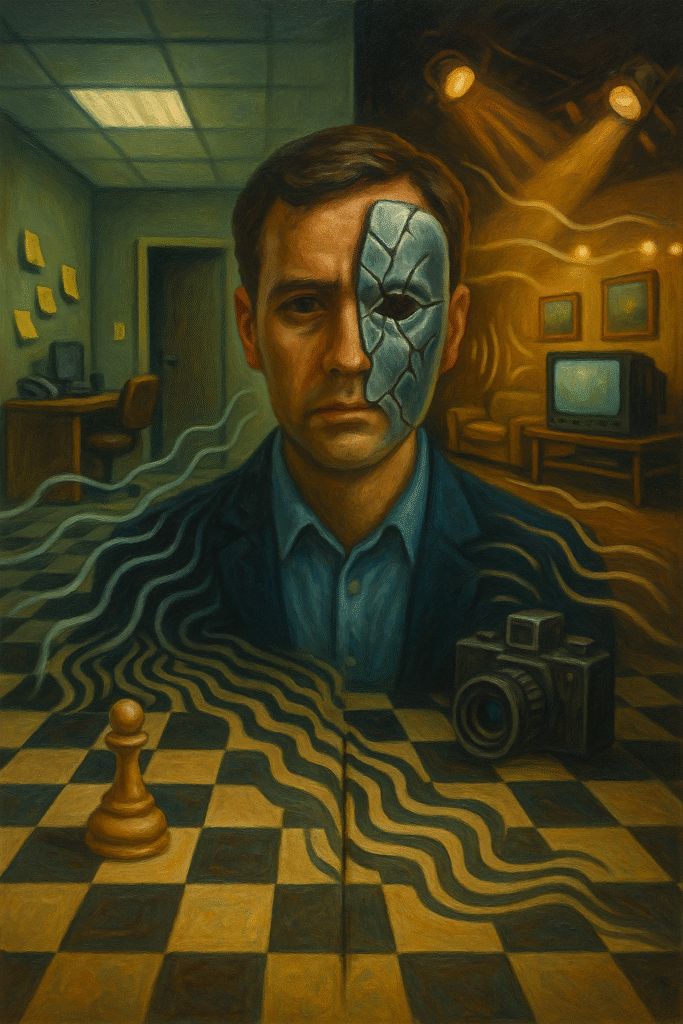
Man with cracked mask over half his face on warped checkerboard; office vs. living-room split, vintage camera—sanity unraveling.
Posted inPsychological Concepts via Characters

Fragility of Sanity: How Rational Minds Unravel

We often assume sanity is stable, but the fragility of sanity on screen shows something else: small cracks in routine, role, or reputation can widen into radical interior change. This…
Posted by Screen Psyche November 6, 2025
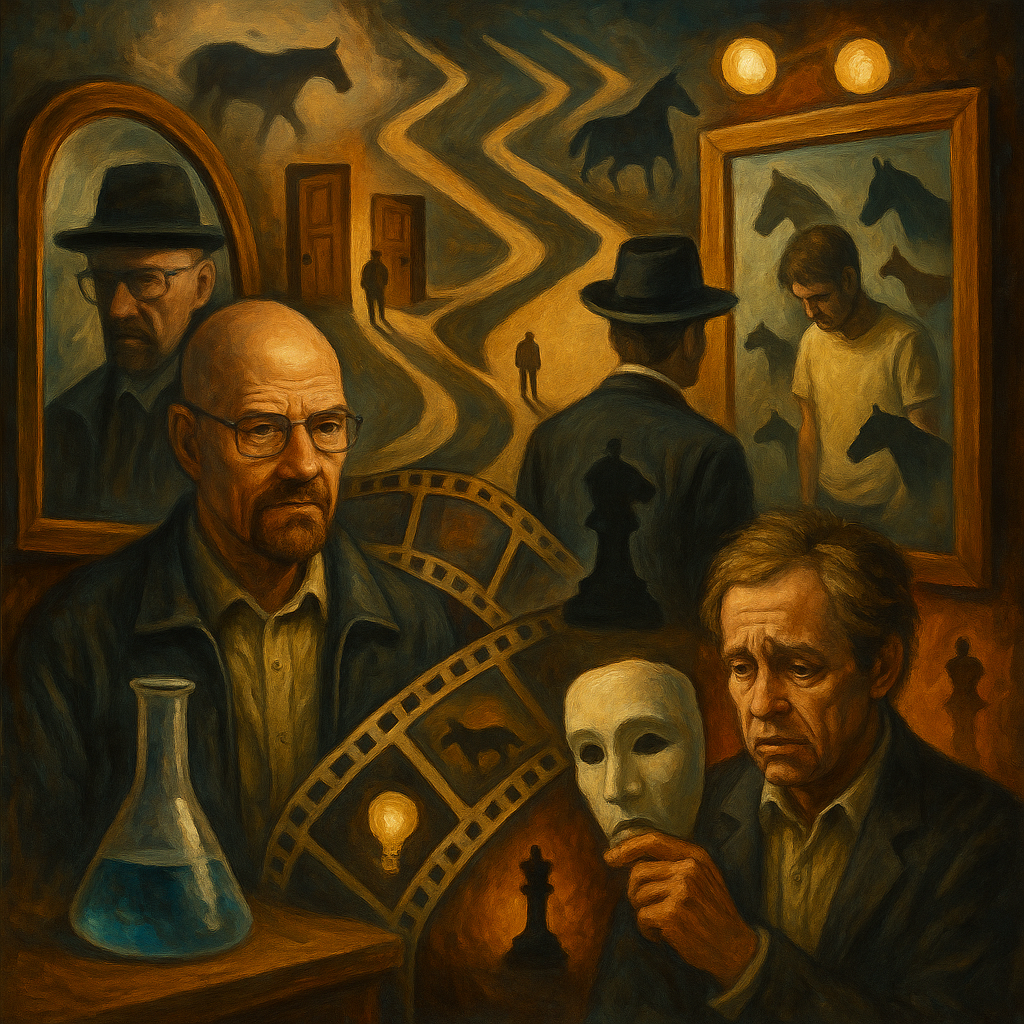
Surreal oil collage: man before mirrors, split paths and doors, film reel, chess pieces and mask—haunted by the self he could have been.
Posted inPsychological Concepts via Characters

Haunted by Potential: The Characters Who Fear Who They Could’ve Been

Spoiler note: this analysis discusses major beats from Breaking Bad, BoJack Horseman, The Godfather, and others. If you're spoiler-averse, skim the psychological framework and filmmaking sections first. Film Characters Haunted…
Posted by Screen Psyche November 3, 2025
Triptych mirror with Joker’s shadow, Amy-like woman writing, and Don Draper–type ad man; shattered shards reflect our flaws and identities.
Posted inPsychological Concepts via Characters

The Mirror Effect: Why We Fall for Characters Who Reflect Our Flaws

Understanding the Powerful Connection to Flawed Characters In film and literature, the most memorable characters are rarely the perfect ones. Instead, they are often reflections of ourselves, embodying the messy,…
Posted by Screen Psyche October 31, 2025
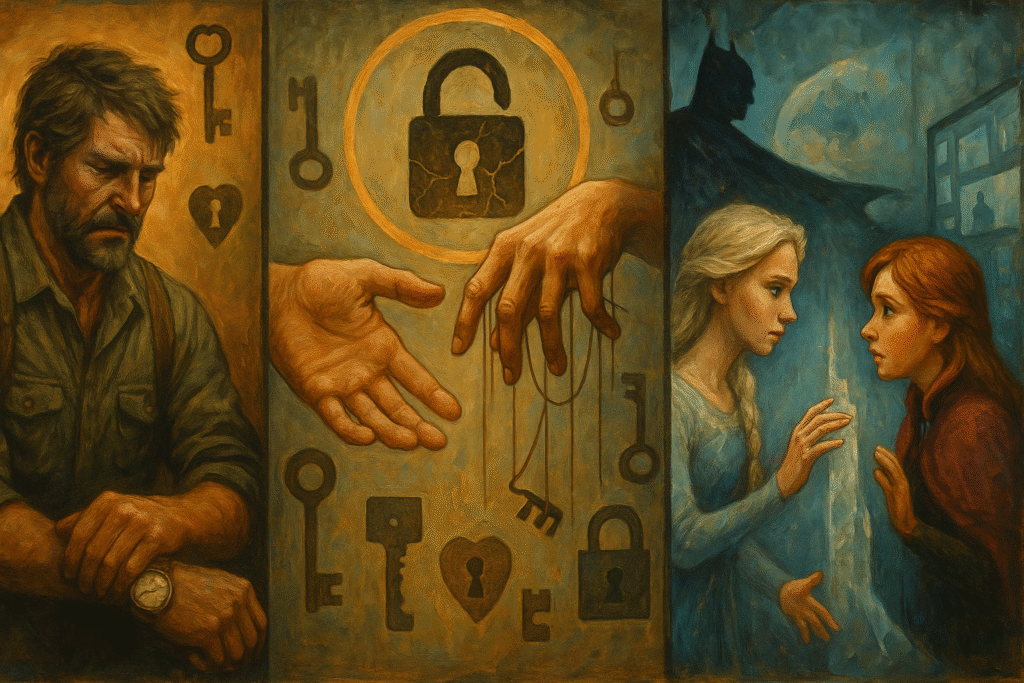
Triptych of Joel, puppet-string hands with keys, and Elsa facing Anna—symbolizing savior complex and the line between help and control.
Posted inPsychological Concepts via Characters

The Psychology of Helping: Savior Complex and When Helping Becomes Control

In the complex dance of human relationships, the line between genuine support and unintentional control can be perilously thin. We've all felt the urge to help someone we care about,…
Posted by Screen Psyche October 28, 2025
Film-strip collage of Walter White, Rue with pill bottle, and Dani in flower crown, symbolizing repetition compulsion and trauma in storytelling.
Posted inPsychological Concepts via Characters

Why Do Characters Relive Trauma? Exploring Repetition Compulsion

Ever wonder why characters in shows like 'Breaking Bad' or 'Euphoria' seem stuck in a loop, reliving the same pain over and over? This phenomenon, known as repetition compulsion, is a…
Posted by Screen Psyche October 25, 2025
A cinematic oil painting depicting three symbolic figures — a jazz drummer under harsh light, a businessman frozen before a city skyline, and a chef in a tense kitchen — representing the fear of stagnation and emotional pressure in modern storytelling.
Posted inPsychological Concepts via Characters

The Fear of Stagnation: Analyzing Its Cultural and Psychological Significance in Modern Storytelling

Stagnation and Its Thematic Relevance Stagnation, often characterized by a lack of progress, development, or change, holds a significant place in modern storytelling. As the pace of contemporary life accelerates,…
Posted by Screen Psyche October 22, 2025
An oil painting depicting three emotionally detached figures — a quiet driver in a dim city, a pale girl with braids staring blankly, and a stylish woman with a cold smile — rendered in muted colors and soft light to symbolize isolation and introspection.
Posted inPsychological Concepts via Characters

The Psychology of Detachment: Why Some Characters Feel Too Little, Not Too Much

Introduction to Emotional Detachment in Characters In the worlds of film and television, numerous characters embody emotional detachment, provoking various responses from audiences. Emotional detachment is characterized by a lack…
Posted by Screen Psyche October 19, 2025

Posts pagination

Previous page 1 2 3 4 … 8 Next page

Recent Posts

  • When Love Flips To Hate: Analysis Through The Lens Of Splitting
  • George Bailey’s Emotional Burden Of Being Everyone’s Safety Net
  • Self-Objectification: Becoming the Brand You Perform
  • Ego and Mastery in The Bear: How Luca Becomes Carmy’s Healthiest ‘Rival’
  • The Girl With The Dragon Tattoo: Lisbeth Salander And Trust As A System

Recent Comments

  1. Wearing The Mask: Study Of The False Self - screenpsyche.com on Identity and Reality in ‘The Truman Show’
  2. Killing Eve Themes: From Civilian To Dangerous - screenpsyche.com on The Trauma Bond: Why Characters Stay in Toxic Relationships
  3. Killing Eve Themes: From Civilian To Dangerous - screenpsyche.com on Charm and Chaos in Killing Eve: A Deep Dive into Villanelle
  4. Parasocial Attachment: Loving a Person Who Doesn’t Know You on The Double Life of Severus Snape: Love, Bitterness, and Redemption in Harry Potter
  5. Kendall on Peggy Olson in Mad Men: A Symbol of Feminism and Ambition

Archives

  • February 2026
  • January 2026
  • December 2025
  • November 2025
  • October 2025
  • September 2025
  • August 2025
  • July 2025

Categories

  • Film Character Analysis
  • Psychological Concepts via Characters
  • TV Character Analysis
Search
Categories
  • Film Character Analysis
  • Psychological Concepts via Characters
  • TV Character Analysis
Archives
  • February 2026
  • January 2026
  • December 2025
  • November 2025
  • October 2025
  • September 2025
  • August 2025
  • July 2025
Copyright 2026 — screenpsyche.com. All rights reserved. Bloghash WordPress Theme
Scroll to Top