Skip to content
screenpsyche.com
  • Home
  • Categories
    • Film Character Analysis
    • TV Character Analysis
    • Psychological Concepts via Characters
  • About Us
Subscribe

Psychological Concepts via Characters

  • Home
  • Psychological Concepts via Characters
  • Page 2
A man sits alone at a birthday party, staring blankly at a cake while others laugh behind him, symbolizing anhedonia and emotional numbness in fictional characters.
Posted inPsychological Concepts via Characters

Anhedonia in Film: Film Characters Who Can’t Feel Pleasure

Fictional characters who can’t feel pleasure often embody anhedonia: a reduced ability to experience joy, interest, or reward from things that should feel good. On screen, this can look like…
Posted by Screen Psyche December 14, 2025
Warm, bright oil painting of exhausted fictional helpers—an archer, a teenage hero in a hoodie, a caped figure, a weary doctor, and a guardian-like angel—gathered around a slumped young man, symbolizing compassion fatigue and secondary traumatic stress.
Posted inPsychological Concepts via Characters

Compassion Fatigue on Screen: When Fictional Helpers Burn Out

Trigger & Spoiler Warning: This analysis discusses emotional exhaustion, secondary traumatic stress, and self-harm risk. It contains spoilers for The Hunger Games, Spider-Man (Tom Holland), The Vampire Diaries, Supernatural, Grey's Anatomy,…
Posted by Screen Psyche December 8, 2025
Oil painting of a couple face-to-face: a serene, loving woman contrasts with an enraged, scowling man—visualizing splitting from idealization to devaluation.
Posted inPsychological Concepts via Characters

Characters Who Flip From Love to Hate: Splitting

In film and TV, characters who flip from love to hate create powerful, gutting moments. Often, that dramatic swing—where love becomes loathing—is rooted in the psychological process called 'splitting' (black-and-white…
Posted by Screen Psyche December 2, 2025
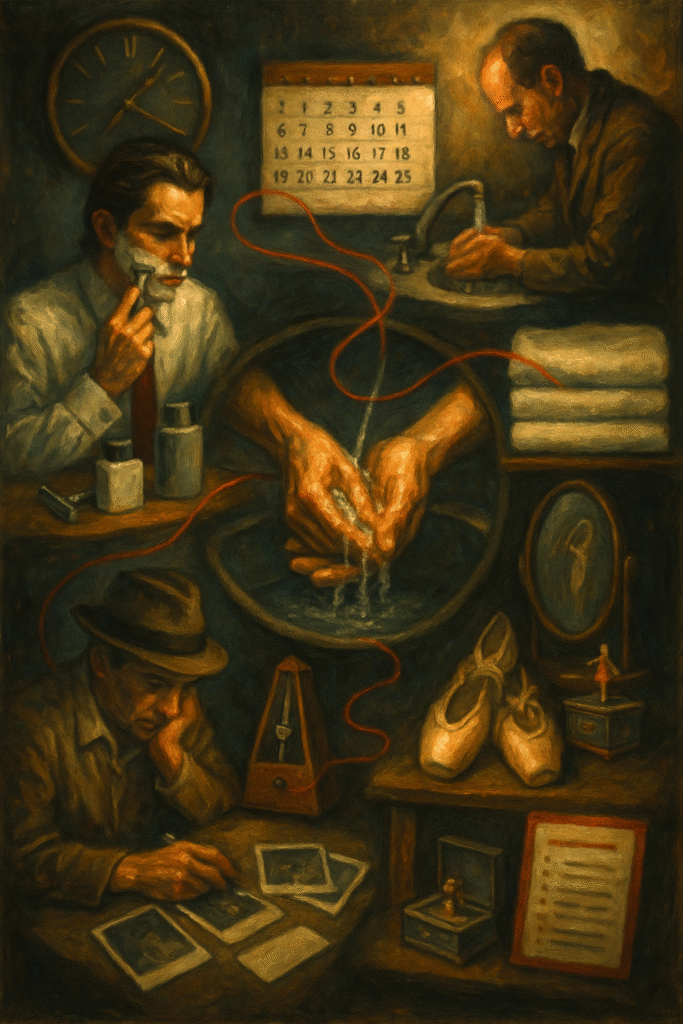
Oil painting of a person executing meticulous morning rituals—aligned toiletries, folded towels, ticking clock—symbolizing control addiction and anxiety relief.
Posted inPsychological Concepts via Characters

Control Addiction: How Routines Act as an Anxiety Sedative

Content warning & spoiler notice This article discusses anxiety, compulsive routines, and may describe scenes from films and TV shows that include disturbing or triggering material. Spoilers for the works…
Posted by Screen Psyche November 26, 2025
Oil painting of a love triangle: three figures in tense dialogue, red thread, chess pieces, phones, envelope, hourglass, mirror shards, dove.
Posted inPsychological Concepts via Characters

Triangulation: Love as a Three-Sided Battlefield

Spoiler warning: This article contains a deep love triangle analysis with TV characters and film scenes to explain triangulation as a relationship dynamic. I avoid diagnosing real people; scenes are…
Posted by Screen Psyche November 24, 2025
Oil painting of a man moving between four rooms, each symbolizing separate lives and roles, visualizing psychological compartmentalization.
Posted inPsychological Concepts via Characters

A Practical Guide to Compartmentalization

He walks into a conference room, pitches a campaign with an easy smile, then later sits alone in a dim apartment, peeling an orange and thinking of the boy he…

Posted by Screen Psyche November 18, 2025
Oil portraits of Sherlock, Spock, Lisbeth, and Don Draper, each tense and inward—icons of characters who can’t name what they feel.
Posted inPsychological Concepts via Characters

Alexithymia on Screen: Characters Who Can’t Name What They Feel

From Sherlock's clinical logic to Don Draper's ritualized distraction, alexithymia appears again and again in film and TV. This practical guide explains alexithymia, surveys on-screen portrayals, and gives craft-forward, ethical…
Posted by Screen Psyche November 12, 2025
Oil collage of romantic couple framed by watchers, masks, screens, and captive writer—obsessive limerence vs love in film and TV.
Posted inPsychological Concepts via Characters

Limerence on Screen: When Obsession Looks Like Love

Trigger warning: this article discusses stalking, boundary violations, captivity, and violence. If these topics are distressing, please pause. Examples of Limerence in Film and TV — Introduction It’s a familiar cinematic…
Posted by Screen Psyche November 9, 2025
Man with cracked mask over half his face on warped checkerboard; office vs. living-room split, vintage camera—sanity unraveling.
Posted inPsychological Concepts via Characters

Fragility of Sanity: How Rational Minds Unravel

We often assume sanity is stable, but the fragility of sanity on screen shows something else: small cracks in routine, role, or reputation can widen into radical interior change. This…
Posted by Screen Psyche November 6, 2025
Surreal oil collage: man before mirrors, split paths and doors, film reel, chess pieces and mask—haunted by the self he could have been.
Posted inPsychological Concepts via Characters

Haunted by Potential: The Characters Who Fear Who They Could’ve Been

Spoiler note: this analysis discusses major beats from Breaking Bad, BoJack Horseman, The Godfather, and others. If you're spoiler-averse, skim the psychological framework and filmmaking sections first. Film Characters Haunted…
Posted by Screen Psyche November 3, 2025

Posts pagination

Previous page 1 2 3 4 … 8 Next page

Recent Posts

  • Schema Clash: When Old Beliefs Break in New Worlds
  • Love, Safety, and the Illusion of Rescue: Alex in Maid
  • Don’t Worry Darling; Love, Control, and the Fear of Being Ordinary
  • When Saying Yes Erases You: Boundary Porosity In Relationships
  • J.D. in Scrubs: The Comfort of Fantasy in an Uncertain Identity

Recent Comments

  1. Love, Safety, and the Illusion of Rescue: Alex in Maid on The Trauma Bond: Why Characters Stay in Toxic Relationships
  2. Don’t Worry Darling; Love, Control, and the Fear of Being Ordinary on The Trauma Bond: Why Characters Stay in Toxic Relationships
  3. Ruth Langmore Loyalty And Rage In Ozark on The Trauma Bond: Why Characters Stay in Toxic Relationships
  4. Wearing The Mask: Study Of The False Self - screenpsyche.com on Identity and Reality in ‘The Truman Show’
  5. Killing Eve Themes: From Civilian To Dangerous - screenpsyche.com on The Trauma Bond: Why Characters Stay in Toxic Relationships

Archives

  • May 2026
  • April 2026
  • March 2026
  • February 2026
  • January 2026
  • December 2025
  • November 2025
  • October 2025
  • September 2025
  • August 2025
  • July 2025

Categories

  • Film Character Analysis
  • Psychological Concepts via Characters
  • TV Character Analysis
Search
Categories
  • Film Character Analysis
  • Psychological Concepts via Characters
  • TV Character Analysis
Archives
  • May 2026
  • April 2026
  • March 2026
  • February 2026
  • January 2026
  • December 2025
  • November 2025
  • October 2025
  • September 2025
  • August 2025
  • July 2025
Copyright 2026 — screenpsyche.com. All rights reserved. Bloghash WordPress Theme
Scroll to Top